- Tradition
- Psychological readingAnimal dreams
- Also read in
- The BibleSame symbol, other tradition
- Draws on
- Revonsuo, Artemidorus
- Reviewed
- 5 min read
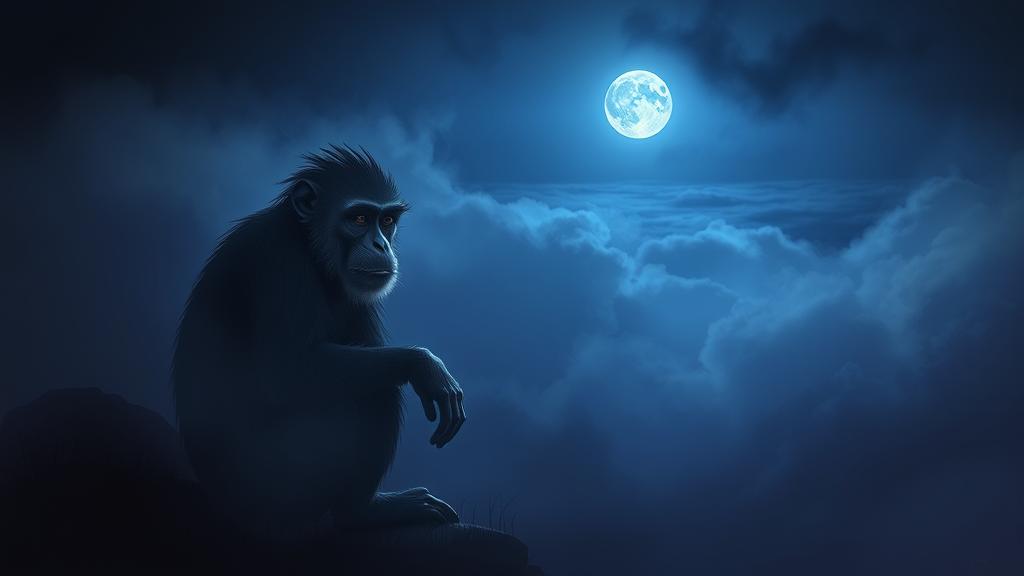
Monkey dreams tend to leave unease, not terror. It lives in the quick, deliberate fingers, the sideways glance, the complete absence of apology. Not quite human. Just enough to be uncomfortable. You wake with the sense that the animal was checking whether you knew something about yourself, and that it already did. Unease edged with recognition.
The monkey is one of those dream animals that refuses to sit still long enough to be catalogued. It steals, it mimics, it watches you from above, it destroys things for no apparent reason. Most animal dreams carry a single dominant quality. Monkey dreams tend to arrive with a whole list of qualities, often contradicting each other, and some of them point uncomfortably close to home.
That sideways glance
The discomfort in a monkey dream usually lives in the resemblance. Primates are close enough to human to trigger recognition without crossing into it. In a dream, the monkey can stand for the part of you that operates below your conscious intentions: the impulse you acted on before you thought, the lie that came out smoothly, the cruelty that surprised you when it arrived. A Jungian reading would recognize this territory immediately. The shadow, the unacknowledged side of the self, doesn’t always arrive as something monstrous. Sometimes it picks a lock and gives you a sideways look.
That’s not the only reading. But it’s the one worth sitting with first, because the monkey’s resemblance to the dreamer is often the whole point. When the animal in your dream could almost be you, the question to ask is: which version of me?
What the monkey is doing changes everything
The oldest readings
Older dream traditions tended to read monkeys as animals of deception and instability, the dream pointing at a person in your life who was cunning, unreliable, or performing a version of themselves that wasn’t real. That isn’t wrong, exactly, though the instinct was always to project the quality onto someone external rather than consider that the dreamer might be the monkey. Artemidorus’s Oneirocritica, from the second century, is a useful document if you’re reading it as a record of how people thought, rather than as an instruction manual, and its core rule, that the same dream means different things for different dreamers, is the part that has aged best.
Across older traditions, monkeys held sacred and comic status simultaneously, which itself is revealing. In Hindu cosmology, Hanuman is a monkey deity of loyalty and power. In Chinese legend, the Monkey King is trickster and hero in the same breath. The animal seems to resist being pinned to one column. That tension is also, possibly, the dream’s point.
When the monkey is someone you know
Sometimes a monkey dream isn’t about you at all. The animal lands squarely onto someone in your waking life, and you feel it immediately when you wake up: ah, that was him. That was exactly how he behaves. The unpredictability, the quick hands, the intelligence deployed without conscience. In that case, the dream is doing something more like threat simulation. Revonsuo would say the brain is rehearsing the social danger, practicing for what happens next time you’re in that person’s orbit. The monkey is a stand-in, and not a flattering one.
It’s worth asking, even in that case, what quality in the monkey you recognized. Because recognition is a two-way thing. If you could identify the behavior immediately, you’ve seen it somewhere you know well. The monkey may be someone else’s face on a quality that lives closer to home. For this kind of shadow-work, dreaming of a dead animal is the other end of the question: what gets buried when the quick, restless quality stops moving.
What stays from a monkey dream usually isn’t the lock-picking or the theft. It’s the glance. The monkey looks at you exactly as long as it needs to confirm something, then looks away. It already knows. It’s checking whether you know too. A monkey dream sometimes works exactly like that: it checks whether you know. Whether you’ve been honest with yourself about the thing you already know you’ve been doing. If you’re unsure whether the monkey in your dream was carrying a threat or a message, dreaming of a spider spinning its web is another animal at work without apology, but slow where the monkey is quick: the web is built with patience, the lock picked with speed. And if what showed up was less an individual monkey and more an infestation, dreaming of fleas is about the itch of many small presences at once.
- Did the monkey’s behavior remind me of anyone, including myself?
- Was I frightened of it, fascinated, or both at the same time?
- What was the monkey trying to get? What have I been trying to get lately?
- Did I feel responsible for the monkey or responsible to it?
One symbol, two traditions
Read side by side, the two traditions pull in different directions: monkey as a signal from your own mind, or monkey as an image to test against the text. Knowing which question you are asking is half the interpretation.
Monkeys in dreams most often carry themes of instinct, cunning, or behavior that bypasses judgment. They can represent a part of yourself that acts before it thinks, or a person in your life whose intelligence operates without…
You are reading this oneJoel 2:28 says God can speak through dreams. But Ecclesiastes 5:7 adds a real caution: ‘in the multitude of dreams there are also divers vanities.’ Jeremiah 23:25-28 warns against reading every vivid dream as divine speech. The…
Read the biblical meaning →Quick answers
What does it mean to dream of a monkey?
Monkeys in dreams most often carry themes of instinct, cunning, or behavior that bypasses judgment. They can represent a part of yourself that acts before it thinks, or a person in your life whose intelligence operates without much conscience. The feeling you had watching the monkey matters enormously.
Is dreaming of a monkey good or bad?
Neither, cleanly. A playful monkey can point to creative energy or mental restlessness that wants an outlet. An aggressive or thieving monkey carries something more uncomfortable. The same animal in two different dreams can mean nearly opposite things depending on the emotional tone around it.
What does it mean when a monkey attacks you in a dream?
An attacking monkey often represents an impulse, social threat, or inner conflict that you’ve been trying to manage and that has now become too large to manage quietly. Revonsuo’s threat simulation framework is useful here: the dream is rehearsing a confrontation. What it’s rehearsing for is worth taking seriously.
What does it mean to see many monkeys in a dream?
A group of monkeys amplifies the quality the individual carries: noise, unpredictability, mimicry, or chaos. It often reflects a social environment that feels unstable or exhausting, where multiple people are behaving in ways that feel performative or self-interested. It can also simply mean your mind is loud and scattered and the monkeys are just being honest about it.
Sources for this reading
- Revonsuo, A. (2000). The reinterpretation of dreams: An evolutionary hypothesis of the function of dreaming. Behavioral and Brain Sciences, 23(6), 877-901.DOI
- Artemidorus of Daldis (2nd century CE). Oneirocritica. English edition: Harris-McCoy, D. E. (2012). Artemidorus’ Oneirocritica: Text, Translation, and Commentary. Oxford University Press.
Full bibliography on Sources and method. Found a mistake? Tell us and see the corrections log.