- Tradition
- Psychological readingAnimal dreams
- Draws on
- Revonsuo, Jung, Artemidorus
- Reviewed
- 5 min read
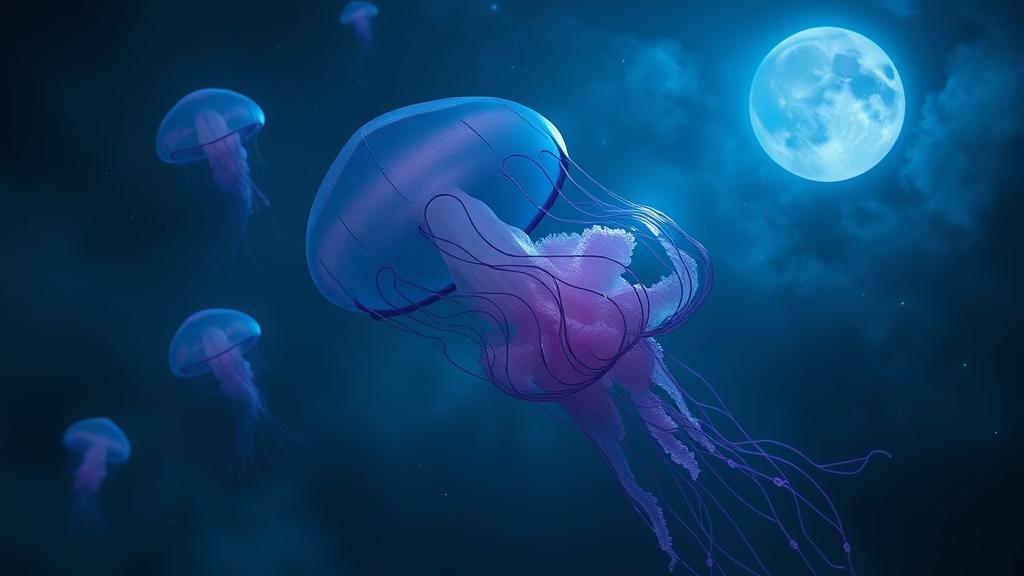
Lit from below, a jellyfish is one of the most beautiful things in the ocean. Brushed from the side, it leaves a welt that takes a week to fade. The same creature. Same moment, even, if you’re unlucky. That particular combination, gorgeous and quietly punishing, is why the jellyfish keeps appearing in people’s dreams at specific moments in their lives.
The glass that doesn’t hold
Picture a dreamer recovering from a friendship that ended badly, the kind where nobody can cleanly name who failed whom, where the damage is real but the evidence is mostly feeling. In the dream they stand in front of a large aquarium tank, watching a jellyfish pulse slowly through the water, translucent, trailing long filaments. Then, without warning, one of the filaments touches their arm through the glass. Impossible, obviously. Dreams don’t observe physics. They wake with the sting sensation still in the forearm. The tank is the distance they thought they’d established. The beauty is still real. The sting comes through anyway.
A jellyfish in a dream most often signals something that drifts into your life without obvious intent and still manages to hurt, or something beautiful that carries a cost you didn’t see until contact. The creature’s transparency can also point to influences that are hard to see clearly, passive forces with real effects.
Drifting without steering
The jellyfish doesn’t navigate. It pulses, which creates a rough direction, but mostly it goes where the current goes. Dreams frequently use this as a symbol for a person or situation in your life that has no agenda but still shapes your world by its movement. The colleague who isn’t trying to undermine you but manages to anyway. The family dynamic that drifts into a room before anyone’s decided anything. The feeling itself that arrives unbidden. There’s also a version where the jellyfish is you. Drifting, pulsing, not exactly in control of direction. If that resonated when you woke, it’s worth sitting with rather than dismissing.
What the translucency means
Jung was interested in things that can’t be looked at directly, that must be approached obliquely or seen through a medium. The jellyfish is almost entirely transparent. You can see through it without understanding it. That quality in a dream tends to point at something in your emotional life that’s visible but still hard to read: a feeling you can observe yourself having without quite naming it, a relationship whose rules you can see but not decode. Artemidorus, writing in the second century, held that the same dream means different things for different dreamers, so even a drifting creature carries no fixed verdict: it depends on who is drifting with it. I’m not claiming his framework maps cleanly onto modern dream experience, but the underlying point holds: what moves without effort still moves, and its path still matters.
The sting you didn’t see coming
This is the version that deserves its own attention. The jellyfish sting in a dream almost always represents a hurt that felt passive, a wound without obvious aggression behind it. Nobody meant to. The filament was just there. The current moved it toward you. Revonsuo’s threat simulation theory is genuinely useful here, and I say that as someone who usually finds purely evolutionary accounts a bit thin. The idea that dreams rehearse threat responses makes particular sense for threats you can’t see clearly: diffuse, drifting, beautiful. A jellyfish is exactly the kind of danger a rehearsal might usefully simulate. Not a predator with intent. A consequence without malice. Your nervous system might be practicing the particular alertness required for that.
The jellyfish as a dream animal sits in interesting company. A dead jellyfish on a beach shades into a dead animal dream, where the question is no longer the sting but what it means that a force has gone inert. Fleas are the same kind of harm at a smaller scale: not one sting but small, invisible threats accumulating. And if the jellyfish felt more like a messenger than a threat, a talking bird is the more direct version of a creature that seems to carry news.
Aquarium distance
The friendship in that example might never fully resolve. There may be no clean conversation that names what happened. It stays at aquarium distance, observable, still beautiful in some ways, not something to reach toward anymore. The dream is right that the glass isn’t always protection. Whether it stops coming because the matter has been processed, or because you’ve stopped pressing your arm against the tank, is hard to tell from inside.
- Was I watching the jellyfish from safety, or was I in the water with it?
- Did the sting surprise me? When did I last get hurt by something I assumed couldn’t reach me?
- Is there something in my life right now that drifts rather than acts, and still shapes things?
- Was the jellyfish beautiful? Do I spend energy admiring something I’m also afraid to touch?
Quick answers
What does dreaming of a jellyfish mean?
It most often signals something that drifts into your life without obvious intent and still manages to leave a mark, whether that’s a relationship, a feeling, or a situation without clear agency. The creature’s transparency points to things that are visible but hard to read clearly.
What does it mean if a jellyfish stings me in a dream?
The sting specifically points to a passive hurt: something that wounded you without apparent aggression. The surprise matters as much as the pain. It often surfaces after experiences where you got hurt by something or someone you thought was at a safe distance.
Is a glowing jellyfish in a dream a good sign?
Generally yes, or at least not threatening. The bioluminescent version tends to carry wonder rather than danger. Something strange and luminous has entered your awareness, not everything that surprises you is a threat.
Why do jellyfish appear in dreams?
Their particular combination of beauty and invisible danger makes them useful dream symbols for situations that don’t announce their risks. They also don’t navigate, which the dreaming mind sometimes uses to represent passive forces: influences without agenda that still shape your world by their drift.
Sources for this reading
- Revonsuo, A. (2000). The reinterpretation of dreams: An evolutionary hypothesis of the function of dreaming. Behavioral and Brain Sciences, 23(6), 877-901.DOI
- Jung, C. G. (Ed.). (1964). Man and His Symbols. Doubleday.
- Artemidorus of Daldis (2nd century CE). Oneirocritica. English edition: Harris-McCoy, D. E. (2012). Artemidorus’ Oneirocritica: Text, Translation, and Commentary. Oxford University Press.
Full bibliography on Sources and method. Found a mistake? Tell us and see the corrections log.