- Tradition
- Psychological readingAnimal dreams
- Also read in
- The BibleSame symbol, other tradition
- Draws on
- Revonsuo, Artemidorus
- Reviewed
- 4 min read
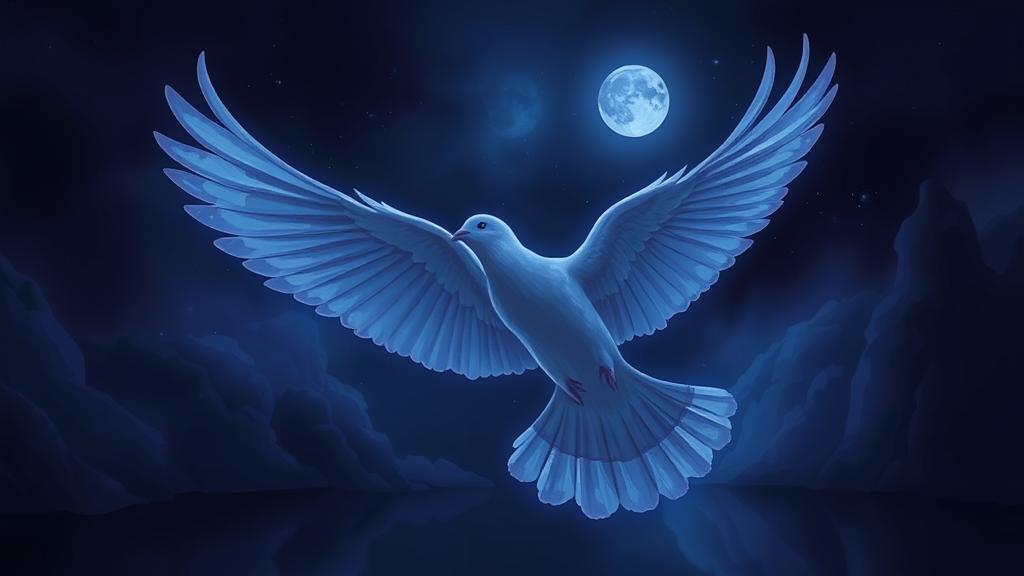
A pale shape lands on the windowsill, or crosses the sky above a street gone quiet, and for a moment the noise in your head stops. Not silence exactly, something gentler than silence. It’s the stillness between two hard conversations, the pause before you know what you’re going to say. The dove turns up in dreams at exactly those pauses. Not as a verdict. As a breath.
A dove in a dream most often signals a desire for or arrival of peace, within yourself, in a relationship, or after a period of conflict. But the message changes depending on what the dove does: a dove that arrives carries news or resolution; a dove that flies away points to something slipping out of reach; a dove that won’t move or seems hurt tends to surface when peace feels actively blocked.
What the dove was doing matters enormously
Dove dreams invite over-interpretation, because it’s easy to assume the symbol is the whole message. It rarely is. A dove gliding toward you and a dove lying dead on a windowsill are using the same image for opposite purposes. Before you look up any meaning, try to remember: was the bird arriving or leaving? Still or agitated? Alone or paired? Your answer to those questions probably tells you more than any interpretation I can offer.
The bird’s condition is especially telling. A dove in perfect white is the archetypal reading, peace, purity, a message that’s clean and welcome. A dove that looked injured or grounded is a different story. That version tends to appear when the peace you’re hoping for is available in theory but something in you (or in the situation) is keeping it from landing.
Across the traditions, one quality keeps returning
| Tradition | How doves read the dream |
|---|---|
| Ancient Near East (Chester Beatty papyrus, ~1200 BC) | The Chester Beatty papyrus sorts dreams into good and bad omens. A dove, with its quality of return (doves come back), would sit naturally on the good side, as a sign of homecoming, literal or emotional. |
| Artemidorus (2nd century Oneirocritica) | He held that the same dream means different things for different dreamers, depending on age, status and occupation. By that rule a dove arriving in the middle of a quarrel is a different dream from one that simply crosses the sky. |
| Ibn Sirin tradition (Islamic dream interpretation) | Islamic dream interpretation, traditionally associated with Ibn Sirin, reads each image in the light of the dreamer’s circumstances and the feel of the dream, so the dove’s behavior matters more than the bird itself. |
| Jungian (20th century) | The white dove as the soul’s messenger, as the aspect of the psyche that carries wisdom without aggression. In a Jungian reading it appears when the self is ready to integrate something it’s been avoiding. |
| Cross-cultural overlap | Across the readings above, the bird arrives as something you need more than you’re asking for. The specific meaning shifts; the quality of the gift, peace, news, reconciliation, stays constant. |
The messenger problem
Dreams involving doves often have a quality that’s hard to name but easy to recognize when you’ve had one: the feeling that something important has been communicated without anything specific being said. The bird didn’t speak. No note was attached. You just knew, inside the dream, that the appearance meant something. A Jungian reading would call this the psyche’s way of moving material from one register to another, the kind of transfer that bypasses argument and lands directly. I find that reading persuasive, though I hold it loosely.
A hurt dove belongs partly to dreaming of an injured animal, where the wounded creature carries what has been damaged in you. When the dove is hurt, or arrives alongside another wounded creature, the pairing can signal peace that’s earned rather than given.
When the dream is about threat, not peace
Revonsuo’s threat simulation theory fits this only loosely, but it’s worth naming: a dove being chased, hunted, or killed in a dream is using the peace-symbol against itself. Your mind chose the gentlest bird and then let something destroy it. That’s not subtle. This version tends to surface when peace feels actively under attack, a relationship fracturing, a recovery interrupted, a fragile thing you’d almost gotten to safety. The message is protective, not hopeless: something in you knows the threat is there and is showing you clearly.
Two doves
Paired doves in a dream usually speak to partnership, a longing for it, a return of it, or the mourning of its absence. This is one of the cases where the cultural resonance is old enough that it’s probably just baked into how we see the image. The stork is the other bird that folklore ties to partnership and new beginnings, so dreaming of a stork is the nearest comparison for the two-dove dream.
What stands out in these dreams is how rarely the dove delivers on its promise within the dream itself. The dreamer wakes before the bird lands. It’s seen through a window. It’s in the air when the alarm goes off. I don’t know what that means exactly. Maybe the message isn’t the point. Maybe the dream just needs you to know the messenger is on its way.
- Did the dove arrive, or was it leaving? That direction is half the meaning.
- Was there a conflict or tension in my waking life that might be asking for resolution right now?
- Did I feel relief seeing the bird, or something more complicated?
- Was the dove whole and healthy, or somehow damaged? What might that be reflecting?
One symbol, two traditions
The two schools are not reading the same book: psychology asks what dove is doing in your waking life, while the biblical tradition tests the image against Scripture and leaves the meaning with God.
A dove in a dream most often signals a desire for or arrival of peace, within yourself, in a relationship, or after a period of conflict. But the message changes depending on what the dove does: a dove that arrives carries news…
You are reading this oneThe dove appears in Scripture at some of the most theologically significant moments: the end of judgment in Genesis 8, the beginning of Jesus’ ministry in Matthew 3:16. It carries real peace-and-new-beginning meaning that isn’t…
Read the biblical meaning →Quick answers
What does dreaming of a dove mean?
A dove in a dream most often signals peace, resolution, or a message your waking mind hasn’t quite formed yet. The reading depends heavily on what the dove does: arriving suggests news or relief coming; leaving suggests peace you’re not quite holding onto; an injured dove often reflects peace that’s blocked.
Is dreaming of a dove a spiritual sign?
Across many traditions it has been read that way, and there’s something to the consistency. The dove appears in ancient Near Eastern, Greco-Roman, Islamic, and Jungian frameworks as a figure of favorable arrival or divine communication. Whether you read it spiritually or psychologically, the dream is worth taking seriously as a symbol of something needed.
What does it mean if a dove is dead in my dream?
A dead dove tends to represent a peace or reconciliation that hasn’t survived something. It’s a grief image, often specific: a relationship that tried to soften and couldn’t, a period of calm that has ended. The dream isn’t predicting anything; it’s probably registering something you already know.
Why do I keep dreaming of a white dove?
Recurring dove dreams usually mean the need for peace or resolution in your life is still unmet. The dream is returning because the question it’s asking, what would actually settle this?, hasn’t been answered yet. The repetition is usually a nudge, not a warning.
Sources for this reading
- Revonsuo, A. (2000). The reinterpretation of dreams: An evolutionary hypothesis of the function of dreaming. Behavioral and Brain Sciences, 23(6), 877-901.DOI
- Artemidorus of Daldis (2nd century CE). Oneirocritica. English edition: Harris-McCoy, D. E. (2012). Artemidorus’ Oneirocritica: Text, Translation, and Commentary. Oxford University Press.
Full bibliography on Sources and method. Found a mistake? Tell us and see the corrections log.