- Tradition
- Psychological readingAnimal dreams
- Draws on
- Revonsuo, Jung, Artemidorus
- Reviewed
- 5 min read
Artemidorus of Daldis, writing the Oneirocritica in the second century, held that the same dream means different things for different dreamers, depending on age, status and occupation. A stork is a good test case. For a couple hoping to start a family it is one dream. For someone about to change careers or move house it is another. The bird is the same and the arrival is not. The stork also comes loaded before it ever reaches your sleep: the mythology moves in first and rearranges the furniture.
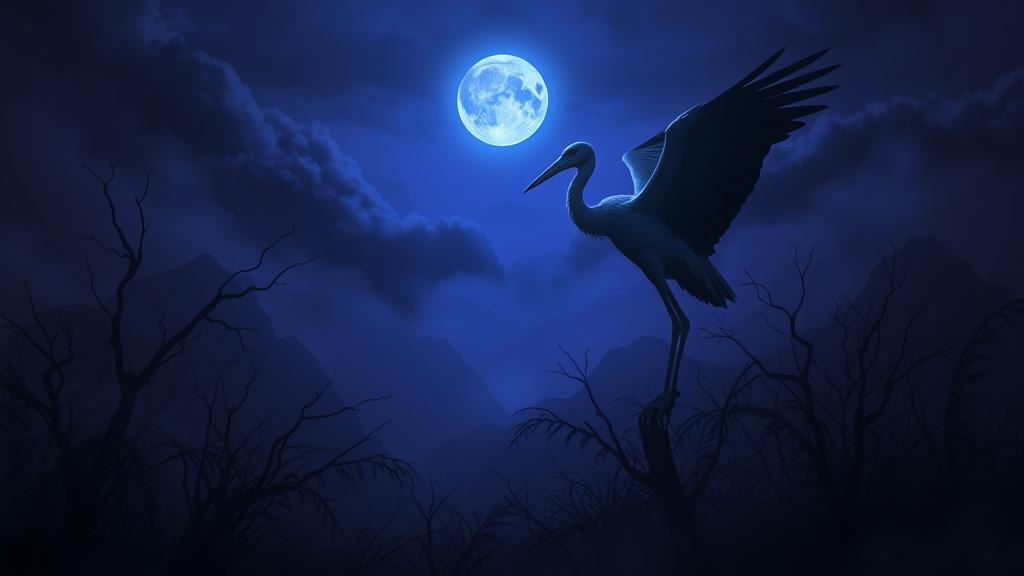
A stork in a dream almost always connects to arrival: something new coming into your life, often something you’ve been waiting for, occasionally something that caught you unprepared. It doesn’t always mean pregnancy, even if that’s the first place the mind goes. It can be any significant beginning.
What the stork brings that isn’t a baby
Let’s get the obvious reading out of the way, because it’s also a real reading: yes, dreaming of a stork can indicate preoccupation with pregnancy, fertility, or the beginning of a family. Dreams about a talking bird often carry messages; the stork’s message is almost purely about what it carries rather than what it says. But the stork’s symbolism is broader than that, and more interesting. The bird is a returning creature, migratory, annual, reliably seasonal. When people in central and northern Europe saw storks coming back in spring, it meant winter was genuinely over. There’s an emotionally specific thing about an arrival you can count on, and the stork in your dream might be pointing at that more than at reproduction. Dreaming of a swallow leans on the same seasonal return, another migratory bird that tells you which part of the year it is. A reliable return. A recurring good. Something that comes back to you cyclically if you make it possible.
| Tradition | How it reads the symbol |
|---|---|
| Ancient Greece | Storks were associated with filial piety. There was a belief that adult storks fed and cared for their elderly parents, making the bird a symbol of family duty and reciprocal care. |
| Germanic and Slavic traditions | The stork on the roof brought luck and protection to the household. Disturbing a nesting stork was considered deeply unlucky. The association with birth-bringing is rooted in this protective, domestic luck. |
| Ancient Egypt | The ba, part of the soul that could travel during sleep, was often depicted as a bird with a human head. Wading birds in general carried connotations of the soul’s journey between worlds. |
| Ibn Sirin tradition | In classical Islamic dream interpretation, a stork often represented a traveller returning home, or a person who would bring news from afar. The emphasis was on return rather than novelty. |
| Modern European folklore | The birth-bringing stork became widespread in 19th-century print culture, particularly in Alsace and Germany, partly through Hans Christian Andersen’s stories. It’s one of the few dream symbols shaped significantly by literature rather than ritual. |
When the nest is the point
A stork building or tending a nest is a specific dream image and it tends to carry different freight from a stork in flight. Nest-building is slow, deliberate work with whatever material is available. You’re not dreaming about a sudden arrival; you’re dreaming about preparation. The domesticity of it. The patience of stacking sticks. People dream of stork nests during periods when they’re building something that matters: a new home, a creative project, a relationship being established brick by deliberate brick. If what you are building is a family, dreaming of having a baby is about what it feels like to bring something to life, which is the very idea the stork myth is built on.
The anxiety version
Not every stork dream is welcome. Some people dream of a stork arriving and feel dread, not joy. Or the stork is circling and hasn’t landed. Or it drops what it’s carrying before it arrives. Revonsuo’s threat simulation theory proposes that dreaming rehearses the way we respond to danger. A stork is no predator, but a stork dropping its bundle can be read in that spirit: the mind working through the fear of an anticipated event going wrong. The dream isn’t a prediction. It’s a practice run for the emotional stakes.
Jung’s house and the bird on the roof
The Jungian tradition treats the house in dreams as a map of the self, its rooms corresponding to different dimensions of inner life. A stork on the roof, by extension, is something arriving at the outermost, most visible part of the self. The roof is what other people see. It’s the face you present. A nesting stork there isn’t subtle: something is happening in your life that will become visible, that you can’t quite contain indoors. That’s an interesting reading for anyone who’s been sitting with a change they haven’t told anyone yet. A new direction. A relationship. An ambition that’s been private. The stork on the roof has a way of saying: this is going to be apparent soon, whether you announce it or not. Back to the opening idea: the same bird means different things for different dreamers. A stork balanced on a chimney under a grey sky is the arrival before the arrival, something already settled before anyone has announced it. Which of your own arrivals might that be?
If the stork came with a feeling of unwanted intrusion, the kind dreaming of fleas is about, that’s worth distinguishing: the stork itself is usually benign, but the feeling underneath the dream is the real reading.
- Was the stork arriving, nesting, or departing? Each movement tells a different story.
- Did I feel ready for whatever the stork was bringing, or was I bracing for it?
- Is there something in my waking life that’s about to become visible whether I announce it or not?
- What would it mean for me right now if something I’ve been waiting for actually showed up?
Quick answers
What does it mean to dream of a stork?
A stork usually points to arrival: something new, wanted or unexpected, coming into your life. It doesn’t necessarily mean pregnancy, though that’s the most familiar layer of the symbol. It can also indicate a reliable return, something that comes back to you annually or seasonally, or the beginning of something you’ve been building slowly.
Is dreaming of a stork a good omen?
Across most traditions, yes. The stork has been associated with luck, protection, and good arrivals for centuries. A dream stork is rarely threatening. Even the anxiety versions, a circling stork or a dropped bundle, are usually the mind rehearsing for something significant rather than predicting disaster.
What does it mean if the stork is dropping something in my dream?
This version tends to appear when you’re worried about an anticipated event going wrong, a birth, an announcement, something you’ve been waiting for. The dream is working through the stakes of the arrival, not forecasting failure. Worth noticing what you fear losing.
Why did I dream of a stork when I’m not pregnant or trying to be?
Because the stork’s meaning is much wider than reproduction. Arrivals, returns, new beginnings, visible changes, things you’ve been building coming into form: all of these fall within the stork’s range. Look for what’s arriving or about to arrive in your life in any sense.
Sources for this reading
- Revonsuo, A. (2000). The reinterpretation of dreams: An evolutionary hypothesis of the function of dreaming. Behavioral and Brain Sciences, 23(6), 877-901.DOI
- Jung, C. G. (Ed.). (1964). Man and His Symbols. Doubleday.
- Artemidorus of Daldis (2nd century CE). Oneirocritica. English edition: Harris-McCoy, D. E. (2012). Artemidorus’ Oneirocritica: Text, Translation, and Commentary. Oxford University Press.
Full bibliography on Sources and method. Found a mistake? Tell us and see the corrections log.