- Tradition
- Psychological readingAnimal dreams
- Draws on
- Revonsuo, Jung, Artemidorus
- Reviewed
- 5 min read
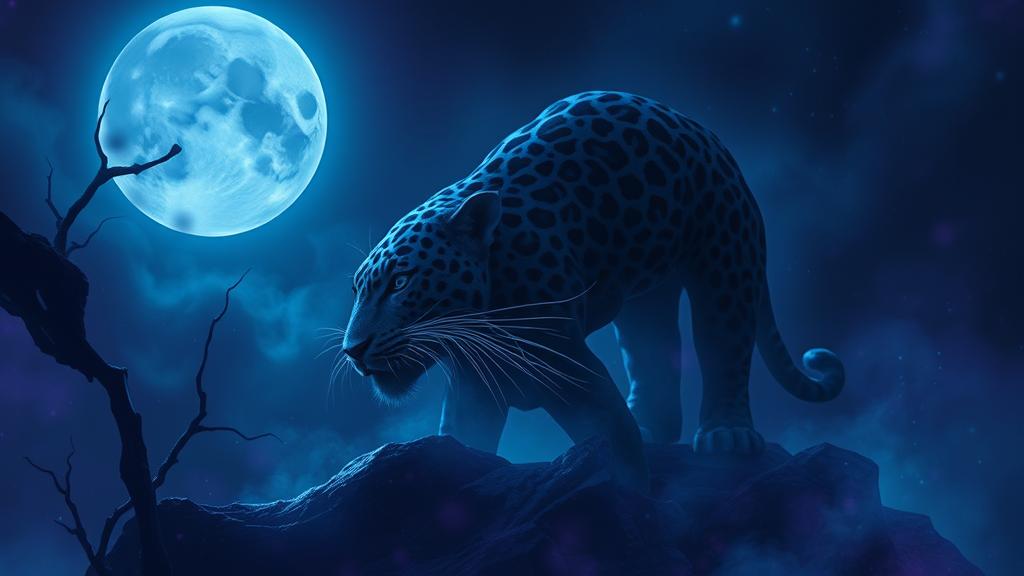
Jaguars kill by biting through the skull. Not the throat, not the neck, the way every other large cat does. Right through the top of the skull, into the brain. Naturalists believe this is an adaptation for hunting caimans in shallow rivers, animals with armored hides that wouldn’t yield to a throat bite. I mention this because when people dream of jaguars, they often can’t explain why the dream felt different from other predator dreams. Why it felt older. This is probably why.
The jaguar isn’t just a big dangerous animal. It’s a specific kind of intelligence, one that adapted itself to an environment almost no other predator could survive, and learned to take prey that looked invulnerable. That’s the image your sleeping mind reached for.
A jaguar in your dream tends to carry older, more elemental energy than other big cats: instinct adapted to deep water, to dark crossings, to what can’t be armored against. It often appears when you’re navigating something that requires a different kind of intelligence than you’re used to using.
Being read without being seen
Most of us know the feeling of being watched by someone whose eyes are pointed elsewhere, the way you can tell when someone in a meeting is watching you even when they appear to be looking at the table. Not seeing through you. Looking through you. That specific quality, that sense of being read without being seen, is almost exactly what a jaguar dream carries.
The jaguar’s spots break up its outline. In deep shadow, in water, it essentially disappears. But it doesn’t stop being there. That’s the dream’s whole texture: something with complete information about you, operating in territory you can’t fully see into.
What the Americas always knew
| Tradition | How it reads the symbol |
|---|---|
| Aztec / Maya | The jaguar ruled the underworld and the night sky. Priests who shapeshifted into jaguars became nahuals, mediators between living and dead. The dream animal arrives as an emissary from something below ordinary consciousness. |
| Andean (Chavin) | The earliest Andean iconography returns obsessively to jaguar-human transformation, the shaman who could move between worlds by taking on the predator’s nature. Meeting the jaguar in a dream was meeting the gate. |
| Guarani tradition | The jaguar is a keeper of forest law, the animal that enforces the balance. A jaguar dream could be a signal that something in your waking life is out of proportion. |
| Artemidorus (2nd century) | He grouped spotted animals as ambiguous omens, less clear than lions, related to deception and concealment. He’d probably have been unsatisfied with the jaguar; it resists simple fortune-telling. |
I’m genuinely careful about borrowing from traditions that aren’t mine, but this cluster of meanings, the jaguar as the thing that moves where you can’t follow, is consistent enough across cultures that I think it’s pointing at something the animal itself actually does. You don’t need to believe in nahuals to recognize the accuracy of the image.
Jung and the thing in the dark water
Carl Jung would have loved the jaguar. Specifically because it hunts in water, and water in his framework is almost always the unconscious: the part of the psyche that’s deeper than what you can see, older than the identity you built on top of it. A predator that not only tolerates that depth but hunts in it, that has adapted to thrive in exactly the territory your conscious mind avoids, is about as tidy a symbol for the shadow as you’re likely to get.
This doesn’t mean something terrible is swimming around in your unconscious. Shadow material is everything powerful you haven’t integrated: rage, yes, but also hunger, sexuality, ambition, the versions of yourself you decided were too much. The jaguar is at home in those waters. The question the dream is asking is whether you can find your footing there too.
If the jaguar in your dream was hunting rather than watching, a roaring lion is what the same predator energy looks like fully activated and outward-facing. If the jaguar felt more like a transformation than a threat, an animal transforming is the closer match, because there the point is the change itself rather than the animal.
Threat simulation, or something older
Antti Revonsuo’s threat simulation theory would read the jaguar dream as exactly what it looks like: your nervous system rehearsing a genuine danger scenario. And I don’t want to be too clever about this. Sometimes a jaguar dream is your stress levels, and your sleeping mind picked a very effective container for them.
But jaguar dreams are often not adrenaline-heavy. They’re quiet. The animal is nearby. You know it’s there. The fear is a specific kind, the kind that comes from something being much better at the terrain than you are. That’s different from being chased. That’s something more like awe sitting right next to dread.
A lynx is the other cat that sees without being seen, though the lynx carries more psychic or intuitive weight and less of the underworld depth. And if what you dreamed was less predator and more darkness in general, a blackbird offers a gentler version: a dark creature that carries intuition and alert attention rather than hunting.
What to do with the dark water
The sense of something in the treeline reading you clearly doesn’t have to scare you the way you think it should. It can mostly make you want to be worth reading. The jaguar in your dream isn’t asking you to be fearless. It’s asking whether you can stay present in the dark water long enough to find out what’s living in it.
Whether that’s a threat or an invitation is genuinely hard to answer from outside the dream.
- Did the jaguar seem aware of you? That distinction, between a predator that’s hunting and one that already knows, changes the reading significantly.
- Was there water nearby, or a sense of depth, shadow, territory you couldn’t see into?
- What in your waking life requires a kind of intelligence or approach you haven’t been willing to use yet?
- Did meeting the jaguar feel like a confrontation with something outside you, or something uncomfortably familiar?
Quick answers
What does it mean to dream of a jaguar?
The jaguar tends to represent an elemental force that operates in depth: your own shadow material, instincts adapted to difficult territory, or a situation that requires a different kind of intelligence than you usually apply. The reading shifts based on whether the jaguar was watching, hunting, or moving through water.
Is a jaguar dream a bad omen?
Not in the traditional omen sense. The jaguar is a more complex symbol than a simple warning. Across the cultures where it’s been interpreted seriously, it tends to be a gatekeeper or a mediator rather than a threat. The discomfort in the dream is often the discomfort of encountering something more capable than you expected.
What does it mean if the jaguar was in water?
Water deepens the reading. In most frameworks, water represents the unconscious, the parts of the psyche below ordinary awareness. A jaguar in water is at home in exactly the territory your waking mind finds hardest to navigate. The dream may be saying that what you’re afraid of is actually your natural environment.
Why does a jaguar dream feel different from other predator dreams?
Most people notice it. Part of it is probably the jaguar’s spotted coat, which signals a different visual texture than a lion or tiger. But part is the quality the animal actually has: it hunts in darkness, in water, through camouflage. The dream picks up that specific intelligence, and it feels older and stranger than straightforward threat.
Sources for this reading
- Revonsuo, A. (2000). The reinterpretation of dreams: An evolutionary hypothesis of the function of dreaming. Behavioral and Brain Sciences, 23(6), 877-901.DOI
- Jung, C. G. (Ed.). (1964). Man and His Symbols. Doubleday.
- Artemidorus of Daldis (2nd century CE). Oneirocritica. English edition: Harris-McCoy, D. E. (2012). Artemidorus’ Oneirocritica: Text, Translation, and Commentary. Oxford University Press.
Full bibliography on Sources and method. Found a mistake? Tell us and see the corrections log.