Animal Dreams
Dreaming of a Goat: Stubbornness, Sacrifice, and the Scapegoat You Didn't Choose
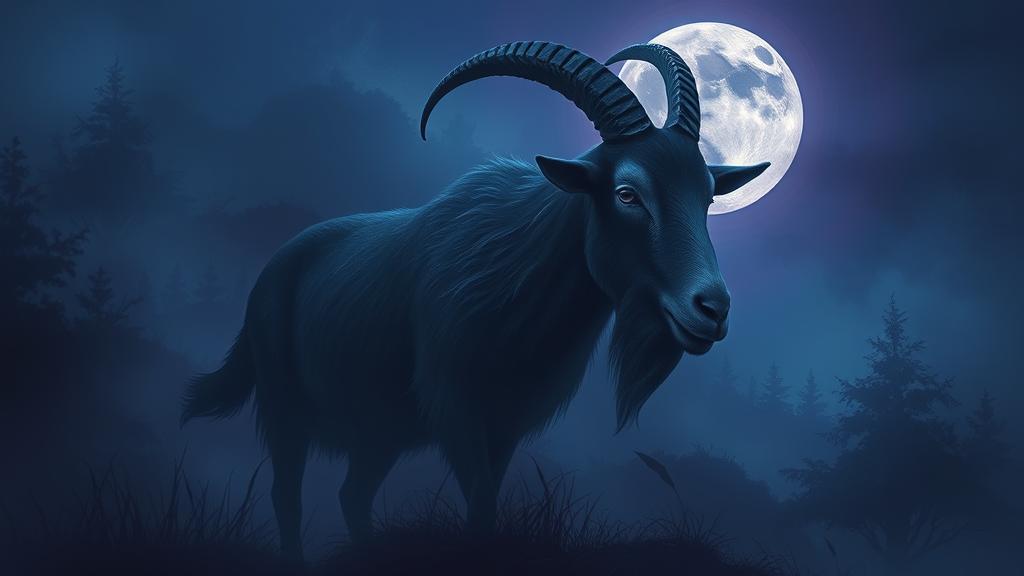
A goat standing on a narrow ledge above a drop, looking at you sideways. That image, or some version of it, is what almost everyone describes. The goat is always somewhere it shouldn’t be able to be. On a rooftop, on a fence post, on the hood of a car in a parking lot. And it looks at you with that flat, rectangular pupil as if you’re the one who ended up in the wrong place.
The image is unsettling in a specific way that isn’t quite fear. The goat isn’t threatening. It’s just improbably located and entirely unbothered. I find that combination almost more disorienting than a dream monster, because there’s nothing to flee and nothing to fight. There’s just this animal in an impossible spot, holding your gaze.
A creature built from contradictions
Goats carry more symbolic freight than most animals this size should be able to carry. On one end, they’re pastoral, humble, agricultural, associated with ordinary provision and the small economies of rural life. Artemidorus treated them as signs of straightforward domestic matters, maybe a journey, maybe a modest gain. On the other end, they carry the entire weight of the scapegoat tradition, the animal that absorbs collective guilt and is sent into the wilderness with it.
That range is genuinely wide, and your dream’s register will sit somewhere along it. The key isn’t which reading is correct in the abstract. The key is which one landed in your chest when you woke up.
What the goat’s position is telling you
Jung would say the goat in the impossible position is a shadow image, a quality you’ve exiled to the margins of your personality that turns out to be stable on terrain you’d find terrifying. The goat on the ledge isn’t falling. You are. I find this reading uncomfortably persuasive. Whatever stubbornness, persistence, or willingness to occupy precarious ground you’ve decided isn’t appropriate in yourself, that’s often what the dream is placing on the ledge and inviting you to look at.
The scapegoat variant arrives differently. You don’t see the goat being loaded with blame explicitly. You just know, in the way dreams make you know things, that it’s carrying something. Sometimes it looks back at you from the edge of a field or a road, just before it leaves. That one tends to arrive when you’ve been absorbing responsibility for something that wasn’t entirely yours, or when you’ve been sending something into exile rather than dealing with it.
Decide what your goat was doing
The rectangular pupil
Briefly: that eye. Dreamers mention it again and again, even in dreams where the goat isn’t particularly central. The horizontal slit of a goat’s pupil reads as alien, knowing, and completely calm, which is a very specific combination. It’s the eye of something that sees the same world you see but doesn’t interpret it the way you do. I think the dream uses it the same way: it places you under observation by a kind of awareness that doesn’t share your categories.
The dreams that stay with you
The goat dream that people find hardest to shake is the one where the animal leaves. It walks away, or it’s led away, and you watch it go. There’s a quality of finality to it that doesn’t feel fully explained by what happened in the dream. It might be worth sitting with the scapegoat reading in those cases, not in a religious sense but in a psychological one: what have you displaced, externalized, sent away? Revonsuo would note that this kind of dream isn’t primarily about prediction. It’s about processing. But processing what, specifically, is the question the dream leaves open.
If the goat dream connects to a broader sense of being burdened or responsible for something you didn’t fully choose, the dreaming of a dead animal piece explores the related territory of loss and responsibility in animal imagery. And if the animal’s strangeness was the main register, dreaming of a spider spinning its web works a similar theme of creatures doing their own thing, indifferent to your discomfort. The dreaming of a talking bird article touches on what it means when an animal seems to know something you don’t, which is very much the goat’s energy.
I haven’t fully resolved the charging-goat version. It doesn’t fit neatly into shadow or scapegoat. Sometimes it just feels like something in your life has run out of patience with being gently managed. I’m not sure that reading is psychological or just correct.
- Was the goat in a place it shouldn’t have been, and did that alarm you or not?
- Did you feel responsible for it, or was it completely its own creature?
- Have I been carrying something that isn’t entirely mine to carry?
- What quality in myself have I decided is out of place, and is it actually holding on just fine?
One symbol, two traditions
The disagreement is honest: one school sees goat as self-communication, the other as an image to be discerned against Scripture. They can inform each other, but they do not merge.
A goat in your dream is rarely neutral. It brings tests, burdens, and a peculiar kind of freedom. Here's how to decide what yours was carrying.
You are reading this oneGoats carry more biblical weight than almost any other animal. Here's what Scripture actually says , and where it's silent , about goats in dreams.
Read the full biblical meaning →Quick answers
What does it mean to dream of a goat?
Goats pull in two directions in dreams: toward ordinary provision and domestic life on one side, and toward the scapegoat tradition, burden-bearing, and exile on the other. The key is noticing which register your dream was in, and what the animal was doing when you woke.
Is a goat dream a bad sign?
Not necessarily. A goat navigating difficult terrain confidently often reflects a strength you’ve underestimated in yourself. It gets heavier when the animal is loaded, injured, or being sent away, which tends to point at something you’ve been displacing.
What does it mean if the goat was staring at me?
That unsettling sideways gaze is one of the goat dream’s signatures. In Jungian terms, it’s shadow material looking back at you calmly from outside your normal field. Something you’ve exiled hasn’t gone anywhere. It’s just watching.
Why do I keep dreaming about goats?
Recurring goat dreams tend to surface when something has been displaced, avoided, or sent away rather than resolved. The dream keeps returning because the exile isn’t complete. Whatever the goat is carrying in your dream, it’s probably still present in waking life under a different name.