- Tradition
- Psychological readingAnimal dreams
- Also read in
- The BibleSame symbol, other tradition
- Draws on
- Revonsuo, Artemidorus
- Reviewed
- 4 min read
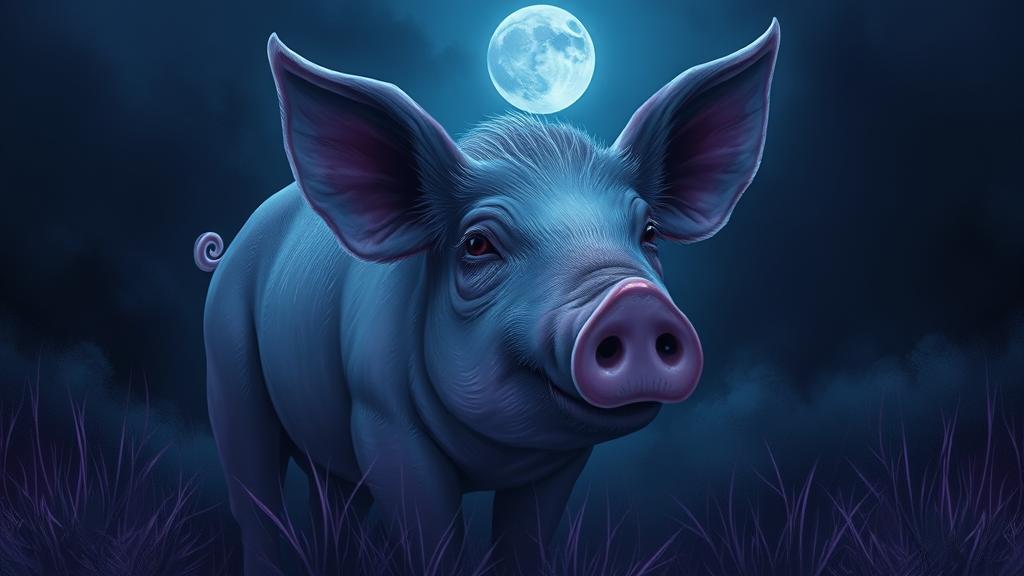
A pig stands in a yard at dusk, big and warm and breathing, looking back at you with an attention that makes you step away. You expected the cartoon, the wallowing creature of the insult. What you have in front of you is an animal with its own business, real and heavy. The dream is almost certainly not using the cultural shorthand. It’s using the animal.
Pigs are often ranked among the most intelligent animals people keep, a fact that tends to stop people mid-sentence, because everything we’ve built around the pig as a symbol assumes otherwise. The dim, wallowing creature. The animal you don’t name until it’s food. That gap is worth keeping in mind whenever a pig appears in a dream.
A pig in a dream is usually about appetite, intelligence, or abundance rather than filth. The feeling matters more than the appearance: was the pig threatening, calm, clever, or neglected? That distinction points toward what the dream is actually processing.
Two things the pig can be at once
The creature of appetite
This reading carries the cultural weight: the pig as excess, as wanting too much, as something that can’t stop. If you dream of a pig eating voraciously or something overwhelming in scale, this register is probably active. It’s not a moral judgment from the dream. It’s a question: where in your life is the want outrunning the satisfaction? Appetite dreams rarely mean gluttony in the literal sense. They tend to appear when someone is genuinely hungry for something: recognition, rest, contact, meaning. The pig won’t tell you which one. It just shows you that the hunger is large and has been running unsupervised.
The creature of intelligence
The pig in this register is the animal you underestimated. Calm, self-possessed, aware. If the pig in your dream seemed to be watching you, leading you, or solving something, you’re not dreaming about appetite. You’re dreaming about a kind of knowing that doesn’t perform itself. In Jungian terms this is the territory of the shadow: the part of the self that gets pushed below the surface because it doesn’t fit the image we hold of ourselves. Something capable and resourceful, living in the sty because we put it there.
What Artemidorus made of it
Artemidorus of Daldis, writing in the second century, worked on the principle that the same dream means different things for different dreamers, which is a good way to approach the pig. Read it by its condition: a fat, healthy pig suggests material abundance, a thin or sick one scarcity or waste, and a pig that chases you an opponent with more cunning than they appear to have. That kind of nuance was available long before the concept of the unconscious existed. I’m always a little gratified by that. It means the pig has never been purely an insult in the dream tradition, even if popular culture decided it should be.
The threat version
A charging or aggressive pig, a pig that corners you: Antti Revonsuo’s threat-simulation work on dreaming gives one lens here. Dreams rehearse for threats the waking mind can’t fully face. The pig as threat is often the appetite that’s become ungovernable, something you’ve been feeding without watching, that now has momentum. If this was your dream, the question isn’t whether something bad will happen. It’s what you’ve been avoiding confronting.
The colors and the context
A white pig reads differently from a black one. A pig in a clean pen reads differently from one in filth. A piglet reads differently from a boar. These aren’t fixed symbols with locked meanings; they’re modifiers on the central image. The piglet carries something new and unformed, a capacity not yet grown into its full size or need. The boar carries something older and wilder, closer to the animal before domestication.
If the pig was interacting with other animals in the dream, the context sharpens considerably. If the pig shifted into something else, an animal transforming is the dream to read, because transformation tends to be about identity specifically. And if what stayed with you was less the pig itself than the sense of being chased or threatened, many snakes is about a threat that is multiple or swarming rather than singular.
The weight of the animal
There’s something about confronting the animal behind the abstraction, a cut of meat on a deli counter, say, that strips away the comfort of not-thinking-about-it. The feeling that follows isn’t sadness. It’s closer to being grounded. I think pig dreams can do the same thing. They restore the weight to something you’ve been making abstract: a want, a capacity, a part of yourself that you’ve decided isn’t respectable.
The animal is real. It’s intelligent. It has needs. That’s not the insult we were taught it was. It might be the most honest thing in the dream. And there’s a different quality to this animal when it turns. A pig is a domesticated animal, and a dog attacking shares some of the same charge: something that’s supposed to be tame, suddenly not.
- Was the pig threatening, calm, hungry, or watching? That register carries the reading.
- Is there an appetite in my waking life that feels out of proportion or unsupervised?
- Have I been dismissing something capable or resourceful in myself as somehow unworthy?
- What feeling stayed with me after the dream? That’s where the real interpretation starts.
One symbol, two traditions
The two schools are not reading the same book: psychology asks what pig is doing in your waking life, while the biblical tradition tests the image against Scripture and leaves the meaning with God.
A pig in a dream is usually about appetite, intelligence, or abundance rather than filth. The feeling matters more than the appearance: was the pig threatening, calm, clever, or neglected? That distinction points toward what the…
You are reading this oneNo dream recorded in Scripture features a pig. The pig appears in waking-world passages: as a prohibited food in Leviticus, as the location of crisis in the prodigal son parable, and as the destination for a demon in the Gadarene…
Read the biblical meaning →Quick answers
What does it mean to dream of a pig?
A pig in a dream usually points toward appetite, abundance, or an intelligence that’s been underestimated. The cultural reflex to read the pig as filth or excess is rarely what the dream is doing. The feeling on waking, whether the pig felt threatening, calm, or eerily knowing, does most of the interpretive work.
Is dreaming of a pig a bad omen?
Not in any tradition I find useful. The more interesting question is what the pig was doing. An aggressive pig points toward something ungovernable in your waking life; a calm, intelligent one tends to surface a capacity you’ve been dismissing.
What does a boar mean in a dream?
A boar is the pig before it was domesticated: wilder, harder to contain, older in its instincts. It often appears when something instinctual or unrefined has been suppressed for a long time and is now pushing back. Less about appetite than about force.
Why do I dream about pigs when I don’t eat meat?
The pig in dreams is rarely a literal food reference. It operates as a symbol of abundance, intelligence, or appetite regardless of your diet. The cultural weight of the image is what the mind reaches for, not your personal relationship to pork.
Sources for this reading
- Revonsuo, A. (2000). The reinterpretation of dreams: An evolutionary hypothesis of the function of dreaming. Behavioral and Brain Sciences, 23(6), 877-901.DOI
- Artemidorus of Daldis (2nd century CE). Oneirocritica. English edition: Harris-McCoy, D. E. (2012). Artemidorus’ Oneirocritica: Text, Translation, and Commentary. Oxford University Press.
Full bibliography on Sources and method. Found a mistake? Tell us and see the corrections log.