- Tradition
- Psychological readingAnimal dreams
- Draws on
- Revonsuo, Jung, Artemidorus
- Reviewed
- 5 min read
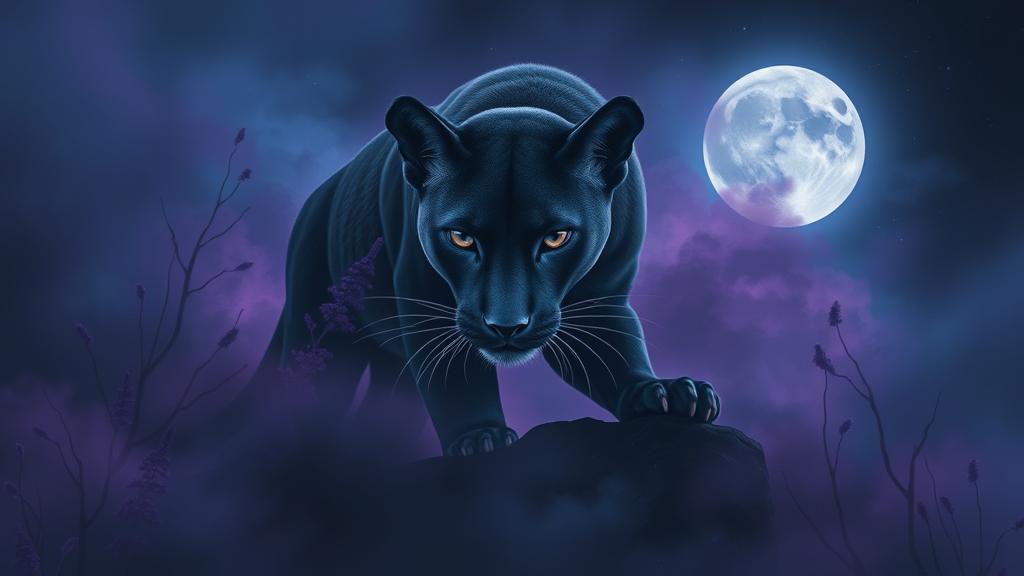
The puma dream is quieter than most people expect. Mountain lions can scream, but most of the time they move through the world without announcing themselves, and that’s exactly what unnerves you when one appears in a dream. Not rage. Not fangs. Just something enormous and still, watching you from a distance, and the specific dread of being seen by something that hasn’t decided what to do yet.
That’s the dream, usually. Not an attack. Not a chase. A puma sitting at the edge of the yard, or at the end of a corridor, or simply existing in the same space. The silence is the whole point.
A puma in your dream usually represents a force in your life that moves quietly and doesn’t announce itself: your own suppressed authority, a slow-building situation you haven’t named, or a part of you that’s been waiting for permission to act. The feeling during the dream decides the reading more than the puma itself.
The fence post at the edge of the yard
In puma dreams the animal tends to stand at a perimeter: a fence post, the foot of the stairs, just beyond the treeline. Almost always at the edge of somewhere safe. That’s not coincidence. Your sleeping mind is drawing a clear border: here is where your ordinary life ends, and here is the thing that lives just beyond it.
Take a hypothetical dreamer with a recurring puma dream, different locations, always the same stillness. Suppose she has been offered a promotion that would mean leading a team twice her current size, and she has said no three times. She isn’t afraid of the work. She’s afraid of how clearly she wants it. In that picture the puma would stop appearing around the time she finally says yes. It would feel like a confession, though it doesn’t need to be one.
The puma watches from a distance
The thing waiting isn’t trying to harm you. It’s waiting to see if you’ll come closer. This version often points to a version of yourself, a more direct or powerful one, that you haven’t yet agreed to inhabit. The distance is yours, not the puma’s.
The puma is close, or approaching
Proximity shifts the meaning toward urgency. Something you’ve been circling is no longer willing to be ignored. It might be a decision, a confrontation, or a capacity you’ve been treating as optional. The puma isn’t threatening you; it’s simply done waiting.
What Artemidorus didn’t have words for
Wild predators in dreams have been read as portents for a very long time, and the ancient dream books, Artemidorus’s second-century Oneirocritica among them, sorted animals by what they meant for your social fortune. They didn’t have much use for nuance. I find them fascinating as a record of how seriously antiquity took all this, even when the specific readings haven’t aged particularly well.
The more useful frame, at least to me, is Carl Jung’s. The predator in a dream tends to be what Jung called shadow material: the parts of yourself that carry force, ambition, sexuality, anger, that you’ve decided aren’t acceptable in daylight. This doesn’t mean the puma is something dark. It means it’s something powerful you’ve been keeping outside the fence.
Threat, or something that only looks like threat
Revonsuo’s threat simulation theory argues that dreaming evolved partly to rehearse dangerous situations, and a puma in your dream would be textbook material for that framework. But I’m a little skeptical of letting that reading do all the work. Most people who dream of pumas aren’t in physical danger. They’re in situations that feel like danger: a conversation they’ve been avoiding, a choice that would change things permanently, a version of themselves that frightens them because of how much it wants.
The threat is often the opportunity. That’s the uncomfortable thing about big-cat dreams. They’re easy to read as warnings and much harder to read as invitations. Which one it is depends almost entirely on what the puma was doing and, more importantly, how you felt when you saw it.
The cheetah is the puma’s opposite number: dreaming of a cheetah carries a different kind of urgency, pure speed rather than silent authority. And a vulture sits at the other end of the animal-power spectrum, the predator that doesn’t hunt so much as wait.
When it follows you back
Recurring puma dreams tend to show up when a decision has gone unmade for long enough that your unconscious has stopped being subtle about it. The puma gets closer over successive dreams. Or it starts appearing in places that used to be safe. I don’t think it’s doing this to scare you. I think the distance was always yours to close.
Writing down exactly what the puma looked like, and what it was doing, can tell you something you already knew. The dream isn’t really about the animal. It never is. The animal is a container for something you haven’t been able to look at directly in waking life, and the puma is specifically good at holding authority, drive, and the particular discomfort of wanting something large.
Patient may be the word that fits the puma best. Not menacing. Just patient.
If the puma in your dream felt less like power and more like threat, a black horse is where animal energy tips into something darker and harder to control. And if what you felt was more about being tracked than about confronting something, lice are the other classic version of that feeling, the sense of something persistent you can’t quite shake.
- Where was the puma standing, and where were you? The geography of the dream is the geography of your situation.
- Did the puma feel like something outside you, or like something that could have been you?
- What in your waking life has been waiting quietly at the edge of things, patient and unacknowledged?
- If the puma could speak, what do you think it would have been trying to tell you it was tired of waiting for?
Quick answers
What does it mean to dream of a puma watching you?
A puma that watches without attacking usually represents something in your life, often your own suppressed authority or a decision you’ve been avoiding, that has been waiting long enough. The watching is a mirror for your own hesitation. The puma isn’t threatening; it’s patient.
Is dreaming of a puma a bad sign?
Not inherently. The dream tends to be uncomfortable rather than dangerous, because it holds something you’ve been keeping at the perimeter of your attention. Whether that’s good or bad depends on whether you’re ready to stop keeping it there.
What does it mean if the puma is friendly or calm in the dream?
A calm puma is arguably the most direct version: the power or drive it represents is available to you, not working against you. Some people describe this as one of the most quietly energizing dreams they’ve had, once they stop waiting for it to turn threatening.
Why do I keep dreaming of the same puma?
Recurrence almost always means the thing the puma represents hasn’t been acknowledged in your waking life. The dream keeps returning because the situation keeps returning. Naming the real-world parallel, even imprecisely, tends to break the loop.
Sources for this reading
- Revonsuo, A. (2000). The reinterpretation of dreams: An evolutionary hypothesis of the function of dreaming. Behavioral and Brain Sciences, 23(6), 877-901.DOI
- Jung, C. G. (Ed.). (1964). Man and His Symbols. Doubleday.
- Artemidorus of Daldis (2nd century CE). Oneirocritica. English edition: Harris-McCoy, D. E. (2012). Artemidorus’ Oneirocritica: Text, Translation, and Commentary. Oxford University Press.
Full bibliography on Sources and method. Found a mistake? Tell us and see the corrections log.