- Tradition
- Psychological readingAnimal dreams
- Also read in
- The BibleSame symbol, other tradition
- Draws on
- Revonsuo, Artemidorus
- Reviewed
- 5 min read
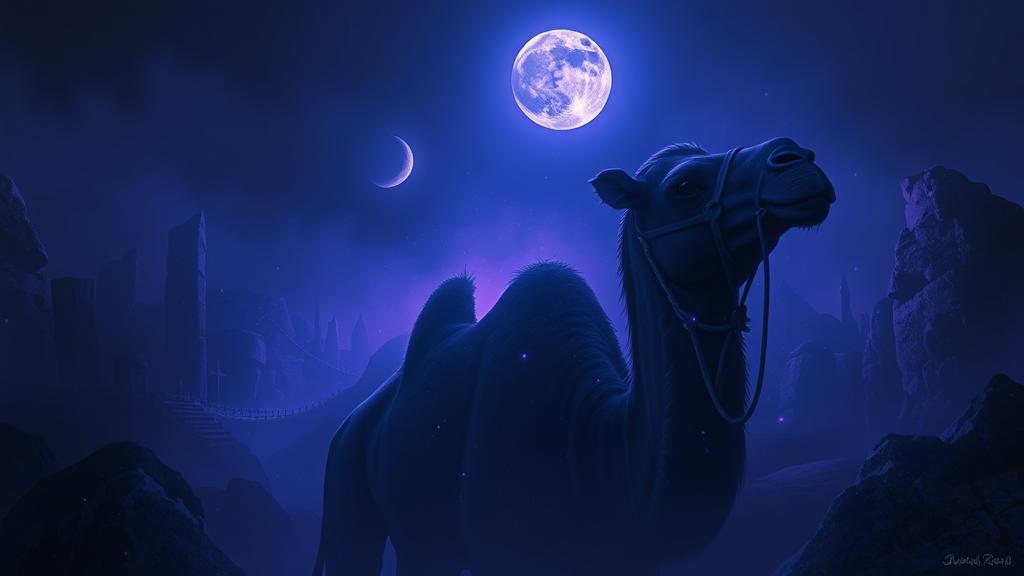
A camel in a dream looks like a desert cliché, a postcard from somewhere far away. What the image carries is more specific. A camel survives by storing what other creatures have to keep importing, which makes it a dream about reserves, and about burdens carried so long they stop being felt. It is most telling when it turns up somewhere it shouldn’t be: a parking garage, a hospital corridor, the end of a familiar street. Standing very still. Patient. Not threatening. Just waiting.
That waiting is what makes the camel worth taking seriously.
A camel in a dream usually signals reserves of endurance you haven’t drawn on yet, or a burden you’ve been carrying so long you’ve stopped noticing its weight. The camel’s temperament in the dream matters: a calm camel is steadiness; an aggressive one is stubbornness turning on itself.
What makes a camel different from every other large animal
Most large animals in dreams carry straightforward freight. Horses are power and freedom. Bears are the unconscious, the hibernating thing. The camel’s charge is more specific and stranger: it’s an animal that survives by storing what other creatures have to keep importing. It crosses the impossible stretch. It looks awkward doing it. It gets there.
That oddness is worth sitting with. When you dream of an animal that functions through accumulated reserve rather than speed or strength, the question your dream is actually posing isn’t “what’s dangerous?” It’s “what have you been stockpiling, and is it actually keeping you alive right now, or just making you heavy?”
A Jungian reading would probably call this an image of the psyche’s adaptive apparatus, that thick reliable part of you that doesn’t dazzle but doesn’t fail. Animals in dreams are often read that way, as parts of the self driven underground by civilisation, still doing their work at a depth where the conscious mind can’t see them. The camel fits that frame well: unglamorous, load-bearing, quietly essential.
Camel that’s calm or cooperative
Points to latent resources you haven’t needed yet. Endurance in reserve. Often arrives before a long, grinding stretch of life, as if the dream is stocking the pantry. The feeling on waking is usually steadier than the dreamer expects.
Camel that’s aggressive, spitting, or refusing to move
Stubbornness that’s curdled. A load carried so long it’s calcified into identity. This version tends to appear when the burden has become the person’s entire self-definition and they haven’t noticed. The animal is mirroring something back.
The caravan and the desert
Context in a camel dream carries unusual weight. A camel in a desert is almost too obvious, doing its expected work in its expected terrain, and these dreams are rarely the interesting ones. The camel that appears in domestic or urban spaces is your mind pulling the symbol free of its cliché. It’s insisting on the camel’s qualities without the comfortable backdrop. That parking garage version: your patience, your endurance, your extraordinary capacity to go without, has arrived somewhere it looks absurd. Maybe that’s the point.
A camel in a caravan, moving with others through difficulty, points to a collective effort, a project, a team, a family working through something slow and hard. Riding a camel smoothly suggests you’ve made peace with a plodding pace. Struggling to ride it, or being thrown, suggests the long-haul approach isn’t working and you know it.
Artemidorus, writing in the second century, held that the same dream means different things for different dreamers, depending on age, status, and occupation, and a camel is a good test of that. For a caravan driver it is livelihood. For a city dweller it is only a strange animal. The practical reading still holds: ask who is dreaming.
When it’s about carrying something for other people
The burden reading is the one most worth asking about directly. Not “what are you carrying” in the vague motivational-poster sense, but: is there weight you took on so gradually that you genuinely can’t feel it anymore? A camel in a dream, standing still and patient in an impossible place, might just be your own capacity for bearing things, turned into a creature and handed back to you so you’ll finally look at it.
Revonsuo’s threat simulation theory argues that dreams evolved partly to rehearse threats. A camel dream in that frame becomes practice for difficulty: your sleeping mind running the scenario of the long crossing, checking your stores, taking inventory. Not frightening. Preparatory.
A camel is powerful and yet cooperative, which is the same tension as in dreaming of a tamed wild animal: something strong that has agreed to carry. The lynx is the camel’s opposite, a hunter built on speed and stealth rather than stored reserve, and dreaming of a lynx reads very differently.
Dead or sick camel
This one is brief because it doesn’t need to be long. A dead or dying camel is an exhausted reserve. Something you relied on to get you through has given out. That’s not a verdict, it’s a weather report.
Here is where the opening image earns its place. Take a dreamer with a steady job and a manageable life, no crisis anywhere in sight, who still meets a camel in a corridor. No obvious crossing, just this animal standing somewhere it doesn’t belong, waiting. Ask what has been stored up, what reserves have been drawn down without acknowledgment, and the answer may be quiet and specific: not a full day off in over a year.
The camel in a corridor. Patient. Not threatening. Just waiting.
The out-of-place animal is almost always the message, and dreaming of a red snake works the same way: something out of its usual context delivering a signal.
- Was the camel calm and waiting, or resistant and difficult? That tells you whether the dream is showing you a resource or a burden.
- Where was the camel? In its natural landscape or somewhere it had no business being?
- When did you last actually take inventory of what you’re carrying, not just what you’re doing?
- Is there weight you’ve been shouldering so gradually that you’ve stopped noticing how heavy it is?
One symbol, two traditions
Psychology keeps camel inside your own story, a symbol your mind built from your days. The biblical tradition looks outward instead, and asks whether Scripture gives the image any voice at all.
A camel in a dream usually signals reserves of endurance you haven’t drawn on yet, or a burden you’ve been carrying so long you’ve stopped noticing its weight. The camel’s temperament in the dream matters: a calm camel is…
You are reading this oneSome commentators have suggested ‘the eye of a needle’ referred to a small gate in Jerusalem that a camel could only pass through with difficulty after being unloaded. Most modern scholars consider this a later invented…
Read the biblical meaning →Quick answers
What does dreaming of a camel mean?
It most often points to endurance, stored reserves, or a burden carried over time. The camel’s condition and temperament in the dream are the real clues: a steady, calm camel suggests untapped capacity; an aggressive or struggling one suggests the load has become too much or too fixed.
Is a camel in a dream a good omen?
In a psychological reading it’s more nuanced. A calm camel is genuinely positive, pointing to inner resources. A dying or spitting camel is less reassuring, though it’s information rather than a verdict.
What does it mean to ride a camel in a dream?
Riding smoothly suggests you’ve accepted a slow, grinding pace toward a goal and are at peace with it. Struggling to stay on, or being thrown, usually means you’re fighting against the kind of endurance that’s actually required here, wanting speed the situation won’t allow.
Why did a camel appear somewhere strange in my dream, like my house or office?
That’s the interesting version. The familiar setting is stripped of the camel’s usual desert cliché, so the symbol has to stand alone. Your mind is insisting on the camel’s qualities, patience, endurance, stored resources, in a context where they feel incongruous. That incongruity is usually the message.
Sources for this reading
- Revonsuo, A. (2000). The reinterpretation of dreams: An evolutionary hypothesis of the function of dreaming. Behavioral and Brain Sciences, 23(6), 877-901.DOI
- Artemidorus of Daldis (2nd century CE). Oneirocritica. English edition: Harris-McCoy, D. E. (2012). Artemidorus’ Oneirocritica: Text, Translation, and Commentary. Oxford University Press.
Full bibliography on Sources and method. Found a mistake? Tell us and see the corrections log.