Animal Dreams
Dreaming of a Frog: what that small leap means
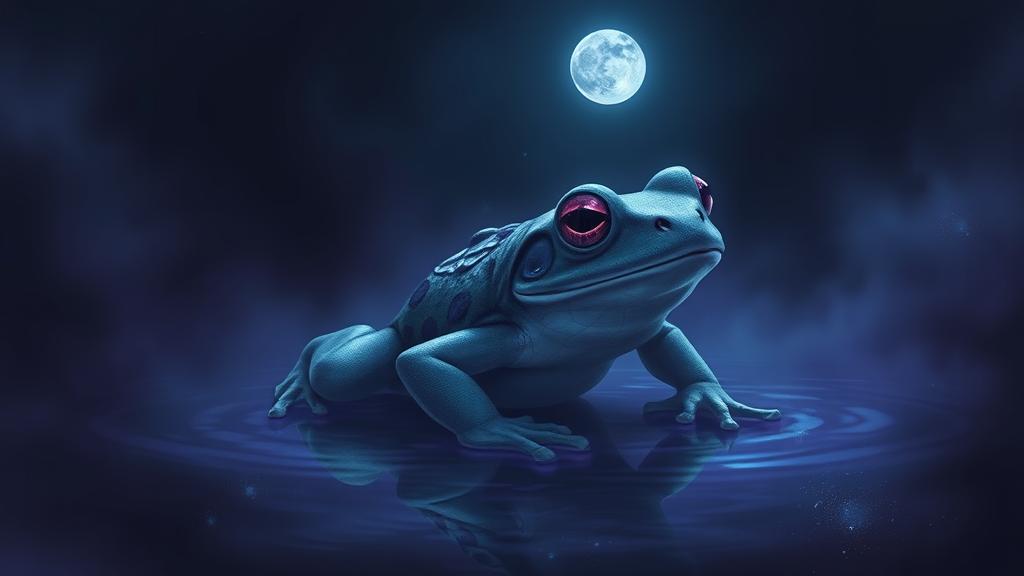
What made you notice it? That’s the first question I want to ask whenever someone tells me about a frog dream. Not where the frog was, not what it did. Just: what made you look down?
I keep a small ceramic frog on my desk, a souvenir from a market I can’t even remember. It sits there doing nothing, and sometimes I’ll stare at it for a full minute while I’m thinking about something else. There’s something about frogs that invites that kind of inattentive attention. They don’t move for long stretches, and then they vanish. You weren’t watching at the right moment. That rhythm, the waiting and the sudden gone, is what frog dreams are usually made of.
A frog in a dream most often signals a transition you’re in the middle of but haven’t fully accepted yet. The frog doesn’t represent the end state. It represents the crossing.
The moment before the leap
Frogs in dreams almost always appear at a threshold, a pond’s edge, a step, a window sill. They’re not doing anything alarming. They’re just there, crouched, and you’re aware they could move at any second. That hovering quality is the whole message. You’re watching something that hasn’t committed yet.
The creature that breathes in two worlds and belongs fully to neither: water and land, larva and adult, the cold and the wet. Carl Jung wrote about liminal creatures as images of the psyche’s own in-between states, the self caught mid-transformation. I find that convincing, especially for frogs, whose entire life is one long series of those crossings. The tadpole doesn’t know it’ll have legs. It just keeps swimming.
When the frog is still in your dream, you’re probably still in that waiting room yourself. When it leaps and you lose it, you’ve already moved, and the dream is just noting that fact. And when the frog lands cleanly, sits, and blinks at you? That’s the rarest version. I think it means the transition’s done and you haven’t quite registered it yet. The feeling is usually mild surprise.
The frog holds still
You’re in it. Waiting, gathering, not yet ready to commit. The dream isn’t urging you forward. It’s acknowledging where you are. This version tends to arrive during a long plateau, an uncertain job situation, a relationship that’s become a question mark.
The frog leaps or vanishes
You’ve already crossed. Something has changed and the old footing is gone. The discomfort here isn’t the leap, it’s the landing, which the dream may or may not show you. Most of the time it doesn’t. You wake before you know if it stuck.
What happens when it’s enormous
A frog the size of a dog is a different dream entirely. Scale in animal dreams almost always means emotional magnitude rather than actual threat. An oversized frog is an undersized reaction that’s been building up. You’ve been treating something big as if it were small, and now your sleeping mind has simply corrected the scale.
The older readings, briefly
Artemidorus of Daldis, writing his dream manual in the second century, treated frogs as ambiguous signs: sometimes good fortune connected to water and fertility, sometimes linked to deception because of their two-faced nature, one skin for land and another for water. I’m more interested in the deception angle than the fortune one, not because frogs are dishonest, but because people who dream of them are often being two-faced with themselves. They’re living in one element while secretly preparing for another.
The threat simulation theory that Revonsuo proposed casts a different light entirely. In that framework, dreams rehearse situations that demand a response, and a frog dream might be rehearsing the specific anxiety of watching something that can move fast and choosing when, or whether, to reach for it. The tension is the practice. Even a calm frog dream might be working out a decision you’re not consciously processing yet. I find I can hold both of these readings at once, which is unusual for me. Usually I want to pick one and be done with it.
People have written to me about frog dreams for years, and what stands out is how often the frog in the dream belonged to someone else. A frog in a jar, kept by a stranger. A frog in a colleague’s hand. A frog at the edge of someone else’s garden. When the creature is near you but not yours, you’re probably watching someone else make the transition you haven’t let yourself make yet. The frog knows whose story this is. It just hasn’t picked you up yet. If you’ve also been dreaming of a black horse, that combination tends to mean you’re tracking not just a transition but a specific kind of power you haven’t claimed.
There’s a version that doesn’t get talked about enough: the frog you’re afraid of in the dream but, objectively, shouldn’t be. You’re inside a normal room and a frog comes in and you’re terrified. A colleague once described this to me with genuine embarrassment. In waking life she had no fear of frogs at all. But the dream-frog made her back against the wall. I don’t think the frog was the threat. I think the threshold it represented was. The leap you can’t predict is scarier than the animal. If this feels familiar, the piece on dreaming of a jaguar explores that specific flavor of inexplicable dream-fear, where the creature is less dangerous than what it means.
My ceramic frog is still sitting here. I bought it in a period when I was between things, not dramatically, just quietly stuck. I don’t think I knew that at the time. I’d only know it later. The frog on my desk didn’t tell me anything. But I kept it, which maybe means I wasn’t ready to stop watching it. Still sort of not. Dreaming of a vulture gets at a different patience, the waiting that knows something is ending rather than beginning, and that difference matters more than it sounds.
- Was the frog still or did it move? The answer tells you where you are in the crossing.
- Whose frog was it? If it belonged to someone else, whose transition are you actually watching?
- Were you afraid, and if so, of the frog itself or of what it might do next?
- Is there something in your life right now that’s crouched and waiting, including you?
One symbol, two traditions
The two schools are not reading the same book: psychology asks what frog is doing in your waking life, while the biblical tradition tests the image against Scripture and leaves the meaning with God.
A frog in a dream rarely means what you expect. Nora Vance unpacks the leap, the stillness, and what you're actually watching transform.
You are reading this oneFrogs in the Bible carry a specific and dramatic role in the Exodus plagues. Here is what Scripture actually says and what it honestly doesn't about frog dreams.
Read the full biblical meaning →Quick answers
What does dreaming of a frog mean?
Most often it signals a transition in progress, something between two states that hasn’t fully resolved yet. The frog’s behavior in the dream, still, leaping, vanishing, tells you where you are in that crossing rather than where you’ll end up.
Is a frog in a dream good or bad?
Neither by default. The tone of the dream does the work. A calm frog on a threshold is generally a quiet acknowledgment of change. An oversized or frightening frog usually means the change feels larger than you’ve admitted to yourself.
What does it mean to dream of a frog jumping at you?
It’s one of the more startling versions. The transition you’ve been watching from a distance has arrived at you directly. This isn’t necessarily alarming in waking terms, but it does mean the waiting phase is over whether you chose to end it or not.
Why do I keep dreaming about frogs?
Recurring frog dreams tend to cluster around periods where something is genuinely in between. You’re in a threshold you haven’t fully acknowledged yet. The dream keeps returning because the transition hasn’t resolved, and part of that might be that you haven’t let it.