- Tradition
- Psychological readingAnimal dreams
- Also read in
- The BibleSame symbol, other tradition
- Draws on
- Revonsuo, Artemidorus
- Reviewed
- 5 min read
Ravens carry a grim reputation in dream dictionaries: the bird is read as an omen of death, and that reading is partial at best. The raven in the dream behaves more like a witness. It appears near something you haven’t admitted yet, holds still, and waits, and what the dreamer feels is rarely fear. It is closer to being caught. The bird didn’t bring the difficult thing. It just found it where you’d left it.
A raven in a dream is nearly always a messenger figure, carrying something you’ve been avoiding knowing. Whether that message is ominous, wise, or simply strange depends far less on the raven itself than on what the bird did and how you felt when it looked at you.
What the raven is actually doing
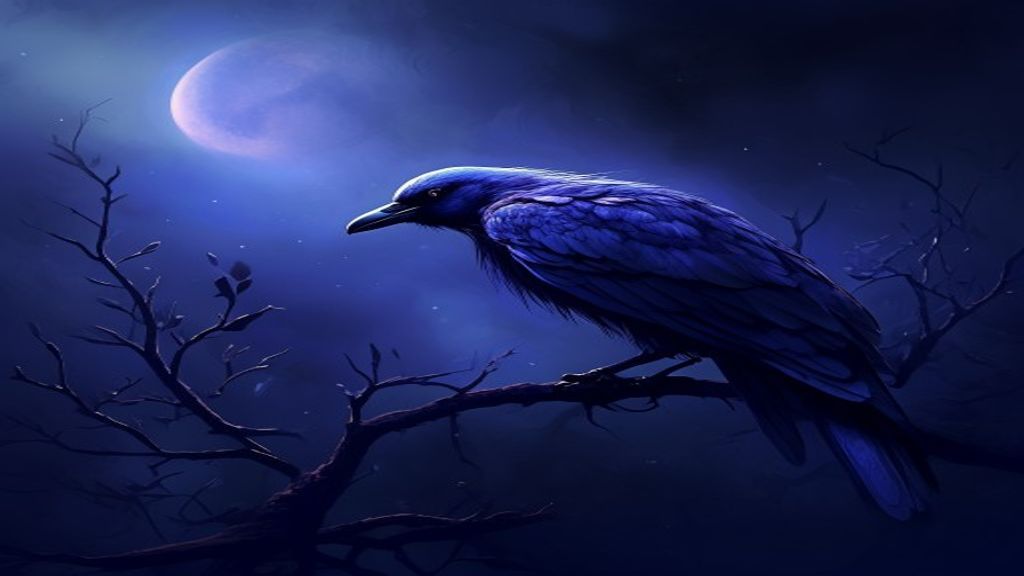
The raven has this quality, even in waking life, of appearing to be paying attention. Crows do it too but ravens take it further. They seem to be waiting for you to say something. In dreams that quality gets amplified, and the typical beat is the same: the bird looks at you, and you feel caught. Not threatened, necessarily, just caught. Like you’ve been found out about something you haven’t admitted yet.
That’s worth sitting with before you reach for any symbol library. What were you not admitting? What had you been folding quietly into the back of a drawer? The raven in the dream didn’t bring that thing. It just found it.
Probably the most common version. The bird observes without moving. This is the dream pointing at something you already know but haven’t spoken aloud. The raven holds it for you like a mirror.
Less common, and genuinely arresting when it happens. If the raven spoke, the words matter far more than the bird itself. Write them down immediately. Your mind chose language for a reason.
A raven that drops or carries an object in its beak is delivering a specific message. The object is the whole dream. The bird is just the postal service.
If the raven leaves, you’re watching an opportunity or a warning depart. The question isn’t whether it was good or bad. The question is whether you let it go or it chose to go.
Rarer, and usually means the knowledge the bird carries has gotten impatient. You’ve been ignoring something for long enough that it’s become insistent. Pay attention to where it strikes.
Ravens in groups shift the energy from the personal to something more collective. This version tends to surface during periods of major change, when the air feels like it’s full of information you can’t quite sort.
The part that surprises most people
Ravens in dreams aren’t usually death omens. I know that’s what half the internet will tell you. It’s not wrong exactly, it’s just partial. The raven got associated with death because it was historically associated with battlefields, and battlefields were where knowledge accumulated fast: who survived, who didn’t, what it meant. The raven was the creature that witnessed. It’s still doing that job in your dream.
When people dream of a raven after a loss, the bird isn’t predicting or announcing. It’s sitting with the fact. There’s a real difference. The dream isn’t being cruel. It’s being honest.
What the old readings got right
Artemidorus, writing in the second century, held that the same dream means different things for different dreamers, which is a more nuanced starting point than most omen dictionaries offer. Attention to what the bird was doing and where it appeared in relation to the dreamer is still the right approach.
A Jungian reading would call the raven a shadow figure, a part of the psyche that knows things the conscious mind has been careful not to look at directly. I’m not always sure how far to take the shadow framework, but with ravens I think it fits. The bird in your dream is probably carrying something you’ve put in the dark on purpose. Not because it was terrible, but because it was complicated or uncomfortable or just a lot. Ravens don’t mind the dark. They’ll hold the thing until you’re ready.
The one place I’d push back on the folklore
Calling a raven dream an omen of bad luck is the least useful interpretation available. Omens are passive, something happening to you. Raven dreams feel much more active than that. The bird in these dreams isn’t a symptom; it’s an invitation. That’s a completely different kind of information.
Revonsuo’s threat simulation theory suggests dreams flag threats we haven’t fully processed, and there’s something to that here. But the raven doesn’t feel like a threat response. It feels more like a correction, the psyche sending a messenger to deliver something that got lost in transit.
Some of the nearest dreams are other birds that carry knowledge. If the raven spoke, a talking bird is about the words and what you already know of them. A blackbird is a dark bird at a smaller, quieter scale, a messenger in the sense that something in you is trying to communicate. And an owl is the other bird that already knew, though its knowing is nocturnal and still where the raven’s is watchful.
What happens after the raven
A raven dream doesn’t need to repeat once the point lands. The thing that was being not-admitted gets admitted, which is overdue and fine. Whether that counts as tidy symbolism or just tidying, the bird has done its job: it found the thing, and you looked at it.
- What was the raven doing, and did it notice you?
- What do you know right now that you’ve been treating as not-yet-known?
- If the bird was carrying something, what would you most and least want it to be?
- What would change if you said out loud the thing the raven seemed to already know?
One symbol, two traditions
A psychologist asks what raven felt like and what it echoes in your week. The biblical reader asks a different question entirely: what does Scripture say when this image appears, and what does it stay silent about?
A raven in a dream is nearly always a messenger figure, carrying something you’ve been avoiding knowing. Whether that message is ominous, wise, or simply strange depends far less on the raven itself than on what the bird did and…
You are reading this oneThe 1 Kings 17 account of ravens bringing food to Elijah is the strongest biblical precedent. A raven delivering something in a dream might be pointing toward provision arriving from an unexpected or unlikely source. Scripture…
Read the biblical meaning →Quick answers
What does it mean to dream of a raven?
A raven in a dream usually functions as a messenger, pointing at something you already know but haven’t fully acknowledged. The bird’s behavior matters more than its presence: a raven that watches you is different from one that speaks, flies away, or brings you an object.
Is dreaming of a raven a bad omen?
Not really. The bad-omen tradition comes from the raven’s historical association with battlefields and death, but in dreams the bird is more of a witness than a warning. It tends to appear when your mind has collected information you haven’t sat with yet.
What does it mean when a raven speaks in a dream?
A speaking raven is one of the more striking dream images. The words themselves are the message. Write them down immediately after waking, because your conscious mind chose specific language for a reason and the exact phrasing matters.
Why do I keep dreaming about a raven?
A recurring raven usually means the message it’s carrying hasn’t been received yet. Something in your waking life knows more than your conscious attention has admitted. The dream tends to stop once you acknowledge what the bird has been trying to hand you.
Sources for this reading
- Revonsuo, A. (2000). The reinterpretation of dreams: An evolutionary hypothesis of the function of dreaming. Behavioral and Brain Sciences, 23(6), 877-901.DOI
- Artemidorus of Daldis (2nd century CE). Oneirocritica. English edition: Harris-McCoy, D. E. (2012). Artemidorus’ Oneirocritica: Text, Translation, and Commentary. Oxford University Press.
Full bibliography on Sources and method. Found a mistake? Tell us and see the corrections log.