- Tradition
- Psychological readingAnimal dreams
- Draws on
- Revonsuo, Artemidorus
- Reviewed
- 4 min read
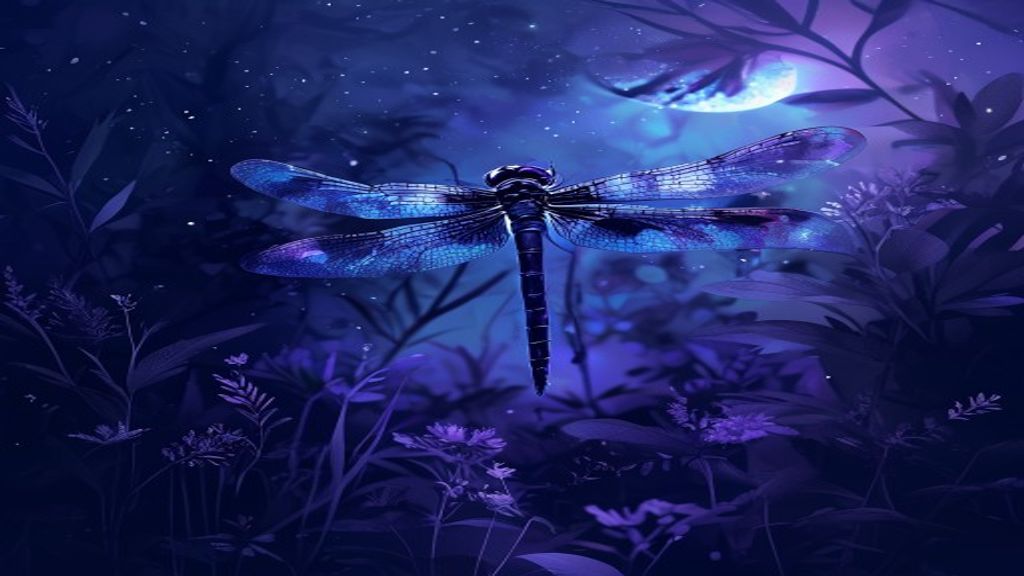
A dragonfly holds still in a way nothing else does. It can hover in one spot, perfectly motionless except for the wings, and then it’s gone so fast you’re not sure where it went. That’s not a metaphor I invented. That’s just what they do. And it’s the exact quality that makes a dragonfly dream different from almost any other animal dream: the image your brain chose is the one that stops completely and then disappears without warning.
It is easy to picture a dragonfly as the eye of a pond, watching the whole surface of the water. A dragonfly in a dream can feel exactly like that: like something is looking at a situation with compound eyes that see in every direction at once, including directions you’ve been avoiding.
The hover and the vanish
Most animal dreams are about pursuit, encounter, or reaction. A dragonfly dream is almost never those things. It’s about observation. The dragonfly lands, holds still, and your sleeping mind turns all its attention on it. What’s underneath that attention is usually more interesting than the dragonfly itself.
Dragonflies are creatures of two worlds: water and air, larva and flight, darkness and light. Many cultural traditions that pay attention to them use that transition as the core meaning. A Jungian reading holds that the psyche uses animals to show us parts of ourselves we can’t access directly, and the dragonfly’s particular shape, this ancient hovering predator that’s been on Earth longer than most of what we recognize as living, carries something about deep time and sudden transformation that your rational mind doesn’t hand over easily.
Artemidorus, working in the second century with a very different understanding of animals and their significance, held that the same dream means different things for different dreamers, depending on age, status and occupation. I’m not claiming he said anything about dragonflies, but the principle fits: this image reads differently at a crossroads than in a calm stretch. Dragonfly dreams do seem to gather around stillness before action.
Which dragonfly dream did you have
What it’s watching
Here’s the part worth returning to: if a dragonfly in a dream is an eye, what exactly is it watching? Think of the pond, the whole surface of a thing, the boundary between what’s visible and what’s underneath. I think that’s close. Dragonfly dreams tend to arrive when you’re standing at the edge of your own surface, aware that something’s moving below it and not sure whether to look.
Antti Revonsuo’s threat-simulation framework is usually invoked for nightmares, but there’s a quieter version of his point that applies here: the dream brain is particularly alert to what might be approaching. A hovering dragonfly is a creature that’s entirely still while preparing. It isn’t passive. It’s about to move. Whatever your dream was watching, it wasn’t idle.
The dragonfly as a symbol of transition comes up across cultures in ways that are just worth noting: in Japanese tradition, for instance, they’re associated with autumn and courageous resolve. I’m not collapsing cultural readings into one meaning, that would be sloppy. But the weight of transition runs through most of them.
When the dream keeps returning
A recurring dragonfly dream is unusual. This one tends to come once, sharp, and doesn’t need to repeat. When it does recur, it’s often because the transition it was marking hasn’t been acknowledged. The pond is still there. You’re still standing at the edge.
If you’ve been circling back to this dream, dreaming of a butterfly is the other small winged creature people reach for when they talk about change, and its page argues the image is more than transformation, which is a useful check on the dragonfly’s own transition reading. And dreaming of a dead animal is the nearer read if the dragonfly in your dream was still, fallen or diminished.
The eye of the pond is an image worth keeping, whether or not anyone ever believed it literally. Either way, a dragonfly is hard to see without wondering what it’s looking at.
- Was the dragonfly still or moving when you were most aware of it?
- Did you feel watched, or did you feel like you were the one watching?
- What transition in your life is currently paused, just before the move?
- If the dragonfly was trying to show you something, what would be the most honest answer about what it was?
Quick answers
What does dreaming of a dragonfly mean?
It usually signals a moment of transition or heightened awareness, especially one where you’re suspended between what’s been and what’s next. The dragonfly’s quality of hovering before darting is the whole symbol.
Is a dragonfly dream a spiritual sign?
Many traditions read it that way, particularly around transformation and the souls of those who’ve passed. Psychologically, it tends to mark a boundary moment, something is about to shift. Both readings point the same direction.
What does it mean when a dragonfly lands on you in a dream?
Something you’d expect to be fleeting has chosen to stay near you, at least for a moment. It usually feels like reassurance in the dream. Trust what felt stable in the scene.
Why do dragonflies keep appearing in my dreams?
Recurrence usually means the transition the dream is marking hasn’t quite been stepped into. Something that was about to change is still hovering. Naming the threshold, even privately, often quiets the dream.
Sources for this reading
- Revonsuo, A. (2000). The reinterpretation of dreams: An evolutionary hypothesis of the function of dreaming. Behavioral and Brain Sciences, 23(6), 877-901.DOI
- Artemidorus of Daldis (2nd century CE). Oneirocritica. English edition: Harris-McCoy, D. E. (2012). Artemidorus’ Oneirocritica: Text, Translation, and Commentary. Oxford University Press.
Full bibliography on Sources and method. Found a mistake? Tell us and see the corrections log.