Animal Dreams
Dreaming of an Octopus: the eight-armed thing you can't quite pin down
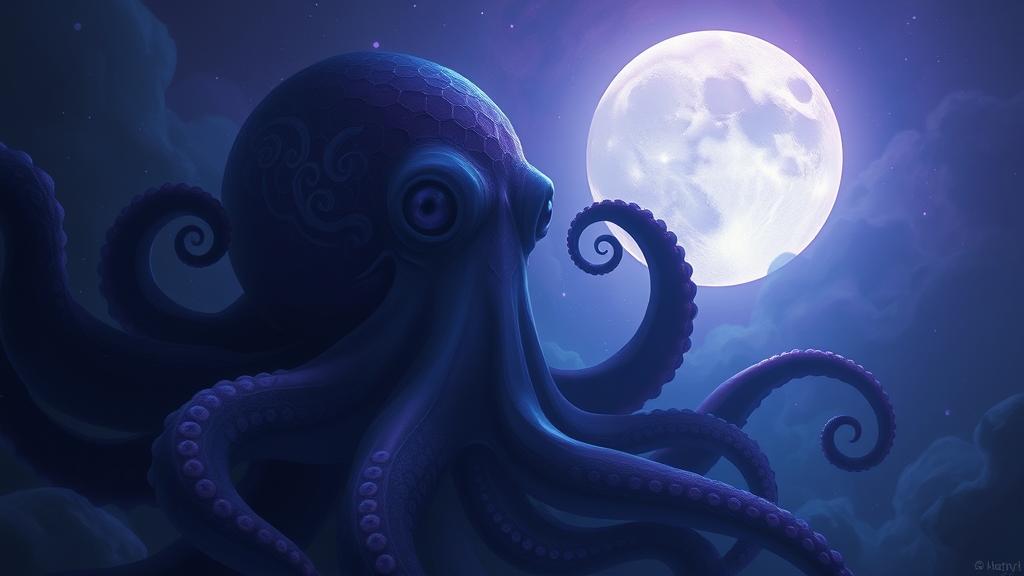
“It kept changing color and I couldn’t tell if it was trying to hide or trying to show me something.” That’s from a message I received about an octopus dream, and honestly it’s one of the most accurate descriptions of the animal I’ve ever read.
Eight arms and one question
My neighbor kept an octopus in a tank in her living room for about two years. I’d stop by sometimes and we’d watch it together. It was difficult to watch, in the way that extremely intelligent things in confined spaces are difficult to watch. It moved differently each time. It watched back. One afternoon it had rearranged all the objects in the tank into a loose ring pattern, and neither of us could agree on whether that was play, boredom, or something else entirely. I think about that tank when octopus dreams come up, because the sensation my neighbor’s octopus produced, intelligence you can see but can’t quite read, is almost exactly the sensation people describe waking up with. Something was doing something. You couldn’t tell if it was with you or around you or simply proceeding according to its own interior logic.
An octopus in a dream usually signals something with many simultaneous angles: a situation pulling in several directions at once, a person or part of yourself that’s adaptive and hard to fix in place, or intelligence you can perceive but not easily categorize. The camouflage element often points to something concealing itself, or to your own capacity to disappear.
A brief history of the eight-armed fear
- 2nd century CE
Artemidorus catalogued sea creatures in the Oneirocritica with attention to their movement and habitat. Deep-sea and many-armed creatures typically signaled complexity, entanglement, or matters with multiple threads. His readers lived close enough to the sea that these weren’t abstract symbols.
- 19th century
The giant squid and octopus became the century’s favorite horror: the Kraken, the tentacled abyss. This cultural weight flooded into dream interpretation of the era. Octopus dreams were read as entrapment, the deep unconscious reaching up.
- 1964
Jung’s Man and His Symbols gave the deep-water creature a more nuanced place: not just threat but the unknown intelligence of the psyche’s lower floors. Things that think differently than the ego does.
- Late 20th century onward
Marine biology shifted the cultural image significantly. The octopus became a symbol of distributed intelligence, of a mind organized nothing like ours. This newer image opened dream interpretations toward multiplicity and adaptability rather than pure threat.
- Now
Most people who dream of octopuses in the current era bring both layers: the old entrapment fear and the newer fascination with alien intelligence. The dream usually knows which one it’s using.
What the arms are doing
An octopus operates eight things at once, each arm semi-autonomous, each capable of sensation and small decisions independent of the central brain. Dreams about octopuses often carry this quality as their emotional core: too many things happening simultaneously, too many demands or extensions or threads to track. If you woke from the dream feeling overwhelmed rather than threatened, that’s probably the register it was using. There’s a different version where one or two arms are what the dream focuses on. Specifically when an arm holds or wraps around something. That version tends to run closer to Jung’s framework of the shadow, the part of yourself that extends toward things your conscious self would prefer to keep at distance. An octopus arm that reaches for something, even something you don’t want reached, is a remarkably precise image for an appetite you haven’t fully acknowledged. Revonsuo’s threat simulation framework is interesting here too, though I find it partial. Yes, an octopus can simulate threat: powerful, unpredictable, capable of real grip strength. But the camouflage element, the color-changing and ink-cloud disappearance, is harder to fit into pure threat simulation. The octopus that hides is rehearsing something different than danger. It’s rehearsing concealment. Which part of the rehearsal your dream was running probably depends on what the octopus was doing when you woke.
The camouflage problem
Changing color to match the environment is a form of intelligence that has no equivalent in human behavior, except metaphorically. And metaphor is exactly what dreams are made of. An octopus that shifts color in a dream is almost always pointing at something that presents differently in different contexts, a person who becomes whoever the room needs, a part of yourself that adapts so thoroughly you’ve lost track of what’s underneath, a situation that keeps looking different every time you examine it. The message in that case is usually the same one my neighbor’s octopus suggested on the afternoon of the rearranged objects: you’re looking at something real, something that’s definitely doing something, and you cannot yet determine its logic. That uncertainty is the content of the dream, not a gap in it.
The octopus in dreams tends to appear alongside other animals whose symbolism turns on intelligence and depth. The article on dreaming of a white horse covers a very different animal register, power that moves openly rather than in concealment. If the octopus dream left you with a feeling of being watched or tracked, the piece on dreaming of a peacock explores what it means when the animal’s gaze is turned outward and display is the whole point. And for dreams where the animal’s speed and precision were the charge, dreaming of a cheetah runs in a completely different direction.
My neighbor eventually rehomed it
The octopus went to an aquarium. She said she felt guilty having it in the tank, that it was too smart for the space. I asked her once if she’d ever dreamed about it. She said she’d dreamed it had gotten out of the tank and was sitting at the kitchen table, and that in the dream this hadn’t seemed strange at all, just another presence with its own business to attend to. I’ve thought about that dream more than my own octopus dreams, honestly. The octopus at the table, not threatening, not fleeing, just present with its inscrutable distributed intelligence. Some things in our lives are like that. We’ve let them in, we’ve made a kind of space for them, and we don’t fully understand them, but they’re at the table now.
- Was the octopus coming toward me or moving away? Was it watching me?
- Which arms was I paying attention to, and what were they reaching for?
- Did it change color or hide? Is there something in my life that looks different every time I examine it?
- Did the dream feel like threat, or like contact with something intelligent I don’t fully understand?
Quick answers
What does dreaming of an octopus mean?
Usually it signals something operating on multiple tracks at once: a situation with many simultaneous demands, a person who adapts and conceals, or a part of yourself extending toward things you haven’t consciously acknowledged. The camouflage quality can point to something presenting differently in different contexts.
Is dreaming of an octopus grabbing me a bad sign?
It’s a pointed sign rather than a purely bad one. Something has grip in your life that you haven’t fully reckoned with. The octopus arm is a remarkably precise dream image for an appetite, obligation, or dynamic that’s taken hold below conscious awareness.
What does it mean if the octopus was changing color?
Color-changing specifically points to something that presents differently depending on context, hard to fix in place, hard to read with certainty. It might be a person in your life, or a part of yourself, that you can’t quite hold steady long enough to understand.
Why do octopus dreams feel so strange?
Partly because octopuses genuinely are strange, distributed intelligence with no analog in human experience. When the dreaming mind reaches for an image of something that thinks very differently from how you think, an octopus is exactly right. The strangeness of the dream is accurate information about the strangeness of what it’s pointing at.