- Tradition
- Psychological readingAnimal dreams
- Draws on
- Revonsuo, Artemidorus
- Reviewed
- 5 min read
A cheetah at full sprint. That’s it. That’s the whole image, and the reason it arrives in dreams with such force is that there’s nothing in the living world that looks quite like it: the spine folding almost completely in half with each stride, the head perfectly still while everything else moves, and that particular quality of total commitment, no hesitation, no reserve, just absolute conversion of intention into speed. You’ve probably never seen a live cheetah run. You’ve still seen it in your body when you dreamed it.
That’s where I want to start, not with what the cheetah means, but with what it does. Because the meaning follows from the doing.
A cheetah in a dream usually signals something about speed, timing, and full commitment: either you’re being called to move with everything you have, or you’re watching something move with everything it has and feeling the gap between that and how you’ve been operating. The cheetah doesn’t have a neutral gear.
The tick after the engine stops
Think of the sound a car makes after a long drive, that rhythmic cooling-metal tick once the engine is switched off. Ten minutes of ticking, then silence. It’s the sound of something that has been running hard, coming back to itself. That’s the aftermath of a cheetah dream, the specific quality of waking up and lying still for a moment, as if the dream had been running and you just now stopped.
Not everyone feels this. Some people wake from cheetah dreams feeling urgency rather than release. The distinction matters, and I’ll come back to it.
What the cheetah actually costs
Here’s the piece of natural history that I find most useful for reading this dream: a cheetah’s sprint is short. A chase lasts seconds, not minutes, and afterward the animal has to stop and recover, often resting before it can even eat. The fastest land animal alive has a hard biological stop built in.
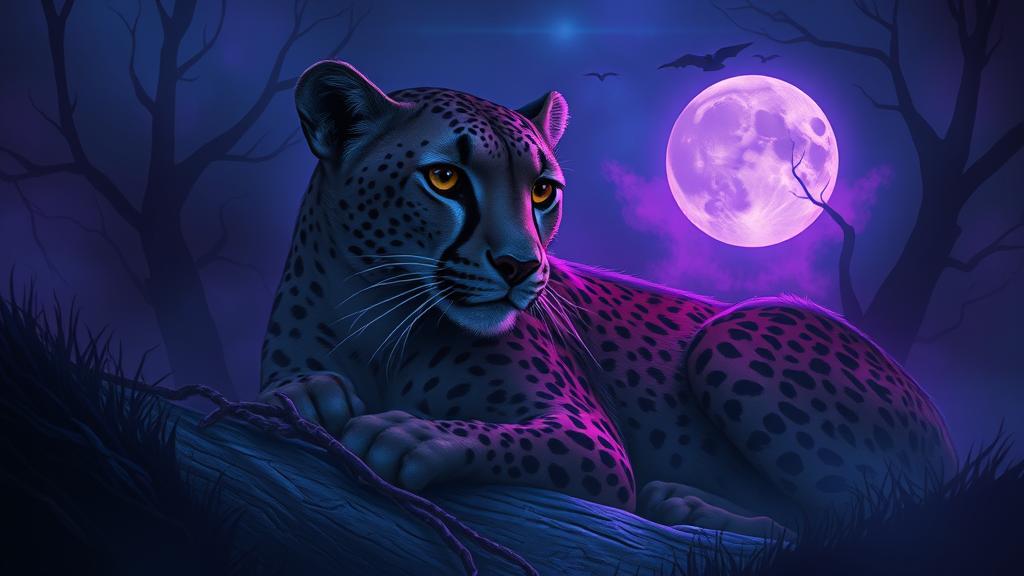
This is, I think, why cheetah dreams feel different from lion or tiger dreams. The cheetah isn’t about sustainable dominance. It’s about a particular window of maximum output, and what you do with it, and what you need afterward. If your dream featured a cheetah at rest rather than at speed, that’s not a lesser version of the dream. It might be the more honest one.
Five things the dream might be asking
- Are you at the start of the sprint, or at the end?The cheetah coiling to run is about potential and readiness. The cheetah still and panting after the chase is about depletion and what comes next. Both are valid dreams, but they’re asking completely different questions of you.
- Was the cheetah you, or something outside you?If you felt like the cheetah, or moved with it, the dream is probably about a capacity of yours. If it was clearly something separate, you may be watching something in your life move with speed and commitment that you haven’t matched yet.
- What was it chasing, or what was chasing it?Cheetahs in dreams are rarely directionless. The prey or the obstacle tells you almost everything. What in your waking life are you pursuing with that level of single-mindedness? Or what’s that direct in pursuing you?
- Did you feel the speed as freedom or as pressure?The same sprint reads completely differently depending on whether it felt like liberation or like something demanding more than you had. Your body in the dream knows which one it was.
- What happened when it stopped?The resting phase, if your dream included it, is often where the real meaning sits. Rest after full effort is different from rest from avoidance. The cheetah earns its stillness.
A Jungian reading would take the cheetah as a specific flavor of instinctual energy: not the slow patient accumulation of the self, but the burst capacity, the thing that can only be done at full speed or not at all. It’s worth adding that the cheetah is also, among the big cats, relatively non-aggressive toward humans. It’s not interested in domination. It’s interested in one thing at a time, done completely.
Artemidorus’s principle that the same dream means different things for different dreamers points the same way: speed is neither good nor bad until you know who is running and where it ends up. I’m usually willing to give him credit for the general direction even when I think the texture gets lost.
Revonsuo’s threat simulation lens would see a large predator and register the obvious. But a cheetah dream is rarely felt as primarily threatening. What stands out is the quality of the movement. It’s more like watching something be completely itself, and feeling the contrast with how cautiously you’ve been moving.
If the cheetah in your dream was injured or slow, dreaming of a dead animal is closer, since the animal’s energy has been diminished or lost. And if what struck you wasn’t the speed so much as how long the animal could keep going, dreaming of a camel is the endurance counterpart: reserves drawn slowly rather than burned in a burst.
The sprint you’ve been saving
This dream tends to turn up in a period of either holding back or burning out. Not the comfortable middle. It shows up when there’s something that needs full-speed commitment, and you’re either not quite doing it or you’ve been doing nothing but that for too long.
There’s a version of this dream that I think is essentially your nervous system showing you what real commitment looks like. Not gradual. Not strategic. That folded spine, that still head, that short window. The cheetah doesn’t save any for later, and for once, that isn’t a problem. That’s the point.
The dreaming of a heron article is the almost exact opposite in temperament: a hunting animal that works through absolute stillness rather than speed. If you’ve been dreaming of both, or if one resonates and the other doesn’t, that contrast can tell you something.
That cooling tick after the engine stops is the sound of having gone somewhere and come back. The cheetah in your dream did that: somewhere, at full speed, without apology. The open question is whether you want that for yourself, or are afraid of how much of it you already do.
- Was the cheetah running toward something or away from something? The direction is rarely random.
- Did you feel the speed as belonging to you, or as something you were watching from outside?
- What in your life right now needs full commitment for a short window, not a sustainable pace, but a real sprint?
- After the cheetah stopped, or after you woke, what was the emotional residue? Relief, urgency, or something quieter?
Quick answers
What does it mean to dream of a cheetah?
The cheetah is specifically about speed and full commitment, not just predator energy in general. The dream tends to show up when something in your life requires that kind of maximum-output, short-window action, either because you haven’t given it yet, or because you’ve been running at that pace for too long without the rest that follows.
Is dreaming of a cheetah a good sign?
It’s an energizing sign, usually. Unlike dream predators that signal danger, the cheetah tends to carry an invitation: to move with intention, to stop hedging, to use the sprint you’ve been saving. Whether that feels good or pressured depends on where you are right now.
What does it mean if the cheetah in my dream was resting?
A resting cheetah is often the more useful dream. The cheetah earns its rest through complete effort, so a still cheetah in a dream can point to the legitimate exhaustion that comes after giving everything, or to the permission you haven’t quite given yourself to stop. Both readings are worth sitting with.
Why does the cheetah feel different from other big-cat dreams?
Because it is different. Lions and tigers carry dominance and territory. The cheetah carries a specific biological reality: complete commitment over a very short window, then necessary stillness. That pattern maps onto a real experience most people have had, and the dream uses the animal as a precise image for it, not just generic predator energy.
Sources for this reading
- Revonsuo, A. (2000). The reinterpretation of dreams: An evolutionary hypothesis of the function of dreaming. Behavioral and Brain Sciences, 23(6), 877-901.DOI
- Artemidorus of Daldis (2nd century CE). Oneirocritica. English edition: Harris-McCoy, D. E. (2012). Artemidorus’ Oneirocritica: Text, Translation, and Commentary. Oxford University Press.
Full bibliography on Sources and method. Found a mistake? Tell us and see the corrections log.