- Tradition
- Psychological readingAnimal dreams
- Draws on
- Revonsuo, Jung, Artemidorus
- Reviewed
- 5 min read
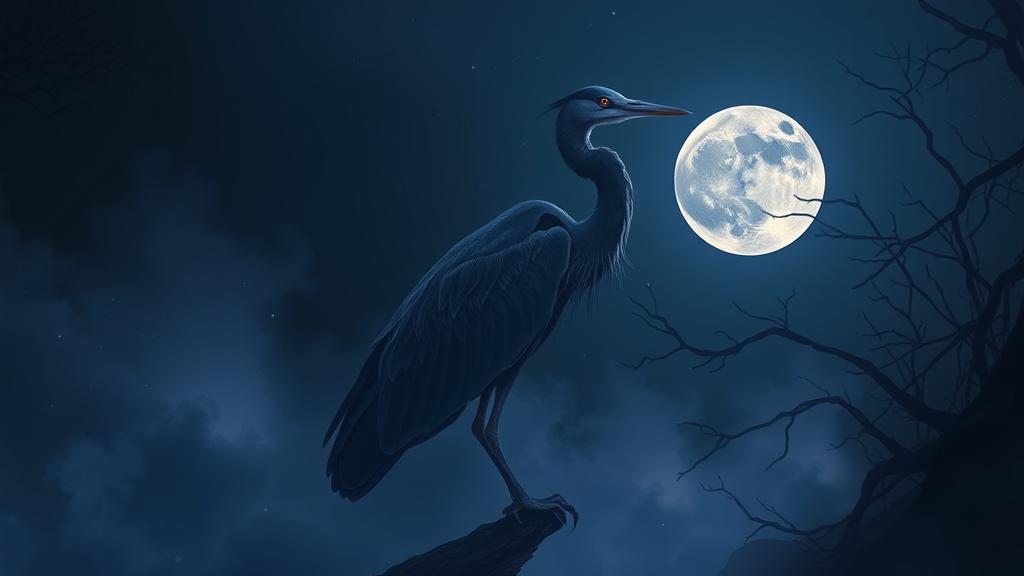
A heron dream is easy to read as a dream about doing nothing: a bird standing in water, a symbol of passivity. Look closer at the bird: the heron isn’t idle. It stands at the edge of the water at exactly the place where something will come to it, and when it strikes there is nothing slow about it. What the dream shows is stillness with intent. Not dread, not wonder exactly. Something quieter. A question the bird isn’t answering yet.
A heron in a dream most often points to a patience you’re being asked to practice, a solitude you’ve chosen or had chosen for you, or an intelligence that works by staying still rather than moving fast. The water it’s standing in matters as much as the bird.
The heron’s particular kind of stillness
Most birds in dreams move. They swoop or flee or land and leave. A heron stays. That’s the first and most insistent fact about this symbol, and it’s what separates heron dreams from dreams of other birds such as a talking bird, where speech and communication dominate the scene. The heron stands at the edge of water. Always the edge. Never the middle, never the dry centre of a field. That liminal position, between water and land, between known and unknown territory, is precisely where the heron does its work. Your mind chose this bird because you are, right now, at some kind of edge. A decision pending. A wait you haven’t finished yet. A piece of patience that’s costing you more than you expected.
Heron watching the water
The heron is still and the water moves: you’re watching a situation develop that you can’t control, waiting for the right moment to act. The patience here is strategic, not passive. Something is about to surface.
Heron taking flight
A heron launching from the bank is a different dream entirely. Movement after waiting. What looked like stillness was actually readiness, and now that preparation cashes out. People often wake from this version with a decision already made.
What the water tells you
Carl Jung would say the water is the unconscious, and the heron’s position above it is the part of you that watches your own inner life without flinching. I’m cautious about applying that framework too mechanically, but on this particular image it lands cleanly. The heron doesn’t wade. It doesn’t dive. It observes from a precise altitude, and when it strikes it’s fast and unerring. A grey or still pond reads differently from a river in flood. Still water next to a heron dream usually suggests clarity available, if you can hold the patience. Turbulent water suggests the situation you’re watching is more volatile than it appears from where you’re standing. The bird’s composure in both cases is the point.
The solitude question
Herons are alone in most dreams. Occasionally you get a pair, more rarely a colony, but the dream heron is usually solitary, and that solitude is the second major register this symbol uses. It’s not loneliness in any simple sense. The dream rarely carries sadness. It carries something more ambiguous: a sense of being separate from the current of things without being miserable about it. A slug shares the slowness, though not the composure: it is exposed where the heron is poised. Anton Revonsuo’s work on threat simulation theory argues that many dream animals are there because our minds are rehearsing responses to danger. Herons don’t quite fit that frame. They’re not threatening and they’re not threatened. They just stand there. Revonsuo would maybe say this is the brain simulating a period of watchful waiting rather than active threat, which sounds exactly right.
What Artemidorus made of wading birds
Artemidorus, the second-century Greek whose Oneirocritica insisted that the same dream means different things for different dreamers, would have asked what the dreamer does for a living. A long-legged water bird sits well with someone whose work rewards patience, a fisher, a farmer, someone waiting out a legal dispute, and less well with someone who needs speed. In many stories, the long-legged water bird carries the same freight: deliberateness, foresight, a knowledge of tide and season that makes others impatient. The heron is also easy to associate with places between worlds. Marshland. The estuarine edge. Borders that aren’t quite either shore. That’s why the dream heron can feel eerie even when it’s not threatening: you’re being shown a liminal place, and the bird is your guide to it, or possibly it’s the place itself made animal.
When the heron is watching you
In some versions the heron turns and looks directly at you. This is the version that tends to stay. You’re the one being observed now. The heron’s yellow eye is on you and it doesn’t look away. A dog attacking is a totally different kind of animal attention, urgent and destabilising. The heron’s gaze is almost the opposite: still, diagnostic, without judgement. It feels like being seen rather than threatened. It can feel like the part of you that watches yourself has suddenly externalised. Turned around. Has a face now. That version of the dream, I think, is the most useful one to sit with.
The heron isn’t struggling with the waiting. It is just the waiting, which is why the dream can be so useful during a long professional wait, a stalled application, a slow recovery. It doesn’t teach you to master the wait. It lets you recognise it.
- What edge was I standing at, and was I at peace there or restless?
- Was the heron watching me, or was I watching it? Which of us felt more settled?
- What in my waking life am I currently waiting for without acknowledging the wait?
- If the water was turbulent or clear, what situation in my life does that water resemble?
Quick answers
What does it mean to dream of a heron?
A heron in a dream most often points to patience, strategic stillness, and liminal awareness. It’s the part of you that watches a situation carefully before acting. The water the heron stands in, and whether it’s still or moving, shapes the meaning considerably.
Is a heron in a dream a good sign?
Generally yes. It tends to arrive during waiting periods and suggests that the waiting itself is purposeful rather than wasted. If the heron is calm, the dream is usually asking you to trust a slower process. If the heron is agitated or fleeing, something may need your attention sooner.
What does it mean when the heron flies away in a dream?
A heron taking flight often marks the end of a waiting period. It can feel like permission: whatever you’ve been holding still for, you can move now. People sometimes wake from this version with unusual clarity about a decision they’d been postponing.
Why does the heron feel eerie in some dreams?
Because of its liminal position, always at the edge between water and land, the heron can carry an uncanny quality. It’s a creature of in-between places, and when you dream it you may be registering that you’re in an in-between place yourself. Not bad, but unsettled.
Sources for this reading
- Revonsuo, A. (2000). The reinterpretation of dreams: An evolutionary hypothesis of the function of dreaming. Behavioral and Brain Sciences, 23(6), 877-901.DOI
- Jung, C. G. (Ed.). (1964). Man and His Symbols. Doubleday.
- Artemidorus of Daldis (2nd century CE). Oneirocritica. English edition: Harris-McCoy, D. E. (2012). Artemidorus’ Oneirocritica: Text, Translation, and Commentary. Oxford University Press.
Full bibliography on Sources and method. Found a mistake? Tell us and see the corrections log.