- Tradition
- Psychological readingAnimal dreams
- Also read in
- The BibleSame symbol, other tradition
- Draws on
- Revonsuo
- Reviewed
- 4 min read
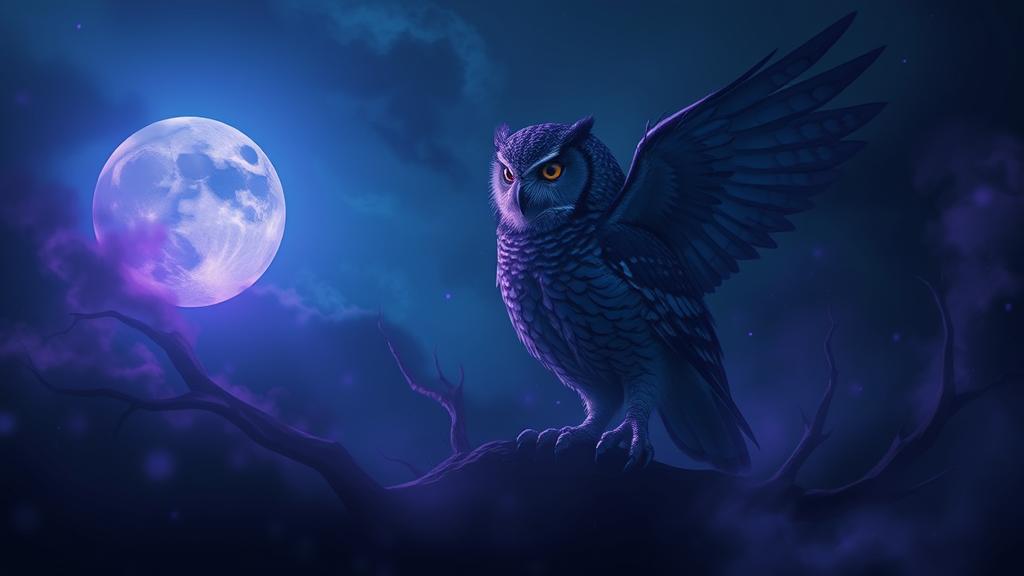
An owl sits perched at the edge of the dream, and while everything else moves, it does not. Slowly it rotates its head toward you, with the look of something that has already made up its mind. You aren’t threatened. You feel seen. That is what an owl in a dream seems to say: you’d know if it was important. You do know. The owl’s presence is the announcement that knowing has already happened, somewhere below the level you’ve been paying attention to.
What the owl carries that other birds don’t
Most bird dreams are about movement, direction, escape. Owls are almost always still. They sit. They rotate toward you. This is not an aggressive gesture in the dream, and it’s not passive either. It’s judicial. The owl in a dream feels like something that has already made up its mind.
The stillness is the message, actually. When everything else in a dream is in motion and there’s an owl perched and watching, your mind has installed a fixed point. A reference. Something that isn’t confused by the surrounding activity. Ask yourself what was in motion in the dream and what the owl was facing: that contrast is doing most of the interpretive work.
A Jungian reading would put this in the category of the wise old figure, an archetype representing insight that the dreamer hasn’t yet integrated consciously. It’s not a flattering reading, necessarily. It implies a gap between what you already know at some level and what you’re willing to act on. Owls have a talent for making that gap visible.
Which kind of owl dream did you actually have
The tradition is older than Athena
The owl’s association with wisdom runs across cultures in a way that’s genuinely striking. Ancient dream readers were already treating the owl as a figure of ambivalence, capable of meaning wisdom or a difficult revelation, depending on context. That two-sided quality is exactly right. Wisdom isn’t comfortable. It’s accurate.
In many other traditions the owl was a death omen, and that reading isn’t without basis either. It’s just that death in dream symbolism usually means transformation, the end of one version of a situation, not a literal forecast. An owl appearing at a crossroads in your life isn’t predicting the worst. It’s marking the fact that you’re at a crossroads.
What Revonsuo might say, and why that’s not the whole story
Revonsuo’s threat simulation theory holds that dreams rehearse our responses to threats. It’s a useful framework for nightmares, for chase dreams, for all the versions where something is actively after you. With owls, though, the theory feels incomplete. The owl in these dreams isn’t a threat rehearsal. It’s something closer to an audit. Your mind reviewing what it knows, before it has to use the knowledge.
Other animals set off the owl’s stillness. A giant snake is about something that has grown too large to avoid, which is often what the owl is silently pointing at. A cheetah is speed and full commitment, the opposite of the owl’s fixed watching. And a herd is the group in motion, where the owl is the lone figure that stays put.
You already know
You’d know if it was important. Maybe the more accurate version is: you already know. The owl in the dream isn’t the knowing itself. It’s the part of you that’s tired of the gap between what you know and what you’re doing about it.
I don’t always find that reassuring, honestly. Sometimes the owl in the dream looks at you and you wake up with this specific feeling of being caught mid-avoidance. Which is not comfortable, but it’s real. A feeling counts as data, and the owl is that data given a body.
- Was the owl still or in motion, and what was fixed versus moving around it?
- What do I already know that I’ve been treating as uncertain?
- If the owl delivered a verdict, what would I most expect it to say?
- Am I afraid of what clear sight would cost me right now?
One symbol, two traditions
The two schools are not reading the same book: psychology asks what owl is doing in your waking life, while the biblical tradition tests the image against Scripture and leaves the meaning with God.
An owl in a dream usually represents knowledge or judgment that’s already present but hasn’t been fully acknowledged. Unlike birds that signal movement or escape, owls in dreams are typically still and watchful, pointing at…
You are reading this oneNo. That association comes from Greek tradition (the owl as Athena’s symbol), not Scripture. The Bible never uses the owl as a wisdom symbol. Its appearances in the Hebrew text are almost entirely in desolation contexts: ruins…
Read the biblical meaning →Quick answers
What does it mean to dream of an owl?
An owl in a dream usually represents knowledge or judgment that’s already present but hasn’t been fully acknowledged. Unlike birds that signal movement or escape, owls in dreams are typically still and watchful, pointing at something your mind has already assessed.
Is an owl in a dream a bad omen?
The omen tradition is old but partial. Owls were associated with death and difficult news in many cultures, but in dream interpretation the meaning tends to be more about transformation and clear sight than literal threat. A frightening owl dream is worth examining, but not because the bird is malign.
What does it mean when an owl speaks to you in a dream?
A speaking owl is delivering a verdict your mind has been working toward. Whatever it said, or the feeling it communicated, is the message your deeper awareness has assembled. Write it down exactly as you remember it.
Why do I keep dreaming about an owl watching me?
Recurring owl dreams usually mean a gap between what you know and what you’re acting on hasn’t been closed yet. The owl is a fixed point your mind keeps returning to. It tends to stop appearing once the knowledge gets integrated into your decisions.
Sources for this reading
- Revonsuo, A. (2000). The reinterpretation of dreams: An evolutionary hypothesis of the function of dreaming. Behavioral and Brain Sciences, 23(6), 877-901.DOI
Full bibliography on Sources and method. Found a mistake? Tell us and see the corrections log.