- Tradition
- Psychological readingAnimal dreams
- Also read in
- The BibleSame symbol, other tradition
- Draws on
- Revonsuo, Artemidorus
- Reviewed
- 5 min read
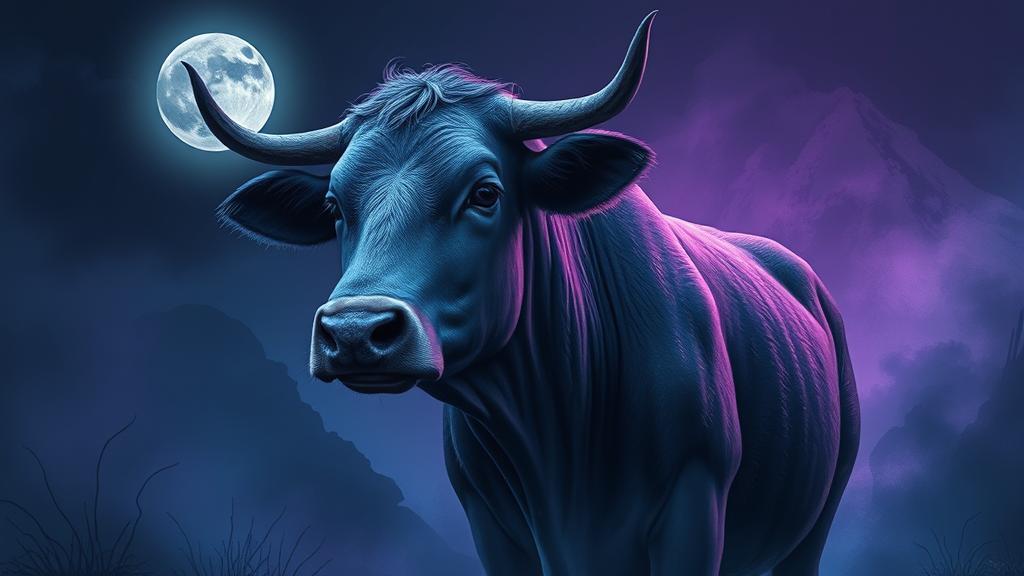
One of the oldest dreams on record is a cow dream. In Genesis 41, Pharaoh dreams of seven fat cows and seven thin ones, and the thin ones eat the fat. The image still works because the logic is simple: the cow’s condition mirrors the dreamer’s material circumstances. That is why a cow in a dream is rarely about the cow. It’s about what is being given, what is being taken, and whether the source of nourishment is holding up.
The oldest version of this dream
The cow is not a modern symbol. It might be one of the oldest dream images with a documented interpretive tradition. Dream books of the ancient Near East sorted dreams into good and bad omens, the Chester Beatty papyrus from around 1200 BC among them, and the logic of reading an animal’s condition as a mirror of the dreamer’s fortune is consistent with what every culture since has done. Fat cows mean abundance. Thin cows, or cows that scatter, mean disruption. Pharaoh’s dream uses exactly this grammar, and the fact that the image still works says something about how deep this particular animal runs in the human psyche.
| Tradition | How it reads the symbol |
|---|---|
| Ancient Egypt / Near East | The Chester Beatty papyrus (about 1200 BC) sorts dreams into good and bad omens, and Pharaoh’s cattle in Genesis 41 show the same grammar: the animal’s condition is a mirror of material fortune. Fat, healthy cattle signal abundance; thin or sick cattle signal scarcity. |
| Vedic and Hindu tradition | The cow is sacred in these traditions because it sustains without taking: it gives milk, fuel, labor. For a dreamer who holds that view, a cow in a dream would naturally carry the principle of nourishment itself, and a calm, well-fed cow would be a good sign. |
| Artemidorus (2nd c.) | He held that the same dream means different things for different dreamers, depending on age, status and occupation. A cow reads differently for a farmer, whose livelihood it is, than for someone in a city who has only seen one from a train window. |
| Jungian / depth psychology | A Jungian reading would place the cow in the territory of the mother archetype: the sustaining, patient, non-dramatic feminine principle. A cow in this reading isn’t weak; it’s the kind of strength that doesn’t assert itself. The shadow side is the cow as something that has been over-milked, given too much for too long, and is now hollowed out. |
What the cow is giving, and whether you’re taking too much
Many cow dreams turn on one central question: is the animal giving freely, or is something being taken from it? These are not the same dream. A cow that gives milk readily, that is calm and full and unbothered, is one of the warmer images the sleeping mind can produce. It tends to appear when a reliable source of nourishment in your waking life is doing its job: a relationship, a creative practice, a source of income, a way of being cared for. The dream isn’t saying “look how lucky you are.” It’s just confirming what you already half-know but haven’t stopped to appreciate.
The other version is harder. A gaunt cow, a cow being over-milked, a cow lying down that won’t get up. A Jungian reading of the sustaining feminine would take this as an image of depletion, something in your life that has been giving without replenishment for too long. This version is often recognized immediately, without wanting to be. The source of sustenance you’ve been relying on has been quietly running dry. The dream just says it without diplomacy.
When the cow moves toward you
A cow approaching, especially a large bull or a herd in motion, shifts the register entirely. Revonsuo’s threat simulation theory is relevant here not because a moving cow is necessarily a nightmare image, but because the body’s response to large animals approaching is pre-linguistic. Your nervous system has an opinion before your mind does. If the movement felt benign, almost ceremonial, you may be dreaming about something large and nourishing coming into your life. If the approach felt threatening, the dream is probably rehearsing a confrontation with something you’ve been stepping around.
Dreaming of a puma shows what happens when a large animal carries pure threat without this sustaining undertone. And if the animal in your dream seemed to be communicating something, almost asking to be heard, dreaming of a talking bird is the closer match, since it is about what the mind does when it puts speech in an animal’s mouth.
The cow in the field again
Picture cows in a field beside a motorway, three in the afternoon, pale November light. They aren’t doing anything. They’re just standing, the way cows do, which is a kind of presence that has no agenda in it. What restores, in the sight of them, is the complete absence of performance. Nothing to prove. Nothing to accomplish in the next ten minutes. Just presence in the weather. I don’t know if I’d call that enviable, but I’d call it honest. And sometimes a cow dream is doing exactly that: arriving to remind you what unhurried and unperforming actually looks like. Not passivity. Not defeat. Just the quality of standing in your own field without apologizing for the fact that you’re a cow.
If fleas or small parasites were part of your dream and the cow appeared alongside that sense of something draining energy rather than providing it, dreaming of fleas is the dream logic of that specific kind of slow extraction.
- Was the cow giving freely or being depleted? That’s the central reading.
- What in my waking life has been a reliable source of sustenance that I’ve stopped noticing?
- Is there something I rely on that might be running dry without my having acknowledged it?
- Was the feeling of the dream abundant, ceremonial, or quietly sad?
One symbol, two traditions
The disagreement is honest: one school sees cow as self-communication, the other as an image to be discerned against Scripture. They can inform each other, but they do not merge.
A cow in a dream usually signals nourishment, patience, or sustenance. The condition of the animal shapes the interpretation: a healthy, calm cow points toward abundance and reliable provision in your waking life, while a gaunt…
You are reading this oneThe Bible contains the only ancient dream-interpretation of a cow that we can actually name: Pharaoh’s seven fat and seven lean cattle in Genesis 41, interpreted by Joseph as seven years of plenty followed by seven years of…
Read the biblical meaning →Quick answers
What does it mean to dream of a cow?
A cow in a dream usually signals nourishment, patience, or sustenance. The condition of the animal shapes the interpretation: a healthy, calm cow points toward abundance and reliable provision in your waking life, while a gaunt or depleted cow often reflects something you depend on that’s been running dry.
Is dreaming of a cow good or bad?
In most traditions, a healthy cow is one of the more auspicious images a dream can offer. The dream only turns difficult when the animal is depleted or threatened.
What does it mean to dream of a cow attacking?
A cow charging or behaving aggressively shifts the image from sustenance to force. This version often surfaces when something you’ve relied on or taken for granted has reached its limit and is pushing back. The gentlest interpretation is that a source of patience in your life has run out and is no longer willing to absorb what’s being asked of it.
Why is the cow sacred in some traditions?
The cow’s sacredness in Hindu and some ancient traditions comes from the same quality that makes it powerful as a dream symbol: it gives without aggression or drama. Milk, labor, fertility, fuel, all offered by an animal that asks for very little in return. To dream of a sacred cow is to encounter that principle of unconditional provision, which can be comforting or quietly confronting depending on your relationship to receiving.
Sources for this reading
- Revonsuo, A. (2000). The reinterpretation of dreams: An evolutionary hypothesis of the function of dreaming. Behavioral and Brain Sciences, 23(6), 877-901.DOI
- Artemidorus of Daldis (2nd century CE). Oneirocritica. English edition: Harris-McCoy, D. E. (2012). Artemidorus’ Oneirocritica: Text, Translation, and Commentary. Oxford University Press.
Full bibliography on Sources and method. Found a mistake? Tell us and see the corrections log.