Animal Dreams
Dreaming of a Whale: The Weight That Holds You Down and Lifts You
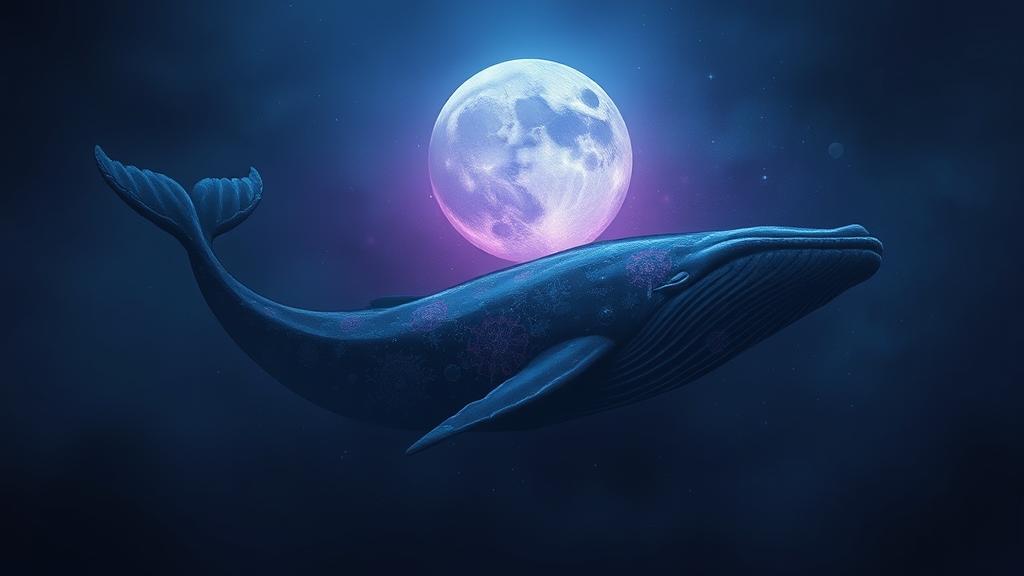
A grey shape moving under the water. Not fast, not threatening. Just massively, irreversibly there. That’s the image most people bring me when they dream of whales. Not a leap. Not a beaching. Just the slow passing shadow of something larger than anything they’ve seen move.
The scale is the message, I think. When your sleeping mind reaches for a whale, it isn’t reaching for a fish. It’s reaching for the largest living thing it can locate, and then it puts that thing just below the surface where you can only partly see it. Whatever this dream is about, it isn’t small. A lot of dream animals sit comfortably in the middle range: nervous, domestic, quick. Fleas, dogs, birds. The whale operates in a completely different register. It’s slow, it’s ancient in feeling, and it seems to belong to a part of the ocean that has nothing to do with what’s happening on the surface. That quality of depth is usually what the dream is pointing at. Not what’s visible in your life right now. What’s underneath it.
| Tradition | How it reads the symbol |
|---|---|
| Polynesian traditions | Whales as navigators and ancestors, creatures who know routes across vast and trackless water |
| Old Norse and North Atlantic | The whale as harbinger, its appearance before a voyage read as either blessing or warning depending on direction and behavior |
| Christian allegorical tradition | Jonah’s whale as the belly of crisis, the place you go before transformation, not after it |
| Artemidorus (2nd c.) | Large sea creatures in dreams as images of overwhelming force: the dreamer faces something that cannot be fought head-on |
| Jung and depth psychology | The sea as the unconscious itself; anything that rises from it represents content pressing upward from beneath the surface of awareness |
The shape on the frosted glass
There’s a type of interior window you find in old office buildings, frosted glass in a wooden frame, where you can see that someone is on the other side but can’t make out their features. Just a shape. Just presence. That’s how I think of the whale in dreams. It’s not hidden. It’s moving right there, right below you, and you can see its outline perfectly. But it’s in another medium. You can’t touch it. You’re not sure it knows you’re there. And its sheer size means that even its unhurried passing changes the water around you. A colleague once described a whale dream to me in a waiting room, in a low voice, like he was confessing something. He’d been carrying a piece of grief for about two years that he hadn’t named aloud to anyone. The whale in his dream had surfaced once, exhaled, and gone back down. He woke feeling certain it had seen him. I don’t have a tidy interpretation for that. I just think the scale was right. For those who also dream of a spider at work on its web, there’s a different but related image at play: patient construction of something enormous from something tiny. The whale moves in the opposite direction. It’s already enormous. It doesn’t build. It just arrives.
What the whale is usually carrying
I’m wary of single-meaning interpretations, especially for animals this culturally loaded, but the emotional payload of the whale dream is strikingly consistent. People report it during: large transitions they’ve been intellectually prepared for but emotionally haven’t caught up with. Grief of the prolonged, undramatic variety. Creative or professional work that feels too big to start. A relationship whose scale has become apparent. Antti Revonsuo’s framework for threat simulation is useful here in an unexpected way, because the whale isn’t always a threat. But the dreaming brain uses threat-rehearsal circuits for any emotionally significant simulation, including things that are enormous and wonderful. The whale might be terrifying in the dream, or it might be magnificent. Either way, the brain assigned it to the “this matters enormously and I need you to pay attention” register. And Carl Jung, who treated the ocean as a fairly reliable symbol of the unconscious, would say the whale is simply what rises when something important has been deep long enough and needs to surface. I’m usually reluctant to accept Jungian readings wholesale, but for a dream this specifically structured around depth and emergence, it holds.
If it breached
A beaching or a breach changes the dream’s register entirely. A whale that surfaces, leaps, or comes aground is no longer a quiet presence. It’s an eruption. Something large and submerged has come fully into the open. This version of the dream tends to arrive around revelations, whether your own or someone else’s. A truth that had been staying under. People who dream of a puma appearing suddenly sometimes describe a structurally similar shock: the moment when something powerful stops being background and becomes fully present in front of you. The puma is quicker, sharper-edged. The whale is slower and more final. The breach feels irreversible in a way that the puma’s appearance doesn’t.
What I’ve noticed in the letters
Almost everyone who writes to me about a whale dream mentions the sound first. The way it moved the water. The way they could feel it before they saw it. That’s worth paying attention to in its own right, because the dream didn’t give you an image. It gave you a physical sensation. Whatever this large thing is in your life, it’s not just intellectual. You feel its displacement. The talking bird dream works in the opposite register: small, verbal, insistent, arriving with a message in language. The whale arrives without language at all. It doesn’t explain itself. It moves, and you’re changed by its having passed.
- Was the whale beneath the surface, at the surface, or beached? Each changes what has surfaced and how far.
- Did it feel threatening, awe-inspiring, or something harder to name?
- What is the largest thing in your life right now that you’ve been treating as manageable background?
- Did the whale seem aware of you? That detail often points to whether the large thing in your life knows you’re there too.
One symbol, two traditions
Read side by side, the two traditions pull in different directions: whale as a signal from your own mind, or whale as an image to test against the text. Knowing which question you are asking is half the interpretation.
A whale in a dream carries enormous emotional weight. Explore what it means when this vast creature surfaces in your sleep and why it's rarely a small message.
You are reading this oneJonah and the great fish is the Bible's most vivid story of scale and containment. Here is what Scripture actually says and what your whale dream might mean.
Read the full biblical meaning →Quick answers
What does it mean to dream of a whale?
A whale in a dream tends to represent something enormous in your emotional life: a grief, a transition, a creative undertaking, or a truth you’ve been keeping at depth. The whale’s scale is the message. Whatever this is, your mind is telling you it’s not small.
Is a whale dream a good or bad sign?
It’s rarely either in a simple sense. The whale is almost always significant rather than positive or negative. It points at magnitude. Whether that feels like a gift or a weight depends on what the large thing in your waking life actually is.
What does it mean if the whale surfaces or breaches?
A breach or surfacing tends to signal that something long submerged is coming into the open. A truth, an emotion, an unspoken thing. The breach usually feels irreversible in the dream, and that irreversibility is part of the message: this is no longer something you can keep below surface.
Why do I dream of whales during grief?
Grief has a whale-like quality: vast, moving in deep water, present even when not visible. The dreaming mind often reaches for scale-appropriate images. A whale during grief isn’t a bad sign. It’s the mind finding a container large enough.