- Tradition
- Biblical reading
- Also read as
- PsychologySame symbol, other tradition
- Scripture
- Jonah, Matthew, Job, Genesis
- Reviewed
- 4 min read
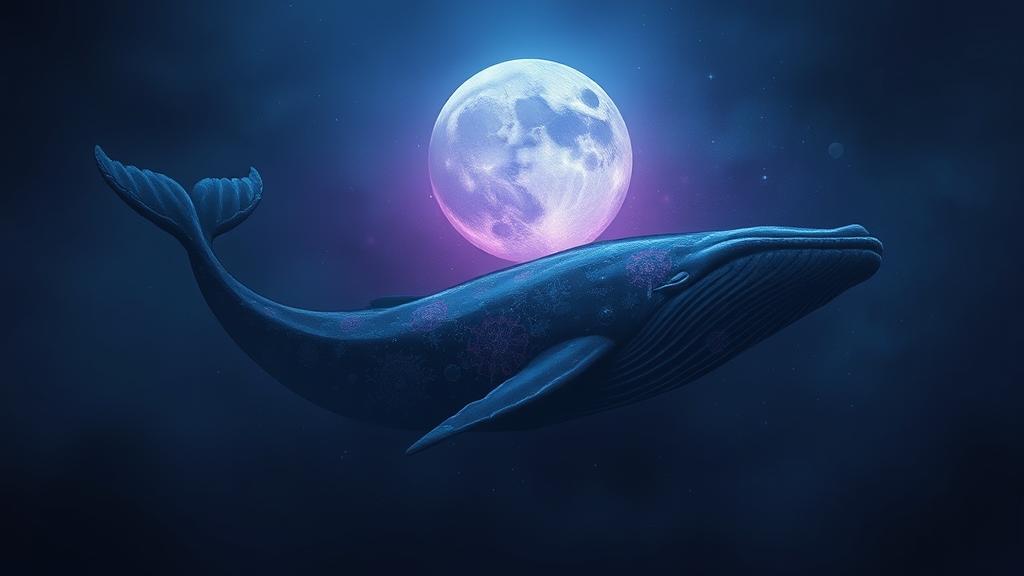
Imagine the moment just after Jonah hits the water. The storm calms because he asked to be thrown in. He’s sinking. And then something else happens. Something comes from below that is larger than the storm, larger than the sea floor he was falling toward, and it swallows him whole. The narrative doesn’t linger on the horror of that. It moves straight to three days in the belly, then a prayer, then a vomiting out onto dry land. Scripture treats this as a rescue story.
That interpretive choice is important for a whale dream. The popular imagination fills Jonah’s experience with terror. The biblical text makes it a container for prayer and return. The question for your dream is which reading applies.
What the Bible actually says about whales and the great fish
The Hebrew in Jonah 1:17 says ‘a great fish.’ The KJV uses ‘a great fish’ there and ‘whale’ in Matthew 12:40, where Jesus says: “For as Jonas was three days and three nights in the whale’s belly; so shall the Son of man be three days and three nights in the heart of the earth” (KJV). Whether the creature is technically a whale or another great fish is a long-running question in biblical scholarship. For the theological meaning, it doesn’t matter: what matters is the three days, the interior of the earth, and the coming out.
- Jonah 1:1-3
Jonah receives a call to Nineveh and immediately books passage in the opposite direction. The flight is the setup for everything that follows.
- Jonah 1:17
The great fish swallows Jonah. Three days and three nights. This is the hinge point of the story.
- Jonah 2:1-10
Jonah prays from the fish’s belly, using the language of Psalms. He’s not freed by the prayer; he’s praying from within the containment.
- Matthew 12:40
Jesus cites the three days in the whale’s belly as a sign of his own burial and resurrection, giving the Jonah story its largest possible meaning.
- Job 41:1-10
The Leviathan, a creature of the deep that cannot be caught or tamed by human beings, demonstrates the limits of human power over the ocean and its inhabitants.
Job 41 gives another angle: the Leviathan, a sea monster or great creature of the deep, is presented to Job as an argument for God’s authority over what humans cannot control. “Canst thou draw out leviathan with an hook?” God asks Job at the beginning of the Leviathan speech. The implied answer is no. The ocean’s great creatures belong to a category of things over which human dominion simply doesn’t extend.
Genesis 1:21 also places whales in creation: “And God created great whales, and every living creature that moveth.” The word is ‘tanninim,’ sometimes translated as sea monsters, and they’re created on the fifth day alongside every creature of the sea. They’re not aberrations or threats to the created order. They’re part of it.
Reading the whale dream through the Jonah frame
The Jonah pattern is specific enough to be genuinely useful for a dream reading: a calling avoided, an enormous containment, a period of darkness and prayer, and an expulsion back toward the original vocation. If any part of that sequence resonates with your waking life, the biblical frame offers language for it.
Jonah’s prayer in chapter 2 is striking because he prays it while still inside the fish. He doesn’t pray for rescue first. He prays in gratitude and from commitment, and then the rescue comes. The biblical order there is worth noticing: the inside of the whale isn’t the place you wait to leave before you pray. It might be precisely the place where prayer becomes possible.
If the whale in your dream felt overwhelming or inescapable, the Jonah story gives you a frame for seeing that containment differently. Not as the end of the story but as the middle of it. Not as punishment but as the thing that carries you when you can’t carry yourself.
The secular dreaming of a whale article handles psychological readings of whale dreams, which tend to emphasize immensity, depth, and the unconscious. Those observations pair naturally with the Jonah frame. If it was the scale of the sea that struck you, the biblical meaning of the ocean in dreams reads that vastness and what God holds back, the water the whale lives in. And if you were sinking before anything swallowed you, the biblical meaning of drowning in dreams covers that moment, which is where Jonah’s story begins.
Within the tradition, readings vary. Some interpreters focus on the terror of the whale as a symbol of spiritual darkness or trial. Others stay with the resurrection typology that Jesus establishes in Matthew 12:40 and read the whale as a figure for death-and-return rather than for threat alone. The text supports both, and both are honest.
- What have you been running from in your life that might be connected to the whale’s appearance?
- Is the inside of the whale in your dream a place of prayer or a place of panic, and what would it mean to pray from inside it?
- What is the Nineveh in your life right now, the place you’ve been going the other direction from?
- If the whale is carrying you rather than trapping you, where might it be depositing you?
One symbol, two traditions
Read side by side, the two traditions pull in different directions: whale as a signal from your own mind, or whale as an image to test against the text. Knowing which question you are asking is half the interpretation.
A whale in a dream tends to represent something enormous in your emotional life: a grief, a transition, a creative undertaking, or a truth you’ve been keeping at depth. The whale’s scale is the message. Whatever this is, your…
Read the psychological meaning →Yes. Genesis 1:21 places great sea creatures in the original creation as part of God’s good order. Jonah 1:17 makes a great fish the central vehicle of one of Scripture’s key rescue and vocation stories. Jesus cites it explicitly…
You are reading this oneQuick answers
Is a whale dream a message from God?
Joel 2:28 says God can speak through dreams, and the whale carries some of the most theologically loaded imagery in Scripture, from Jonah’s vocation-and-return arc to Jesus’s use of it as a resurrection sign in Matthew 12:40. But Ecclesiastes 5:7 and Jeremiah 23:25-28 both counsel testing dreams carefully rather than treating them as prophecy. Bring it to prayer and ask what the Jonah pattern might illuminate in your waking life.
Does the Bible say whales are significant?
Yes. Genesis 1:21 places great sea creatures in the original creation as part of God’s good order. Jonah 1:17 makes a great fish the central vehicle of one of Scripture’s key rescue and vocation stories. Jesus cites it explicitly in Matthew 12:40 as a sign pointing to his own burial and resurrection.
What does it mean to be swallowed by a whale in a dream?
The Jonah story reads this as containment before redirection rather than destruction. The three-day pattern Jesus identifies as resurrection-shaped. If you’re dreaming of being swallowed, the biblical question is: what were you running from, and where might you be heading after you come out?
Is a whale in a dream a sign of spiritual danger?
Not straightforwardly, given the Jonah text. The great fish is the thing that saves Jonah from drowning, not the thing that endangers him. His danger was the storm and the sea. The fish is the providential container that delivers him intact. The scale can be frightening without the intent being harmful.
Sources for this reading
- The Holy Bible, King James Version (1611). Public domain. Scripture quotations on this site are from the KJV.
Full bibliography on Sources and method. Found a mistake? Tell us and see the corrections log.