Animal Dreams
Dreaming of a Crab: what the sideways creature is really saying
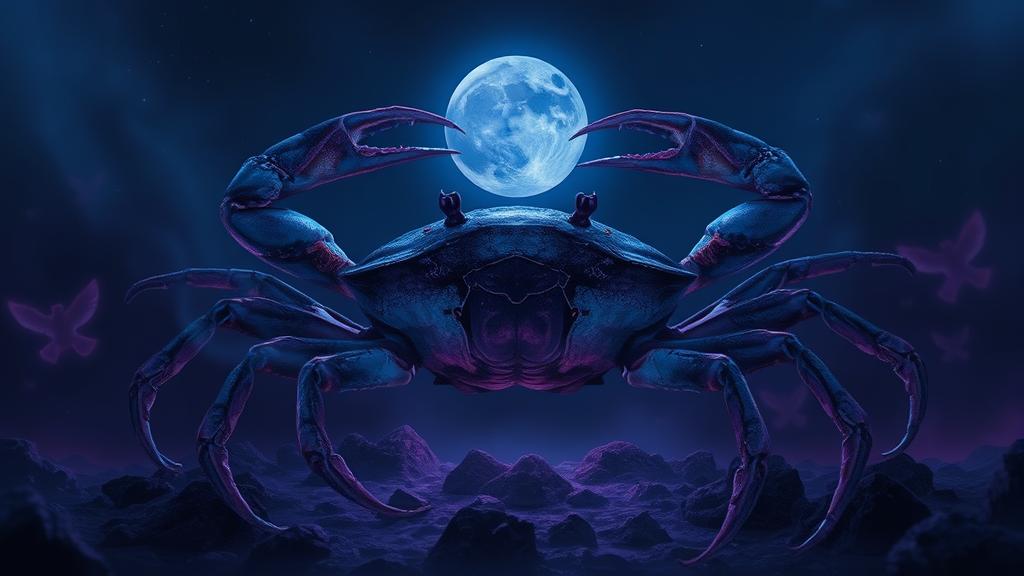
Crabs don’t walk toward things. That’s the whole point of them. Every biologist knows it, and somewhere you already knew it too, which is probably why your sleeping mind chose one.
A crab in a dream typically signals a situation or feeling you’re approaching sideways rather than directly, often because a frontal approach feels too exposed. The shell and claws point to protective instincts. The water-edge territory connects the crab to the boundary between what you’ve processed and what you haven’t.
The thing about sideways
I had a colleague once who’d been wanting to leave her job for the better part of a year. Every Friday she’d send me a message about it. Same message, roughly, with different word order. She was circling it. Never walking toward it. When she finally told me she’d had a recurring dream of a crab on a beach, I didn’t say anything clever. I just asked if she recognized the crab’s behavior. She laughed. She put in her notice that week. I’m not claiming the dream gave her permission. But the dream had caught something real: the particular way humans approach things that scare them, which is to say, not directly. A crab doesn’t turn to face what it’s moving toward. It gets there anyway, by a route that keeps its armor toward the threat. There’s a whole strategy in that gait, and when it shows up in a dream, it’s usually a portrait of something you’re doing right now.
Shell and claws: the two things a crab is
The shell and the claws aren’t separate symbols. They’re the same impulse. Protect the soft interior; extend something sharp toward the outside world. Most people who dream of crabs are doing one or the other, sometimes both at once, and the dream tends to weight which one it’s about by what the crab actually does. A crab that pinches you is almost always about something in your life that’s grabbed hold and won’t let go. An obligation, a relationship, a thought pattern. You know the feeling of trying to shake it off. A crab that withdraws into its shell, or that you can’t get close to, tends to run in reverse: you’re the one who’s retracted. A crab moving freely on a beach, going about its business, occasionally leans toward something you’ve accepted and are now living alongside.
Something has latched onto your life and won’t release easily. Look at obligations, relationships, or recurring thoughts that arrive uninvited and stay.
The withdrawal gesture is yours, not the crab’s. You’ve pulled inward somewhere, and part of you is noticing. Not necessarily wrong, just worth naming.
A crab at ease in its own environment often signals a truce you’ve reached with something difficult. The sideways walk continues, but it’s no longer desperate.
Deeper immersion, deeper avoidance. The emotional territory here is less visible to you. Worth asking what you’ve submerged deliberately versus accidentally.
Volume in a dream usually signals scale. Many crabs can mean many small defenses, many small avoidances, or a life organized around not approaching things directly. Uncomfortable but useful to sit with.
A protection you no longer need, or one that outlasted its purpose. Some defenses work until they don’t. An empty crab shell is a skin you’ve shed, or should have by now.
The territory between land and water
Crabs live at edges. That’s not incidental. The intertidal zone, where the beach becomes sea and then beach again, is the oldest symbol of thresholds we have, and dreams tend to know their geography. If the crab in your dream was at the waterline, some part of the image is about an edge you’re standing at: a decision that hasn’t fully landed, a feeling that keeps coming in and going out. Artemidorus, writing in the second century, grouped sea creatures differently than we do now, but he was consistently attentive to what kind of water and what kind of boundary a creature occupied. His logic wasn’t ours, but the instinct to read habitat as meaning still holds. The crab’s particular genius is that it belongs to both worlds and commits to neither.
What Jung would call the armor
Jung wrote about the persona, the outer layer we present, as something that protects and also constrains. The crab’s exoskeleton is the most literal dream image of that idea I’ve encountered. It’s not a mask exactly. It’s load-bearing. The crab can’t live without it. The question is whether you’ve confused the shell for the creature inside. I’m genuinely uncertain whether this reading applies to everyone who dreams of a crab, and I’d be suspicious of anyone who said it always does. But if the dream left you with a feeling of being enclosed, of something pressing in from outside or in from inside, the persona reading is worth holding up to it.
Why Revonsuo doesn’t ruin it
Antti Revonsuo’s threat simulation theory argues that dreaming evolved partly to rehearse responses to danger. A crab, objectively, is a minor threat, but it’s an interesting minor threat: armored, pinching, sideways, hard to predict. A crab in a dream might be the mind running a low-stakes rehearsal of how you handle something that doesn’t come at you straight. That’s not a debunking. That’s actually a useful frame. If the dream is a rehearsal, what is it rehearsing you for? My colleague circling that job she wanted to leave, the dream wasn’t warning her. It might have been the mind’s version of practice for doing something sideways, by an indirect route, wearing enough protection to get there. She got there.
If you’re working through what other animals in your dreams might mean, the piece on dreaming of a panther covers a very different kind of animal energy, and the one on dreaming of many snakes goes into what happens when one creature becomes a multitude. And if the crab felt less animal than symbol, the article on dreaming of an animal transforming might be where the real question lives.
- Was the crab moving toward me or away? That direction is mine too.
- Do I recognize the sideways walk in something I’ve been doing lately?
- Was I afraid of the crab, or did I feel a strange recognition?
- What would it cost to walk directly toward the thing I’ve been circling?
Quick answers
What does dreaming of a crab mean?
It usually signals an indirect approach to something in your life: a situation, emotion, or decision you’re circling rather than facing head-on. The shell points to protective instincts, the claws to something holding you or something you’re gripping, and the crab’s shoreline territory to a threshold you haven’t crossed yet.
Is dreaming of a crab being pinched a bad sign?
Not necessarily bad, but it’s pointed. Something has latched on and isn’t letting go easily: an obligation, a pattern, a relationship that’s taken hold without your full consent. The dream is less a warning than a very specific observation about where you feel caught.
What does it mean to dream of many crabs?
Volume tends to amplify the core meaning. Many crabs usually points to many small defenses or many small avoidances operating at once. It can feel like a life organized around not approaching things directly. Uncomfortable to admit, but worth the discomfort.
Why do crabs appear in dreams about protection?
The exoskeleton is one of the most literal images of the protective persona in dream symbolism. A crab can’t survive without its shell, but it also can’t grow without shedding it periodically. If the dream carried a feeling of enclosure or pressure, that molting cycle is probably what it’s pointing at.