- Tradition
- Psychological readingAnimal dreams
- Also read in
- The BibleSame symbol, other tradition
- Draws on
- Revonsuo, Artemidorus
- Reviewed
- 4 min read
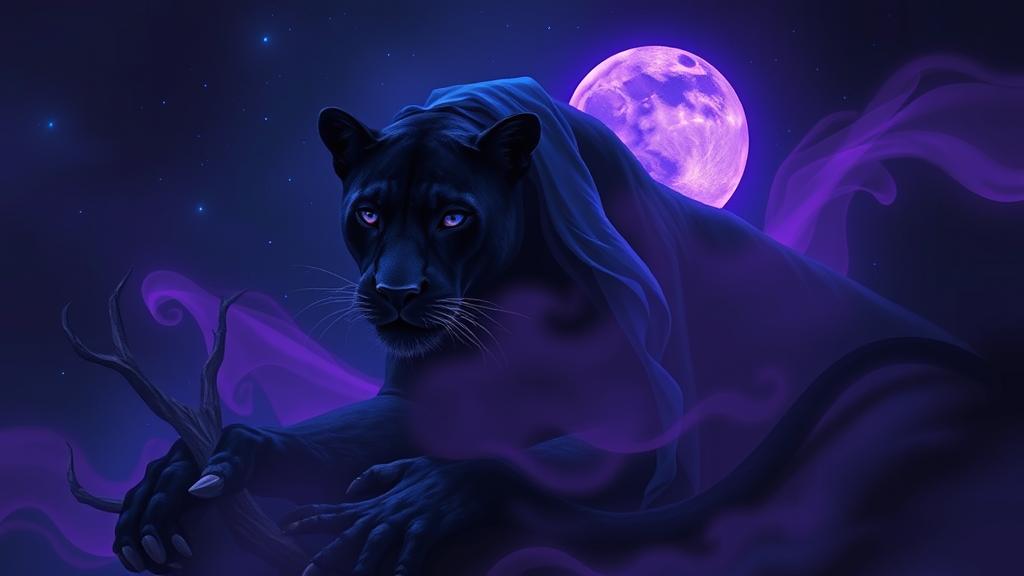
Something is following you through a forest. It is close enough that you can feel the heat radiating off its body, and you keep the same pace: not running, not turning around. Just aware. You aren’t afraid, and that is the part you can’t stop thinking about once you wake. That specific, uncomfortable pocket of not-knowing is exactly where a panther dream wants you.
A panther in a dream usually points to something powerful and largely unconscious moving through your life. Whether it’s hunting you, walking beside you, or watching from a distance shapes the meaning enormously. Fear and fascination in the same dream is the most honest reading of your own shadow.
What the panther is actually made of
The panther isn’t a creature your sleeping mind invented. It’s a distillation. Black coat, near-silence, absolute economy of movement. Every detail your brain selected when it built this animal is a choice, and those choices tell you more than any dream dictionary can. Is it lean or enormous? Moving or still? Curious or focused? The version of the panther your mind cast matters as much as the fact that it cast a panther at all.
What the dream is rarely doing is warning you about an actual predator. It’s much more likely reaching for something that shares the panther’s qualities. Revonsuo’s threat simulation theory argues that dreams rehearse responses to threats, but I think it underpays the possibility that the “threat” is something inside you rather than outside. A force you haven’t faced yet. An energy you haven’t given permission to move.
Six versions and what they usually carry
You’re aware of a powerful force behind you in waking life. The fact that you’re not running is crucial. Are you keeping it at arm’s length, or learning to walk with it?
Height signals authority and perspective. Something is observing your situation with more clarity than you have. It may be your own instinct, not yet trusted.
Not necessarily a nightmare. This version often signals that what’s been stalking you has finally caught up. The confrontation the dream offers is usually the relief, not the danger.
If it walks beside you without threat, you’ve made some peace with a wild part of yourself. Or you’re about to. These dreams tend to follow a decision to stop running from something.
The domestic space invaded by something wild. A desire or drive that refuses to stay outside where you put it. It’s asking to be let into your ordinary life.
Stillness in a predator is its own kind of pressure. This version points to potential energy, something that hasn’t moved yet but will. Anticipation in animal form.
The color black isn’t incidental. The Jungian reading of a black animal appearing in a dream is plain: shadow material. Not evil, not danger, but the parts of yourself you haven’t acknowledged, the traits you’ve left in the dark because they don’t fit how you’ve decided to present yourself. Aggression, ambition, desire, wildness. The panther doesn’t judge them. It just wears them without apology.
The long history of this particular animal
Ancient dream interpretation kept returning to one idea, voiced most clearly by Artemidorus in the second century: the same dream means different things for different dreamers, so the dreamer’s posture counts for more than the species of animal. In that spirit, older readings tended to treat standing your ground before a powerful creature as a good sign and fleeing as a bad one. The moral for predators was simple: how you meet the force matters more than what the force is.
There’s a long line of big-cat symbolism running from the Egyptian goddess Sekhmet to the leopards that attend Dionysus. The panther in particular tends to carry night connotations, and night in symbolic systems almost always means the interior, the hidden, the not-yet-spoken. You can do a lot with that if your waking life has something it hasn’t said out loud yet.
Walking in pace with it
The version where the dreamer walks in pace with the animal, never quite leaving it behind and never quite letting it close, is a near-perfect picture of someone who knows something is following them and has decided to stop pretending otherwise. Not taming it. Not caging it. Just walking. A black cat has the panther’s black coat and its silence at domestic scale, and dreaming of a black cat puts the same shadow material on the windowsill instead of in the forest.
And if the panther in your dream felt genuinely threatening, not exciting-threatening but cold-threatening, a giant snake is the other predator that tends to bring that cold dread: also silent, but arriving low and without warmth. The two animals share a category but almost never the same emotional weather. Pay attention to which kind of dread yours carried, or whether dread was even the right word.
A dream like this rarely announces whether it will stop. What matters is whether the dreamer ever turns around.
- Was I afraid, fascinated, or both? That combination is the most honest signal.
- What quality does a panther have that something in my waking life also has?
- Was the animal behind me, beside me, above me, or in my space?
- What would happen if I quit moving away from it?
One symbol, two traditions
The two schools are not reading the same book: psychology asks what panther is doing in your waking life, while the biblical tradition tests the image against Scripture and leaves the meaning with God.
A panther in a dream usually points to something powerful and largely unconscious moving through your life. Whether it’s hunting you, walking beside you, or watching from a distance shapes the meaning enormously. Fear and…
You are reading this oneNot specifically. The Bible uses the lion as an explicit metaphor for the adversary in 1 Peter 5:8. The leopard appears in prophetic and apocalyptic contexts associated with swift judgment or false authority, but not with Satan…
Read the biblical meaning →Quick answers
What does dreaming of a panther mean?
A panther in a dream most often represents a powerful, largely unconscious force in your life. It can be an instinct, a repressed quality, or a situation that moves silently and inevitably. The relationship between you and the animal in the dream is more revealing than the panther itself.
Is dreaming of a panther a bad omen?
Not inherently. Modern dream work treats the panther as shadow material in a Jungian sense: not evil, but unacknowledged. The dream is an invitation, not a warning.
Why does the panther follow me in my dream?
Following, rather than attacking, is a specific message. Something is keeping pace with you. It’s patient. The dream is probably about something in your life you haven’t faced directly, an impulse, an ambition, or a truth that keeps returning no matter how far ahead of it you walk.
What does a black panther symbolize in dreams?
The color reinforces the shadow quality. In Jungian terms, black animals in dreams tend to carry the qualities we’ve left unlit in ourselves. For the panther specifically, this often means power, desire, or wildness that hasn’t been given room to exist in your everyday life.
Sources for this reading
- Revonsuo, A. (2000). The reinterpretation of dreams: An evolutionary hypothesis of the function of dreaming. Behavioral and Brain Sciences, 23(6), 877-901.DOI
- Artemidorus of Daldis (2nd century CE). Oneirocritica. English edition: Harris-McCoy, D. E. (2012). Artemidorus’ Oneirocritica: Text, Translation, and Commentary. Oxford University Press.
Full bibliography on Sources and method. Found a mistake? Tell us and see the corrections log.