Animal Dreams
Dreaming of a Rat: What Your Mind Is Actually Saying
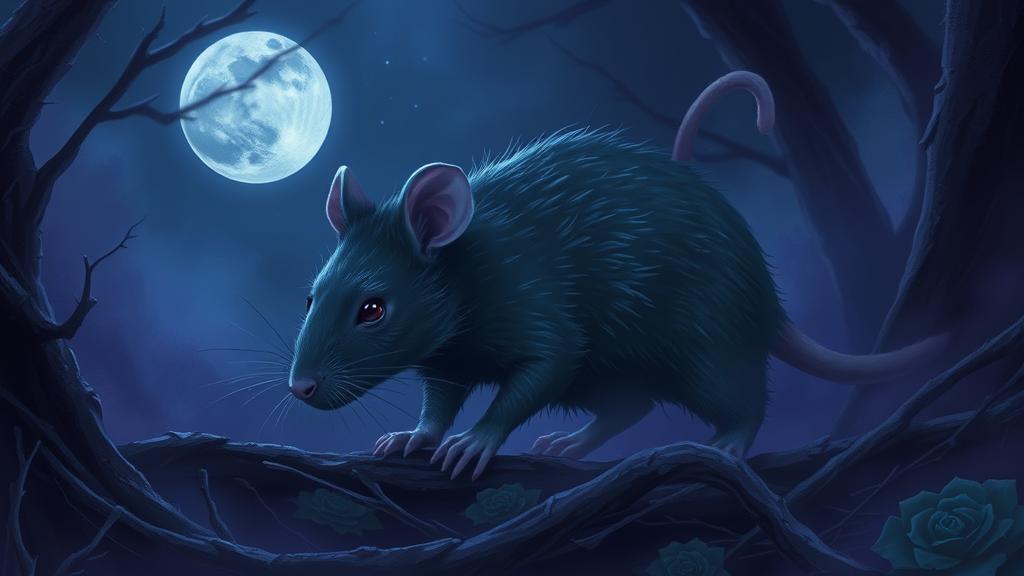
My first flat had rats in the walls. Not many, probably just one, but at three in the morning a single rat sounds like a construction project. You’d lie there tracking it: now near the skirting board, now behind the radiator, now somewhere under the kitchen floor. After a week I stopped being frightened and started being impressed. Whatever it needed, it was getting, in the dark, without my help.
That’s the rat I keep thinking about when people write to me about this dream. Not the sewer rat, not the plague rat, not the thing people recoil from in film trailers. The rat in the wall. The one that knows things you don’t.
A rat in a dream almost never signals filth or disease. It more often points to resourcefulness operating just out of your awareness, something surviving in the hidden margins of your life. Pay attention to what the rat is doing, and whether you fear it or find yourself watching it with reluctant respect.
What the rat is doing in your dream
Context is everything with this symbol. A rat gnawing at something and a rat sitting very still are not the same dream. Most people I hear from describe the rat as moving, watching, or appearing suddenly in a space that should be secure, a cupboard, a bedroom, under the bed. That intrusion quality is the part worth sitting with.
If the rat was gnawing, the dream is almost certainly about erosion. Something small and persistent is eating at something you’ve built, probably something structural: a professional relationship, a financial plan, a confidence you rely on. The gnawing is slow by design. You might not see the damage until one day you press on the beam and it gives.
If the rat was simply there, looking at you, that’s harder to shake but probably less urgent. My honest read of that version: your mind has noticed something and wants you to notice it too. It doesn’t know another way to get your attention.
Something you’re anxious about is moving faster than you can track it. The instinct to follow is worth trusting here, even if you’re not sure what you’re chasing.
A real-world situation is drawing blood in small increments. Less about attack, more about what you’ve been tolerating without naming it.
Possibly the most interesting version. The feared thing has become familiar. You may be in the middle of making peace with something you once wanted gone.
A threat that’s over, or a part of yourself associated with scavenging and survival that you’ve put down. Sometimes relief, sometimes premature relief.
The private self has an uninvited presence. Worth asking what, in your waking life, has got in through a gap you didn’t know was there.
Multiplication of a single anxiety. Less about each individual rat, more about the feeling of being outnumbered by a problem you keep avoiding.
The survival reading
Here’s where I find myself defending the rat. Antti Revonsuo’s threat simulation theory proposes that dreaming exists partly to rehearse responses to danger, that the mind runs threat scenarios in sleep as a kind of practice. Rats are, in this framework, almost ideal dream protagonists. They’re intelligent, they’re adaptive, and they have outlasted nearly every attempt to eliminate them. If your unconscious reaches for a rat, it may be borrowing the animal’s actual qualities.
The shadow in Jungian terms is the part of the self you’ve exiled, the capacities you refuse to own because they feel too opportunistic or too dark. Jung would probably look at a rat dream and ask what it is about the animal that you find disgusting. Then he’d say that’s exactly what you’ve pushed underground. I’m not always sure I agree with the full architecture of that reading, but I’ve heard enough rat dreams to know the question is worth asking.
A note on where this comes from
Artemidorus, writing in the second century, catalogued animal dreams with the systematic cheerfulness of someone who’d heard everything twice. Rats appear in his Oneirocritica mostly as signs of petty enemies and household troubles, small-scale irritants rather than grand threats. I find that historically grounding, not because Artemidorus was right, but because it confirms that humans have been waking from rat dreams for at least two millennia and trying to figure out what they mean over breakfast.
What the rat in your dream probably isn’t
It almost certainly isn’t a literal warning about your physical health, unless you work in a context where rodent exposure is a genuine risk. And it’s not, in my view, primarily about betrayal, though that reading gets repeated everywhere. Rats were associated with betrayal through centuries of cultural sediment, the informer, the snitch, the creature that abandons a sinking ship. But the people who dream of rats aren’t usually dreaming about a person who betrayed them. They’re dreaming about something that got inside somewhere it shouldn’t be.
If you’re looking for dreaming of insects everywhere or another version of that sense of unwanted intrusion, the emotional register overlaps: the feeling of being invaded by something you can’t quite see clearly enough to confront. But rats carry a different weight. They have intentions, or seem to. Insects swarm. Rats move with purpose.
If the rat in your dream felt wrong
There’s a particular version of this dream that people describe as leaving them unsettled in a way they can’t place, the rat that’s too large, or the rat that looks up at you and seems to understand something. I think that’s a related but distinct dream, closer to dreaming of a black snake in its symbolic register: an encounter with something that knows more than it should.
That version tends to arrive when you’re suppressing knowledge you already have. About a relationship, a work situation, a health worry you’ve been circling without landing on. The rat that knows things is your own knowing, wearing the fur of the thing you trust least.
I went back to that first flat once, years later, walked past it on a different errand. The skirting boards were probably fine by then. Probably the rat had long since moved on to somewhere warmer. But I still listened, out of some old reflex, for that sound. Whatever it was doing in there, it had its reasons.
- Was the rat moving toward you or moving around you, indifferent? The direction matters.
- What part of your life has something operating in the margins that you keep not quite looking at directly?
- Did you fear the rat, or find yourself watching it? Your emotional response is the actual message.
- Is there something you know but haven’t said yet, to yourself or anyone else?
One symbol, two traditions
Where the psychological read treats rat as a mirror of your inner state, the biblical tradition treats it as something to weigh, prayerfully, against what Scripture actually says.
Dreaming of a rat? It's rarely about disgust. Nora Vance unpacks what rats in dreams signal about survival, hidden knowledge, and what you already know but won't say.
You are reading this oneMost biblical sites invent meaning for rat dreams. Here's what Scripture actually says , and the honest silence , about rats and mice in the biblical tradition.
Read the full biblical meaning →Quick answers
What does it mean to dream of a rat?
Rats in dreams most commonly point to something resourceful but unwelcome operating at the edges of your awareness. The specific reading depends on what the rat was doing and how you felt about it. Gnawing signals slow erosion; presence alone often signals that your mind has noticed something it wants you to notice too.
Is dreaming of a rat a bad omen?
Historically, yes, in traditions from Artemidorus through folk interpretation. But in terms of what the dream is actually processing, it’s more neutral than that. It often points to survival instincts, things that are quietly managing to persist, which can be a warning or a reassurance depending on context.
What does it mean if a rat bites me in a dream?
Something in your waking life has been drawing blood in small amounts, and you’ve been tolerating it. The bite makes it conscious. It’s less about attack than about accumulated small damage that’s finally registered.
Why do rats appear so often in anxiety dreams?
Rats are expert survivors in marginal spaces. Anxiety tends to live in exactly those spaces: the peripheral worries, the things operating just below the threshold of your full attention. The mind reaches for an animal that matches where the feeling lives.