- Tradition
- Psychological readingAnimal dreams
- Also read in
- The BibleSame symbol, other tradition
- Draws on
- Revonsuo, Jung, Artemidorus
- Reviewed
- 5 min read
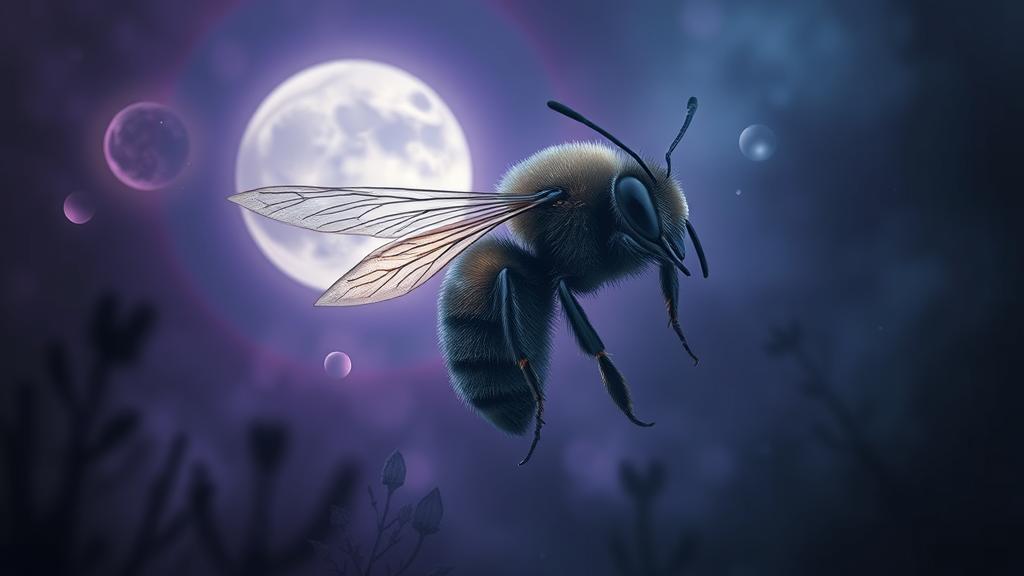
A bee dream tends to get read as a warning: something is about to sting. Except that this version keeps only half the animal. A bee is productive and it can wound you, often in the same moment, and the dream usually leaves it unclear which end is live. A bee settling on a flower and a bee circling your head are not the same dream, and neither one is a prediction.
A bee in a dream usually points to work, contribution, or a threat that carries something worth protecting. Whether you fear the bee or follow it tells you which end of that tension is live for you right now.
What the bee is doing matters more than the bee
The bee flying freely through a dream is a different animal from the one circling your head. One is the world working as it should; the other is a warning you can’t quite name. A bee dream often carries a kind of held breath, a sense that the bee could land or it could sting and the dreamer can’t tell which. That uncertainty is usually the point. Waking life has something like it: a situation with real value that could also hurt you if you move wrong.
The bee that stings you in a dream is oddly clarifying. A lot of dream imagery is soft, open, interpretable five ways. A sting is specific. Something has finally landed. Whether that sting is a consequence you half-expected, a word someone said, or just the arrival of a long-delayed outcome, your mind chose the bee because nothing else quite captures the particular quality of a pain that was always possible and still surprises you.
Work in flow, collective effort humming along, life doing what it’s supposed to. Usually a stable dream, not a warning.
A potential threat you’re aware of but haven’t addressed. The held breath before a difficult conversation or decision.
Something has landed. A consequence, a criticism, or a reckoning you were half-expecting. Notice what you felt after the sting, not during.
Collective pressure. A community, a workplace, a family. The question is whether the swarm is with you or turning toward you.
Something that was once productive has gone quiet. A project, a relationship, a period of your life. The stillness is what the dream wants you to notice.
The full arc: effort followed by reward. Sometimes a nudge toward a thing you’ve been avoiding starting.
The hive behind the individual
One thing that gets dropped in most dream dictionaries: a bee is never really alone. Even a single bee in a dream carries the hive with it, the sense of a larger structure it belongs to and reports back to. So when the bee appears in your dream, it’s worth asking what system you’re embedded in right now. A job, a team, a family arrangement, a creative collaboration. The bee can be asking whether you’re pulling your weight, whether the hive is pulling its, or whether the structure itself is healthy enough to sustain you.
A Jungian reading takes the hive as an image of the collective, the part of the psyche that isn’t private. I find that reading genuinely useful, not because Jung is always right but because it catches something the individual-symbol reading misses: the bee is never only about you. It’s about you in relation to something. A role. An obligation. A contribution that matters or used to.
Older readings
The cross-cultural consistency around bees is striking, honestly. Many traditions that left records treat them as symbols of collective industry and the painful cost of sweetness. Artemidorus of Daldis, writing in the second century, would have asked who is dreaming before saying what the bee means, since the same dream carries different meanings for different dreamers depending on age, status, and occupation. That is still the right first question: a beekeeper’s bee is not a stranger’s. It’s a symbol that earns its place.
The dream that keeps circling
Recurring bee dreams tend to belong to people who are genuinely ambivalent about something productive in their life. Not suffering, not happy, just circling. The held-breath quality of the bee dream is the dream’s way of saying: you haven’t made the move yet. You’re still watching the bee decide.
Revonsuo’s threat simulation theory is useful here, even if you think it sounds too tidy. His argument is that the dreaming mind rehearses threat responses, keeps the circuits warm. A bee dream, in that frame, is a low-stakes rehearsal of the moment before something stings you. The bee gives you a chance to feel the tension without the consequence. Most people don’t use that chance. They wake up, feel vaguely unsettled, and make coffee. The settled feeling is available, though, if you can stay with what the dream was circling.
A wasp has the sting without the honey, so dreaming of a wasp is the same pressure with nothing sweet to protect. And if the bee in your dream felt less like a single animal and more like a pressure from a group, dreaming of a herd deals with belonging to a crowd and being pushed along by it.
A still bee doesn’t look defeated. It looks like it just stopped. Finished. Maybe the bee dream that is hardest to shake isn’t the sting dream at all, but the one where the bee is motionless, the world is very quiet, and you’re not sure what to do next. That one I don’t have a clean reading for. I’m not sure I should.
- Was the bee alone, or did I sense a hive somewhere behind it?
- Did I feel held-breath anticipation, or had something already landed?
- What system or collective am I part of right now that might be straining?
- If the bee was protecting something, what was it?
One symbol, two traditions
A psychologist asks what bee felt like and what it echoes in your week. The biblical reader asks a different question entirely: what does Scripture say when this image appears, and what does it stay silent about?
A bee in a dream usually points to work, contribution, or a threat that carries something worth protecting. Whether you fear the bee or follow it tells you which end of that tension is live for you right now.
You are reading this oneScripture uses bees as a figure for overwhelming opposition in Psalm 118:12 and Deuteronomy 1:44, as the source of honey in the land of promise, as a provider of unexpected sweetness in Judges 14, and as a called-up force of…
Read the biblical meaning →Quick answers
What does dreaming of a bee mean?
It usually points to work, contribution, or something productive that carries a risk. The key reading comes from what the bee was doing and how you felt about its presence, not the bee itself.
Is being stung by a bee in a dream a bad sign?
Not necessarily. The sting tends to mean something has finally arrived, a consequence or clarity that was already possible. It can feel like relief as much as pain, depending on what you’ve been avoiding.
What does a swarm of bees in a dream mean?
A swarm usually brings in collective pressure. A group, an institution, a community you belong to. Whether the swarm feels protective or threatening tells you most of what you need to know.
Why do I keep dreaming about bees?
Recurring bee dreams often belong to people sitting in genuine ambivalence about something productive in their waking life. The dream keeps circling because the decision or acknowledgment hasn’t been made yet.
Sources for this reading
- Revonsuo, A. (2000). The reinterpretation of dreams: An evolutionary hypothesis of the function of dreaming. Behavioral and Brain Sciences, 23(6), 877-901.DOI
- Jung, C. G. (Ed.). (1964). Man and His Symbols. Doubleday.
- Artemidorus of Daldis (2nd century CE). Oneirocritica. English edition: Harris-McCoy, D. E. (2012). Artemidorus’ Oneirocritica: Text, Translation, and Commentary. Oxford University Press.
Full bibliography on Sources and method. Found a mistake? Tell us and see the corrections log.