- Tradition
- Psychological readingAnimal dreams
- Draws on
- Revonsuo, Jung, Artemidorus
- Reviewed
- 5 min read
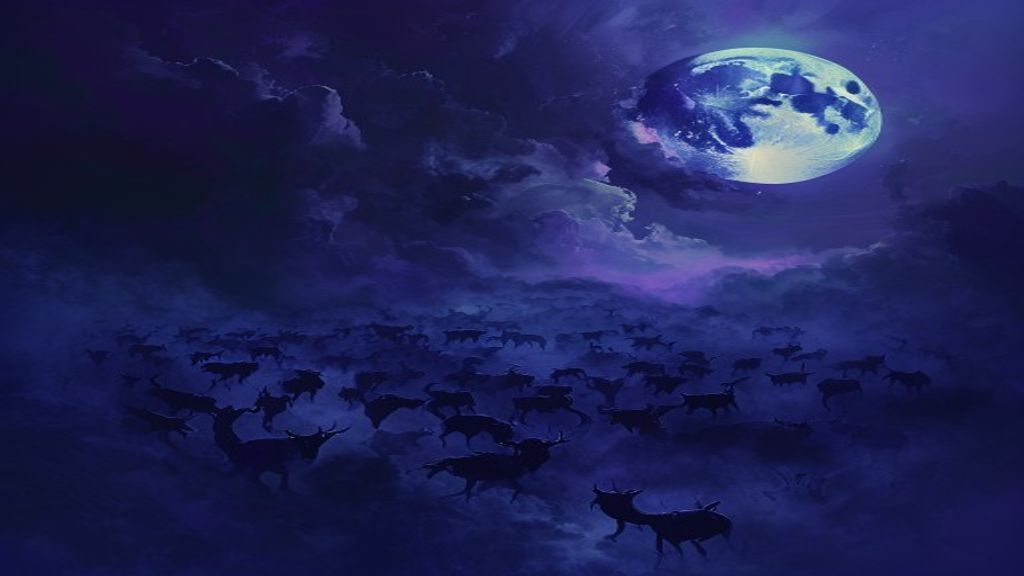
Is a herd dream about the animals at all? Rarely. It begins with the body, not the symbol. The sound and vibration of that much weight deciding to go the same direction is something your body knows before your mind names it, and the sense of scale lingers after waking. Not alarming. Something older than alarming. The meaning comes second, and it starts with one question: were you in the herd, or standing at the fence?
What the herd is actually asking
A herd in a dream is almost never only animals. It’s the image the mind reaches for when it needs to think about collective movement, about belonging, about the difference between being part of something and being swept up in it. A herd dream often leaves a physical memory: the vibration, the noise, the sense of scale. That physical residue is worth noticing before you start interpreting anything.
| Tradition | How it reads the symbol |
|---|---|
| Ancient Egypt | Cattle herds in dream texts from the Chester Beatty papyrus era were linked to abundance and to the cycles of the Nile: the herd that runs freely signals harvest, the herd that scatters signals drought and disruption. |
| Artemidorus (2nd c.) | Dreaming of a herd of cattle moving toward you was read as an omen of prosperity or of collective force arriving in your life, depending on whether the animals were calm or agitated. The interpreter always asked: were they orderly? |
| Jung / depth psychology | The herd represents the collective unconscious in its most literal visual form: the mass of instinctual life that exists before individuation. To be in the herd is to have given up something personal. To watch it from outside is to have separated, at some cost. |
| Indigenous pastoral traditions | In many nomadic and herding cultures, dreaming of the herd’s health directly mirrored the dreamer’s sense of social standing and responsibility. The herd wasn’t metaphor; it was the community made animal. |
Inside the herd or watching from outside
This is the single most useful question to ask. Not what kind of animals. Not where they were going. Whether you were one of them or standing at the fence.
Being inside the herd, moving with it, feeling its rhythm carry you: that’s the belonging dream. It can be warm or frightening depending on how voluntary it felt. If you were running with them by choice, feeling held by the group, the dream is probably doing something kind. Processing a period where collective identity actually gave you something: a team, a community, a family that functioned. If you were moving because you couldn’t stop, because the momentum was doing it for you, that’s a very different charge. The herd as compulsion rather than connection.
Watching from outside carries its own texture. Sometimes it’s pure longing. You’re at the fence and the herd is warm and the field is golden and you are not in it. That’s the exclusion dream, or the left-behind dream, and it’s honest about something people don’t always want to name: a hunger for belonging that isn’t being fed. But sometimes the outside position feels right, even relieved. You watch the herd go and you don’t want to follow. That’s individuating. That’s the psyche registering that you’ve separated from a group identity and the separation is okay, even if it’s lonely.
Carl Jung wrote at length about the tension between the individual and the collective, and the herd is almost too perfect an image for what he described. The person who has never separated from the group psyche, he thought, hasn’t yet fully become themselves. That sounds harsh. I think he meant it practically, not as a judgment: the self that forms inside the herd tends to be borrowed. Some people need to borrow it for a while. Not forever.
When the herd turns
A stampede, a sudden change of direction, the whole mass moving toward you: Antti Revonsuo’s threat-simulation framework would have something to say about this version. The threat in a herd stampede dream is impersonal and enormous, which is its own particular flavor of frightening. It’s not a predator that chose you. It’s force that doesn’t know you exist. This dream often maps onto situations that have that same quality: institutional pressure, social expectations, a group turning in ways that don’t account for them as individuals. The herd doesn’t hate you. That almost makes it worse.
Vermin is the small-scale version of a threat in numbers, and it produces a claustrophobic pressure the herd never does. A herd has weight and direction; vermin has infiltration and disgust. Different threats, worth telling apart.
The species tells you the register
Cattle dream differently from horses, which dream differently from sheep, which dream differently from a herd of deer appearing at the edge of a forest. I won’t list every species, but the register matters. Horses carry status and freedom even in large numbers. Cattle carry labor, sustenance, the patience of things that feed you. Sheep carry the oldest metaphor of collective obedience, willing or not. Deer carry wildness even when they move in herds, which is why a deer herd at the forest edge feels more like a visitation than a management problem.
A donkey is almost the inverse of the herd’s collective energy: the individual working animal, alone. And if the animal in your dream was speaking or otherwise breaking the rules of animal behavior, a talking cat is what happens when an animal crosses out of the purely instinctual register.
The view from the fence
What stays with you from a herd dream is rarely the cattle, or the horses, or the deer. It’s how it felt to stand at the fence watching them: that specific quality of being present to something large that isn’t aware of you at all. Not lonely, not frightened. Just outside. Something like awe with a slight ache underneath it.
That may not be what your herd dream felt like. It might be the opposite. But if the feeling you woke with was somewhere close to that, you might be processing a chapter where the collective moved on without you or you stepped away from it. Both of those are real losses, even when they’re also the right thing.
- Was I inside the herd or watching from outside? How did that position feel?
- Were the animals calm or agitated? Was the movement chosen or compelled?
- What collective in my waking life does this feel like: a team, a family, a culture?
- Am I longing to belong to something, or relieved to be outside it?
Quick answers
What does it mean to dream of a herd of animals?
A herd usually represents collective movement, group belonging, or the pull of shared identity. Whether you’re inside the herd or watching it from outside shapes the interpretation significantly: inside tends to be about belonging or compulsion, outside tends to be about exclusion or chosen separation.
What does a stampede dream mean?
A stampede is the herd as impersonal force. The threat isn’t targeted at you personally, which is its own kind of frightening. It often mirrors real-life pressure that comes from institutions, group expectations, or collective change that doesn’t account for you as an individual.
Does the species of animal in the herd matter?
Yes, in terms of register. Horses carry freedom and status even in numbers. Cattle carry labor and sustenance. Sheep carry the metaphor of collective obedience. Your intuitive response to the species is usually more accurate than any fixed symbolic list.
Why do I dream of watching a herd from a distance?
That outside position often reflects a moment of separation from a group identity. It can be lonely, relieved, or both at once. If the separation felt chosen, the dream may be acknowledging something you’ve been doing in waking life without fully naming it.
Sources for this reading
- Revonsuo, A. (2000). The reinterpretation of dreams: An evolutionary hypothesis of the function of dreaming. Behavioral and Brain Sciences, 23(6), 877-901.DOI
- Jung, C. G. (Ed.). (1964). Man and His Symbols. Doubleday.
- Artemidorus of Daldis (2nd century CE). Oneirocritica. English edition: Harris-McCoy, D. E. (2012). Artemidorus’ Oneirocritica: Text, Translation, and Commentary. Oxford University Press.
Full bibliography on Sources and method. Found a mistake? Tell us and see the corrections log.