- Tradition
- Psychological readingAnimal dreams
- Also read in
- The BibleSame symbol, other tradition
- Draws on
- Revonsuo, Jung, Cartwright
- Reviewed
- 5 min read
What does the dream actually want from you when it hands you a donkey?
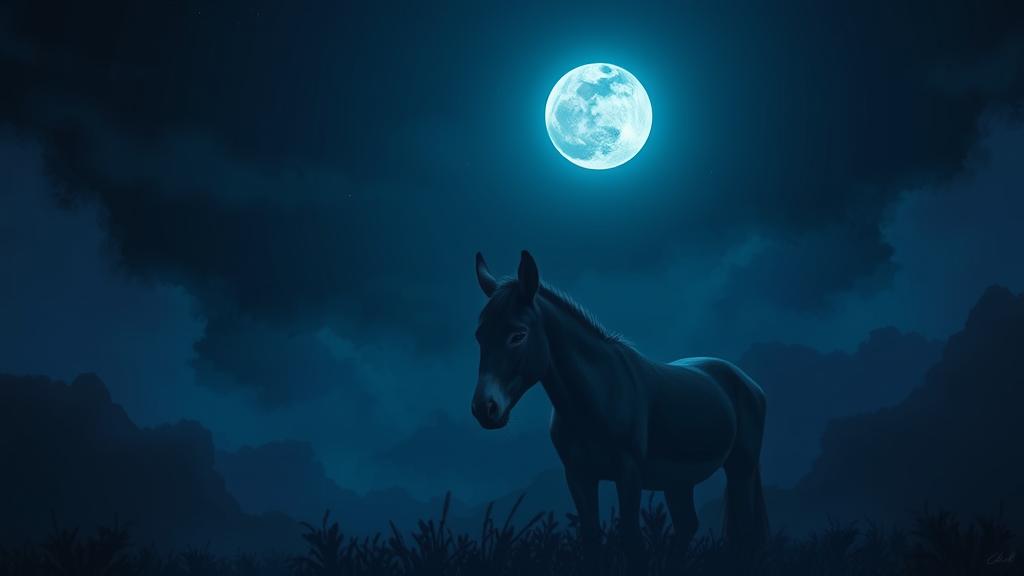
Not a horse. Not a mule. A donkey, with all its specific connotations: the braying, the refusal, the surprising load it can carry, the long history of being the working animal that nobody romanticises. If your mind reached for this particular creature, it wasn’t being careless. Dreams aren’t careless about which animal shows up.
A donkey in a dream usually points to stubbornness, endurance under pressure, or a burden that’s become identity. It can also mean undervalued strength: something reliable and unglamorous you’ve been dismissing. The animal’s mood in the dream is the clearest guide.
The animal nobody celebrates
Picture a donkey in a small paddock beside a lane. It doesn’t perform. It doesn’t prance. It stands at the fence when it wants company and turns its back when it doesn’t, and it carries whatever’s put on it without theatre. Nobody calls it beautiful. Yet it can carry a child who is terrified of horses, very slowly, in a wide circle, without incident.
That’s the donkey’s actual character. Reliable, direct, occasionally absolutely immovable. When it appears in your dream, the question is which of those qualities your sleeping mind is pointing at.
What different cultures have made of this
| Tradition | How it reads the symbol |
|---|---|
| Ancient Greece & Rome | The donkey was sacred to Dionysus and associated with Silenus, the god of drunkenness and earthy wisdom. Artemidorus held that the same dream means different things for different dreamers, so a donkey dream is read against the dreamer’s own station and work. |
| Biblical and Christian tradition | The donkey carried Jesus into Jerusalem: a symbol of humble service and peace rather than war. In medieval dream traditions it carried both connotations of foolishness and of holy usefulness. |
| Islamic tradition | A fat, healthy donkey is generally said to have been read as good fortune and ease of circumstances. A thin or stubborn one pointed to difficulty and overwork. |
| European folklore | Mostly negative: the donkey became shorthand for stupidity or obstinacy. Shakespeare’s Bottom in A Midsummer Night’s Dream wears the donkey’s head as a symbol of the bewitched, the foolish, the unwitting. |
| Psychological (Jungian) | Jung read working animals as parts of the instinctual self, below the level of conscious personality. The donkey in particular, patient and unglamorous, might carry the shadow’s productive side: what you’re capable of that you’ve been too proud to acknowledge. |
Stubbornness that protects you
Here’s the reading I’d push on: donkeys are famously stubborn, but what gets called stubbornness from outside often looks like self-preservation from inside. A donkey won’t walk into ground it can’t trust. It won’t take a load that will break it. What looks like obstinacy is often a finely calibrated refusal.
So when you dream of a donkey refusing to move, or a donkey you can’t get to cooperate, I’d ask: what are you trying to force yourself to do that some part of you knows won’t hold? The dream might not be criticising your stubbornness. It might be embodying it back to you, asking you to look at it more carefully.
Revonsuo’s threat simulation theory suggests that dreams rehearse scenarios we need to navigate. A stubborn donkey dream might be exactly that: practice for the situation where your own deep-set refusal is the obstacle you have to find a way around, or the obstacle that saves you.
Carrying the load
The donkey as beast of burden is the other main channel. If you’re leading it, if it’s heavy-laden and following you, the dream is probably asking you to look at what you’ve loaded onto yourself or others without ceremony. The donkey doesn’t complain. That’s the problem. You don’t hear the weight accumulating.
This connects to a broader pattern in animal dreams where the creature’s endurance is the point: you might want to read the piece on dreaming of a camel alongside this one, since the two animals share the load-bearing quality but carry it very differently in the dream logic. The camel is stoic reserves; the donkey is the cost of that stoicism, made visible.
And if the donkey in your dream was injured or struggling under a burden too heavy for it, that’s the version worth sitting with. The research on how dreams process emotional reality, particularly Cartwright’s work on grief and emotional regulation during sleep, suggests that dreams about struggling creatures often stand in for parts of the self that are genuinely overwhelmed and haven’t been acknowledged as such. The animal in distress is doing the work of telling you something you’ve been avoiding.
Dreaming of an injured animal follows the same thread beyond the donkey: a struggling creature standing in for a part of the self that has been overwhelmed. And for what Scripture makes of the same animal, see the biblical meaning of donkeys in dreams.
The noisy donkey
A braying donkey is something else again. Loud, insistent, impossible to ignore. If the sound was the striking thing about your dream, you might be looking at something demanding your attention that you’ve been underestimating because of how it sounds: inelegant, unglamorous, not the announcement you were expecting.
I stay slightly cautious about Jung’s broader symbolic frameworks, but his idea of the shadow, the disowned and undervalued parts of the self, fits the donkey particularly well. The animal you wouldn’t choose. Loud, earthy, uncelebrated. All the things we tend to filter out of our self-image.
Back to the paddock. A donkey will bray very early, before anyone is fully awake, and the sound cuts right through window glass. Ungainly sound. Not unpleasant, though. It’s just: here I am, this is real, pay attention. Maybe that’s all your dream is saying too.
- Was the donkey refusing to move? What are you trying to force yourself into that some part of you won’t trust?
- Were you the one leading it, or riding it, or watching it? Who’s carrying whom?
- What did the donkey’s condition tell you, fat and healthy, thin and struggling, loud and insistent?
- Is there something unglamorous and reliable in yourself you’ve been dismissing because it doesn’t look impressive?
One symbol, two traditions
Psychology keeps donkey inside your own story, a symbol your mind built from your days. The biblical tradition looks outward instead, and asks whether Scripture gives the image any voice at all.
A donkey in a dream usually points to stubbornness, endurance under pressure, or a burden that’s become identity. It can also mean undervalued strength: something reliable and unglamorous you’ve been dismissing. The animal’s mood…
You are reading this oneNumbers 22 presents this as a direct divine act: God opens the donkey’s mouth. It’s not presented as normal animal behavior; it’s an exceptional intervention to get a prophet’s attention. The point is less about the donkey’s…
Read the biblical meaning →Quick answers
What does it mean to dream of a donkey?
Usually: stubbornness, endurance, or a burden carried without complaint. The donkey’s specific behaviour and condition in the dream are the clearest guide. A calm, healthy donkey points to undervalued reliability; a stubborn or struggling one points to something not working in how you’re carrying your load.
Is dreaming of a donkey a good or bad sign?
Depends entirely on the dream’s tone. A sick or refusing donkey was a warning about overwork or misaligned effort. Neither reading is purely negative: even the stubborn donkey might be telling you something your waking self needs to hear.
What does it mean to ride a donkey in a dream?
Riding smoothly points to accepting a slow, unglamorous but reliable path. Being thrown or struggling suggests conflict with exactly that quality: wanting speed or elegance that the situation genuinely doesn’t allow. It’s worth asking what you’re trying to rush.
Why does a donkey braying appear in dreams?
The bray is the detail that makes the message impossible to ignore. If the sound was what stayed with you, the dream is pointing at something demanding attention that you’ve been underestimating: something inelegant, persistent, real. It’s not the announcement you’d have chosen. It’s there anyway.
Sources for this reading
- Revonsuo, A. (2000). The reinterpretation of dreams: An evolutionary hypothesis of the function of dreaming. Behavioral and Brain Sciences, 23(6), 877-901.DOI
- Jung, C. G. (Ed.). (1964). Man and His Symbols. Doubleday.
- Cartwright, R. D. (2010). The Twenty-four Hour Mind: The Role of Sleep and Dreaming in Our Emotional Lives. Oxford University Press.
- Artemidorus of Daldis (2nd century CE). Oneirocritica. English edition: Harris-McCoy, D. E. (2012). Artemidorus’ Oneirocritica: Text, Translation, and Commentary. Oxford University Press.
Full bibliography on Sources and method. Found a mistake? Tell us and see the corrections log.