Animal Dreams
Dreaming of a Lizard: Old Brain, New Problem
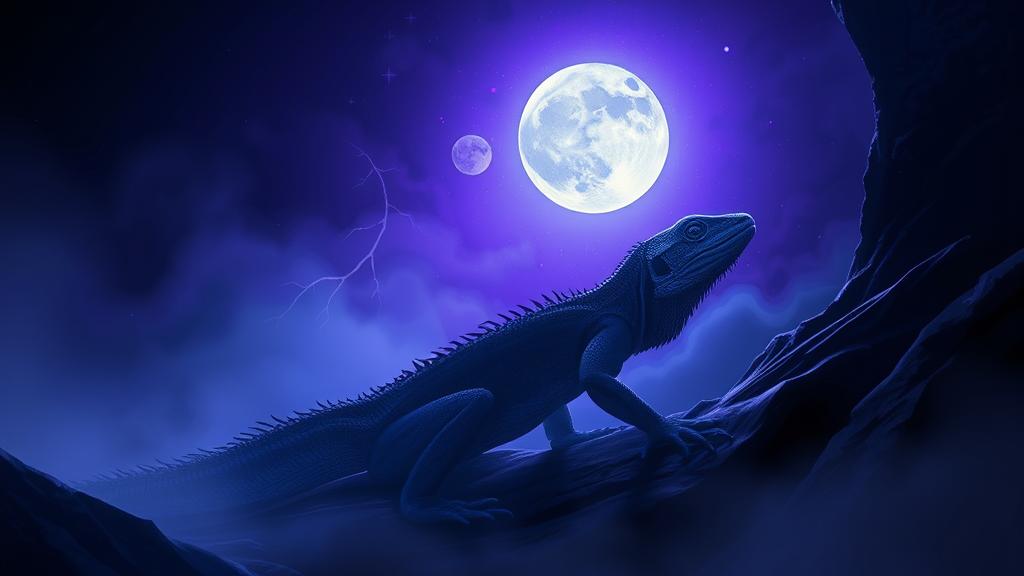
A cracked paving stone at the edge of a sunny wall, and a lizard that doesn’t move when you crouch down beside it. Just watchful. You get close enough to see the tiny pulse in its throat, and then it’s gone, fast and sideways, into a gap you didn’t notice was there. That specific image, the stillness followed by a vanishing, is what most people describe when they tell me about a lizard dream. Not a snake’s strike, not a frog’s leap. A wait, and then an exit that leaves you wondering if you imagined it.
What the old brain knows
Lizards represent something neurologically ancient in dream symbolism, and that’s not a poetic flourish. When Jung wrote about cold-blooded creatures appearing in dreams, he placed them near the layer of the psyche that predates language: instinct, reflex, the part of you that knows something is wrong before you’ve had a thought about it. A lizard in a dream isn’t offering you a lesson. It’s surfacing a signal.
The signal is usually about survival in the broadest sense, not mortal danger but the quieter question of whether a situation is safe enough to stay in. A job. A place you’re living. A dynamic with someone that has a particular quality of stillness to it, watchful, unreadable, neither warm nor cold.
Revonsuo’s threat-simulation theory is useful here. In that framework, dreams aren’t meaningless static; they’re practice runs, the brain rehearsing responses to threats so the daytime response is faster. A lizard fits that model almost too well. It’s not the threat itself. It’s the part of your mind that noticed something and hasn’t decided what to do yet.
Scene matters more than species
What the lizard is doing in the dream, and where, matters more than what kind of lizard it is. Most people can’t name the species anyway. The relevant fact is usually the context: is it in your house? On your body? Running from you or toward you? Watching from a distance? Each of those is a fairly different dream wearing the same animal.
Artemidorus, who catalogued dream-animals in his second-century Oneirocritica, read lizards as messengers from the lower world of earthly concerns, not supernatural ones, but the pragmatic: money, property, the body’s health. That reading is narrower than I’d draw it now, but he was right that lizards tend to be grounded dreams. They’re not about transcendence. They’re about footing.
The lizard that didn’t move
The stillness is what I keep returning to. Lizards regulate their body temperature from the outside, which means their activity is entirely at the mercy of their environment. When they’re still, it’s not laziness and it’s not fear. It’s reading the conditions. The question your dream might be asking is whether you’re doing the same thing, or whether you’ve been still past the point where the conditions changed and you should’ve moved.
For adjacent dream territory, the piece on dreaming of a white cat explores that same quality of watchfulness from a warmer animal, and if the lizard in your dream was menacing rather than ambiguous, the piece on dreaming of a dog attacking covers threat-dreams with more aggression in them.
My honest reading: most lizard dreams are more useful than frightening. They’re not telling you something bad is coming. They’re telling you that part of you already noticed something and is waiting for the rest of you to catch up. The stillness before the gap in the wall. That’s the dream. You already know where the gap is.
- What was the lizard doing, and where was it? The setting is the sentence.
- Was I calm or unsettled by its presence? My reaction matters more than the animal.
- Is there something in my waking life I’ve been very still about, waiting on conditions that may have already changed?
- What instinct have I been ignoring or rationalizing away recently?
Quick answers
What does it mean to dream of a lizard?
Usually that an instinctual part of you has registered something, a situation that needs assessing, a dynamic that isn’t quite safe or isn’t quite resolved. The lizard represents that old, quiet knowing rather than any literal threat.
Is a lizard in a dream a bad omen?
Not on its own. The dream’s emotional tone matters far more than the animal. A lizard you observe calmly tends to point toward healthy instinct. A lizard that disturbs or invades points toward something instinctual that feels out of control.
What does it mean when a lizard runs away in your dream?
You’re close to understanding something but not quite there. An instinct or piece of self-knowledge is quick and elusive. The gap it disappears into is usually a question you haven’t quite asked yourself yet.
Why do lizards appear in dreams across so many cultures?
Because they’re genuinely ancient animals, and that antiquity maps onto what they tend to represent: the older, pre-verbal parts of awareness. Artemidorus read them as connected to earthly concerns; Jung placed cold-blooded creatures near the instinctual layer of the psyche. Both were pointing at the same thing from different centuries.