- Tradition
- Psychological readingAnimal dreams
- Also read in
- The BibleSame symbol, other tradition
- Draws on
- Revonsuo, Artemidorus
- Reviewed
- 5 min read
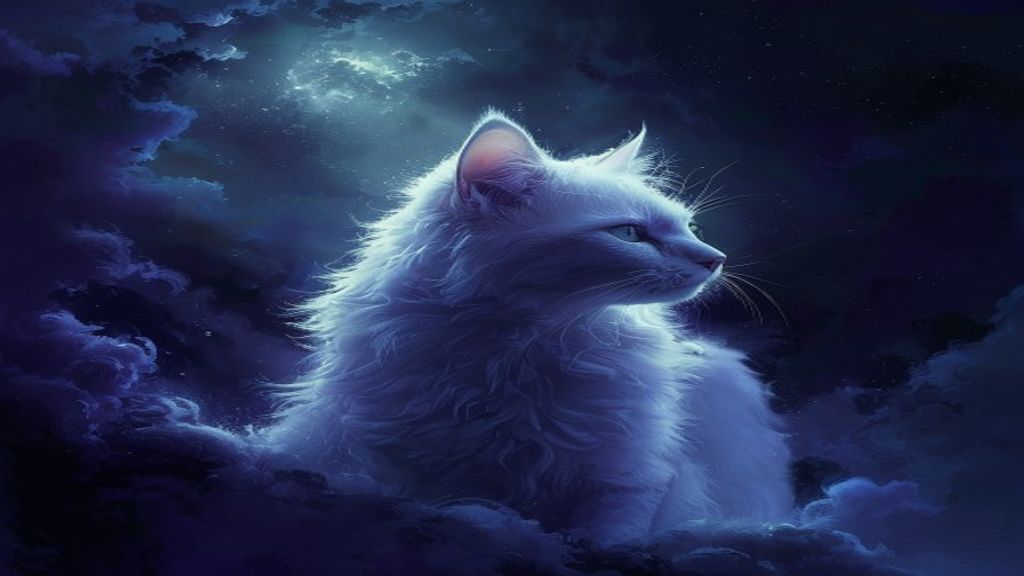
A white cat sits a few feet away and looks at you. It doesn’t want anything. It doesn’t do anything. Just looks. It’s tempting to wave a dream like that off, as though a cat that only sits and watches isn’t worth telling anyone about, and yet it lingers through the morning. That’s the white cat dream. It doesn’t justify itself, and it still follows you.
Cats have a quality in dreams that most animals don’t: they’re simultaneously domestic and unknowable. They live in your house and you still can’t fully read them. A white cat sharpens this to a point. White strips away camouflage and personality. What’s left is pure cat behavior, the independence, the stillness, the gaze that gives nothing back. If a white cat appeared in your dream and it didn’t do much except be there, that might be the entire message.
The cat that sits beside you, not on you
The anchor image for the white cat dream isn’t dramatic. It’s this: the particular frustration of a cat that chooses to sit twelve inches away from you rather than on your lap. Close enough to be present. Too far to be contact. You put your hand out, it leans slightly away. Not hostile. Not indifferent. Making a precise choice about how close it allows you to get.
That twelve-inch gap is the emotional texture of many white cat dreams. The cat is there. It isn’t threatening you. It won’t come closer. And you wake up wondering whether to feel rejected or respected. Whether the distance is protection or withholding.
A Jungian reading of cats as symbols of the instinctual feminine, or more broadly of the autonomous psyche, the part of you that won’t be trained or redirected, feels genuinely useful here. The cat in that framework isn’t hostile to you. It simply doesn’t recognize your authority over it. That’s not the same thing. And a white cat in particular, luminous and deliberate, carries the quality of something you can’t pretend you didn’t notice.
The long tradition of ambivalent cats
Artemidorus, whose second-century Oneirocritica remains the best-known ancient dream text, held that the same dream means different things for different dreamers. Applied to cats, that makes the reading depend heavily on the dreamer’s relationship with the creature and the circumstances of the encounter, rather than treating the cat as simply good or bad. Which is still the correct approach.
Western medieval tradition was brutal on cats, particularly black ones, associating them with witchcraft and bad fortune. But that was a cultural anxiety, not a universal reading. Egyptian tradition considered cats sacred. Japanese folk belief gave white cats specifically auspicious associations. The cross-cultural spread here tells you something important: cats are loaded enough that every culture felt the need to decide how to read them, and they kept arriving at different answers. Your own feelings about cats, in waking life, matter enormously here.
Read through Revonsuo’s threat simulation theory, a cat is an interesting case: domestic, but still a small predator. A white cat doesn’t camouflage in the wild. It’s visible. Exposed. That may be why white cat dreams so rarely feel threatening, as if the predator logic gets short-circuited by the whiteness. That’s my speculation, not something the theory claims.
What your reaction tells you
Here’s a useful test: the emotional aftertaste of the white cat dream tends to divide along one line. Whether you woke wanting more contact with it, or relieved it didn’t get closer. That division is diagnostic. Wanting the cat to come to you often points to feeling estranged from your own instincts, your own desires, the quiet inner voice that gets overridden by schedules and obligations. Relief is more likely if you’ve been doing intensive internal work and know what it costs to let that instinctual part of the psyche fully into the room.
There’s something related going on in the panther dream, which carries that same quality of autonomous, powerful self-knowledge, but turned up louder. The white cat is the quiet version of that energy. Domestic scale. Equally serious.
White cat dreams may belong to periods of transition, which would make sense. The cat as symbol tends to surface when you’re being asked to trust something you can’t fully see yet, which is exactly what transitions require. Another animal that sets its own pace is the snail: a part of you that moves at its own speed and keeps half a defense up. Where the cat chooses its distance, the snail carries its shelter with it.
The twelve inches between you
Back to that gap. You wake thinking: it wasn’t unfriendly, I just couldn’t tell what it wanted. And the answer is that you’re not supposed to be able to tell. That’s the whole point. The white cat that just looks at you is the part of you that knows something and isn’t ready to deliver it in a way you can categorize and set aside. It’ll sit in that twelve-inch space until you stop trying to make it come to you.
Some details won’t resolve, the color of the cat’s eyes, say. Hold on to them anyway. The details that refuse to mean anything are often the ones you remember longest.
- Did I want the cat to come closer, or was I relieved it didn’t? My honest answer is the reading.
- What part of my own instincts have I been keeping at a careful distance lately?
- The cat was watching me, not the room. What do I think it saw?
- Is there someone or something in my life I’ve been giving exactly twelve inches of space, close enough to keep, too far to fully commit?
One symbol, two traditions
A psychologist asks what white cat felt like and what it echoes in your week. The biblical reader asks a different question entirely: what does Scripture say when this image appears, and what does it stay silent about?
A white cat in a dream most often points to intuition, instinct, or a self-contained part of your inner life that won’t be redirected. The color white makes it highly visible, removing the cat’s usual ability to disappear into…
You are reading this oneScripture doesn’t mention domestic cats, white or otherwise, in any dream or vision. Any ‘biblical meaning’ of a white cat dream is therefore an application of broader biblical themes: purity (white), independence, and the nature…
Read the biblical meaning →Quick answers
What does it mean to dream of a white cat?
A white cat in a dream most often points to intuition, instinct, or a self-contained part of your inner life that won’t be redirected. The color white makes it highly visible, removing the cat’s usual ability to disappear into the background. The dream is usually asking you to notice something you’ve been stepping around.
Is dreaming of a white cat good luck or bad luck?
That depends heavily on which culture you’re in and, frankly, on your own feelings about cats. Egyptian and Japanese traditions read white cats favorably. Western medieval tradition was more ambivalent. From a psychological standpoint, luck isn’t really the frame: the dream is about instinct and independence, not fortune.
What does it mean when a white cat in your dream won’t come to you?
The distance is the message. A cat that stays just out of reach typically represents an aspect of your own instincts or desires that you haven’t been able to fully access in waking life. It’s not withholding from you out of hostility. It’s waiting for conditions it trusts.
Why do cats appear so often in dreams?
Cats occupy a genuinely unusual psychological position: they’re familiar and unknowable at the same time. They live in our houses but remain autonomous in a way dogs usually don’t. That tension between closeness and independence makes them natural dream material for questions about trust, instinct, and the parts of ourselves that don’t respond to direct management.
Sources for this reading
- Revonsuo, A. (2000). The reinterpretation of dreams: An evolutionary hypothesis of the function of dreaming. Behavioral and Brain Sciences, 23(6), 877-901.DOI
- Artemidorus of Daldis (2nd century CE). Oneirocritica. English edition: Harris-McCoy, D. E. (2012). Artemidorus’ Oneirocritica: Text, Translation, and Commentary. Oxford University Press.
Full bibliography on Sources and method. Found a mistake? Tell us and see the corrections log.