- Tradition
- Psychological readingAnimal dreams
- Draws on
- Revonsuo, Jung
- Reviewed
- 5 min read
Hold a snail shell to your ear when you’re a child and you’ll hear the sea. You know that’s air pressure, bone conduction, the shape of your own ear canal bouncing sound back at itself. You know this, and you still tip the shell and listen anyway. That’s the thing about shells: they promise interiority. They say something’s in here even when you can’t see it.
When a snail turns up in a dream, most people wake half-embarrassed. It seems like a strange thing for your unconscious to spend time on. Too small, too unremarkable. But the stranger and quieter the animal, the more precise the message tends to be. A tiger is obvious. A snail is a surgeon.
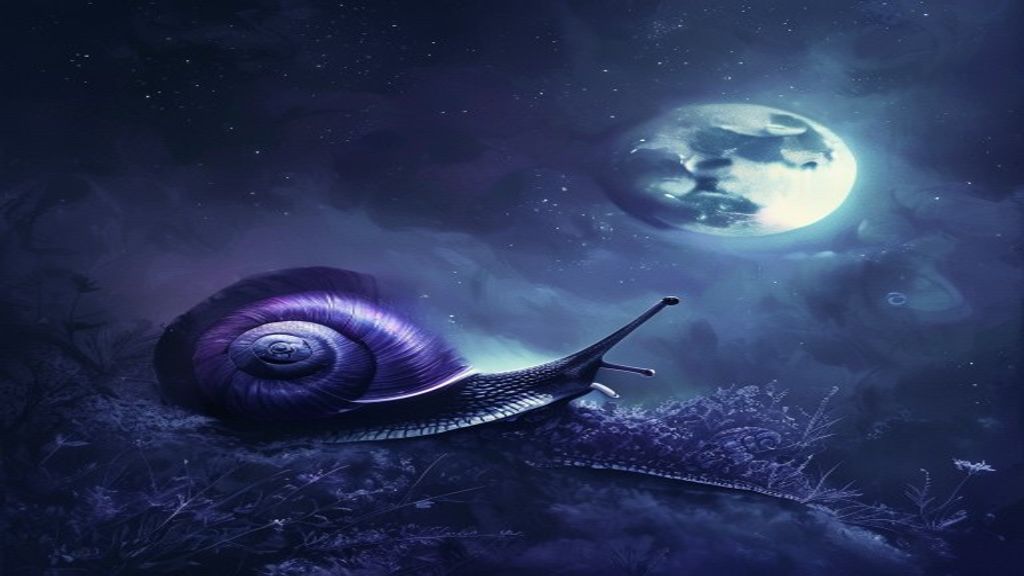
A snail in a dream usually points to a part of you that’s moving at its own pace and half-defended about it. The shell is the key symbol: it’s not just slowness, it’s the choice to carry your home with you and retreat when the world gets too loud. Whether that’s wisdom or avoidance is something only you can answer.
The shell as the whole argument
The shell present
The snail has retreated into its shell, or you see the shell intact and closed. This is the dream’s way of showing you a boundary. Something in your life is protected, maybe over-protected. You’re not refusing to engage; you’re deciding on your own timeline. The discomfort comes if the shell feels like a trap, not a choice.
The shell absent or broken
You see the animal exposed, moving without its shell, or the shell is cracked. This version carries much more urgency. The thing that usually keeps you safe isn’t working. You’re out in the open and you know it. Pay attention to what’s chasing you, or what’s simply watching, in the same dream.
That split matters more than whether the snail is big or small, one or many. A single large snail in a shell is rarely threatening; it’s almost stately. Dozens of small ones can feel like a creeping overwhelm, the kind where no single thing is the problem and the accumulation is. If you dream of stepping on one by accident, that’s its own conversation about something fragile you’ve dismissed.
What the pace is actually about
I want to push back gently on the reflexive reading. Yes, snails are slow. But I don’t think most snail dreams are about moving slowly in the way people assume, as if your unconscious is lecturing you about productivity. The snail isn’t a nag. It’s more specific than that. The pace in these dreams is usually about something you’re approaching carefully because it deserves care: a decision you’re circling, a relationship you haven’t committed to, a change you know is coming and aren’t quite ready to name. The snail is doing something deliberate. It’s not stuck. There’s a difference.
Snail dreams can be most unsettling for anyone who has been told, by others or by their own internalized voice, that their pace is a problem. That the circling is avoidance. That they should’ve decided by now. The dream shows you the animal and asks: is this creature in danger, or is it moving exactly as it should? Look at the terrain it’s crossing. Is there threat in the dream? Or just open, damp ground?
The trail
Snails leave evidence. That silvery line behind them is one of the stranger details to appear in dreams, and when it does, it tends to carry meaning about continuity: you’ve come from somewhere, and the path is visible. The trail can look beautiful in the dream. It can also feel repulsive, a visceral reaction that’s worth sitting with. Revonsuo’s threat simulation framework would suggest the disgust is doing real work, flagging something about that trail, that visible history, that feels unsafe to leave exposed. I find that reading plausible, but not the only one. Sometimes the trail is just the proof that you got here.
A very short section on color
Golden or yellow snails in dreams show up rarely, but they do show up. Jung would likely call it a sun symbol, a solar quality trying to manifest through the slowest possible vehicle. Funny, and possibly true.
The old readings
Older readings tend to take snails in dreams as signs of delay and hidden difficulty, but the image also holds the person who carries their house with them and needs no one. I find that second reading more interesting than the first. There’s something genuinely dignified about an animal that doesn’t need a fixed address. If you’re in a period of transition, between homes, between relationships, between versions of yourself, a snail dream might be less about slowness and more about that particular kind of self-sufficiency.
Jung’s framework of the house as self applies here with a small twist: the snail’s house isn’t a building you walk through, it’s something worn on the back. That’s a different kind of self-knowledge. Portable. Always with you. The rooms it contains are small, and that’s not a flaw.
If the animal in your dream had no shell at all, dreaming of a slug is the exposed version: slow, soft and harder to ignore than it should be. If the shell was what held you, dreaming of a turtle carries the same slow pace and portable shelter, with a heavier sense of armor and what lies underneath. And dreaming of armor asks whether the shell you wear is a boundary you chose or one that has outlived its purpose.
I keep coming back to that shell you hold to your ear as a child. You know there’s nothing mystical in it. You listen anyway. The snail dream works the same way: you probably already know what it’s pointing at. You’ve been circling it for a while. The animal in the dream is just showing you that the circling is okay.
Or maybe it isn’t okay, and the shell is cracked, and you already know that too. Either way, the dream is more patient with you than you probably are with yourself.
- Was the shell intact, or was the animal exposed? That detail shifts everything.
- What in my life am I approaching at my own pace, and do I feel apologetic about it?
- Is the snail in danger, or is it simply moving through open ground?
- What would I find if I looked inside the shell?
Quick answers
What does it mean to dream of a snail?
A snail in a dream usually points to something in your life that’s moving deliberately, on its own timeline, and may be protected behind a shell. The key is whether the shell is intact or exposed: a closed shell suggests a chosen boundary; a broken or absent one suggests vulnerability. It’s rarely just about being slow.
Is dreaming of a snail a bad sign?
Not inherently. The snail is often a surprisingly dignified symbol, pointing to self-sufficiency, careful pacing, or a decision you’re approaching with appropriate caution. It tips toward a warning only when the shell is cracked or the animal is in obvious danger in the dream.
What does it mean if you step on a snail in a dream?
That version tends to be about something small and fragile you’ve overlooked or dismissed in waking life. The crunch, if the dream includes it, can stay with you all morning. It’s worth asking what you’ve been minimizing.
What does it mean to see many snails in a dream?
A crowd of snails usually reflects accumulation: many small things that individually seem manageable but together have become overwhelming. It’s less about pace and more about volume. How many small obligations, avoided decisions, or quiet pressures are currently moving through your life?
Sources for this reading
- Revonsuo, A. (2000). The reinterpretation of dreams: An evolutionary hypothesis of the function of dreaming. Behavioral and Brain Sciences, 23(6), 877-901.DOI
- Jung, C. G. (Ed.). (1964). Man and His Symbols. Doubleday.
Full bibliography on Sources and method. Found a mistake? Tell us and see the corrections log.