- Tradition
- Psychological readingAnimal dreams
- Also read in
- The BibleSame symbol, other tradition
- Draws on
- Revonsuo, Artemidorus
- Reviewed
- 4 min read
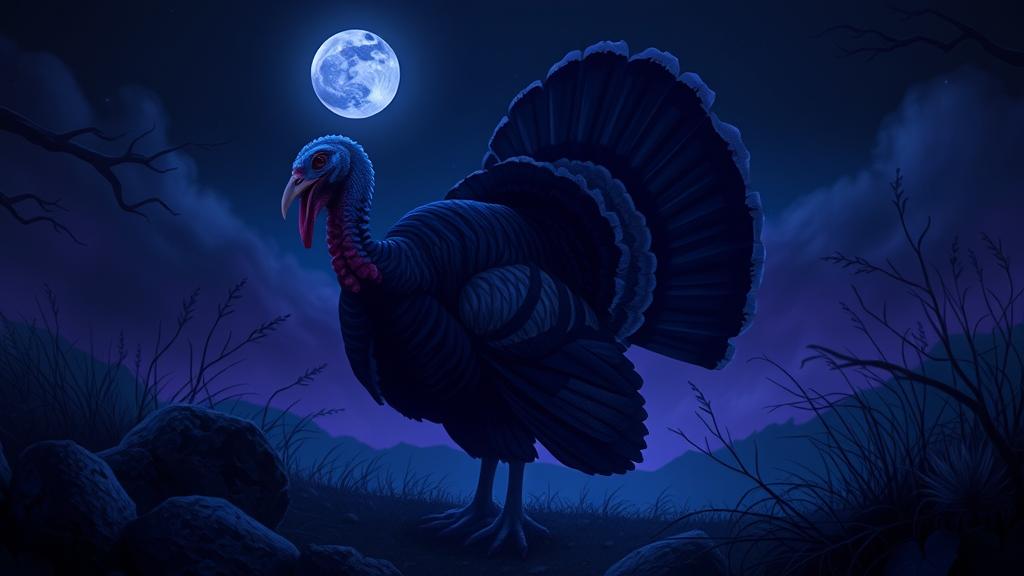
Turkey equals Thanksgiving, at least on the calendar: a holiday dinner, family around a table, a wish for plenty. That equation fails because the dream turkey is almost never on a platter. It is alive, standing in a yard or a pen with that weird, sideways dignity birds have, watching you as if it knows something and isn’t particularly impressed that you don’t.
It’s a strange animal to dream. Big enough that you can’t ignore it, slow enough that it feels weighty rather than urgent. Nobody’s running from a turkey. Which is part of the point.
A turkey in a dream most often signals abundance that’s become complicated: something substantial in your life that you’re not sure whether to be grateful for or burdened by. The bird’s behavior and your own feeling in the dream carry most of the meaning.
Why a turkey, of all things
The turkey isn’t a graceful animal. It’s domestic, it’s heavy, and it can’t really fly. That gap between its size and its capability is, I think, exactly what the dream is using. You dream a hummingbird when something small and fast is on your mind. You dream a turkey when something substantial and earthbound is sitting in your life, taking up space, staring at you.
A turkey dream tends to turn up in the middle of something that should feel like plenty but doesn’t sit right. A promotion that came with twice the responsibility. A relationship that’s stable and full and somehow exhausting. A house saved for over years and now not so sure you like. The dream gives you a turkey. It makes a kind of blunt, comic sense.
The turkey displays or struts
It’s showing off. This version connects to pride that needs to be seen, or to a question of whether you’re performing adequacy for someone’s benefit, including your own. Turkeys fan their feathers when they feel threatened as much as when they feel confident. The dream might not distinguish between those two.
The turkey is still or passive
Stillness in a large animal reads as weight, as presence without action. This is the dream pointing at something in your life that’s simply there: filling space, requiring upkeep, not going anywhere. Whether that’s a relief or a burden is yours to answer.
What the bird’s doing matters more than the bird
Revonsuo’s threat-simulation theory is designed for predator dreams, the ones where you’re running, and it doesn’t map cleanly onto a turkey. But there’s something useful in the idea anyway. The dream rehearses conditions. A calm turkey in a sunlit yard might be rehearsing sufficiency. A turkey that’s suddenly in your kitchen, somehow, wrong and out of place, is rehearsing the feeling of abundance that’s invaded the wrong space. That second version belongs to good luck that arrived badly timed.
Jungian readings treat birds broadly as messengers, as the part of the psyche that moves between what’s known and what isn’t. A bird that can’t actually fly, though, is a messenger that stayed. It landed and decided this was far enough. That reading, half-joking as it is, does something for the turkey dream: it’s a message that isn’t going anywhere until you deal with it.
A turkey can hardly fly, and neither can an ostrich: dreaming of an ostrich is the other big bird that stays on the ground, and it is worth a look if the bird in your dream seemed to be refusing something obvious, a capacity left unused, rather than simply being heavy.
The older readings
Artemidorus, writing in the second century, didn’t have turkeys. They were a New World animal. But his method is the one that holds: the same dream means different things for different dreamers, so ask what the animal is to this dreamer. Heavy, slow, domestic, fattened, destined for a table. Those aren’t flattering associations, but they’re honest ones. The older tradition wasn’t trying to make you feel good about your dreams. It was trying to tell you what they were actually about.
A dream of vermin leaves you disturbed; a turkey dream rarely has that quality. It’s more bewildering than upsetting. You wake and think: why a turkey? And that slight comedy is part of the message. Your mind chose something unglamorous to hold the weight.
The small awkward truth
A turkey in a yard moves its head in that slow, jerky way, processing you. No threat, no flight, no particular acknowledgment. Just presence. That kind of undemanding, ungainly presence is probably the most honest thing a dream can offer about something in your life. Not dramatic. Not a warning. Just: this is here. It’s been here. Have you actually looked at it? Dreaming of bees is the busier animal dream about what is working away in your life: a hive of effort, or a sting that points at one tension.
- Was the turkey moving, displaying, or just standing there? What does that quality feel like in something in your waking life right now?
- Did the turkey feel like a gift, a burden, or something that wandered in uninvited?
- Is there something substantial in your life you’ve been walking past without really stopping to look at it?
- If the turkey was out of place, what space was it in, and what does that space usually mean to you?
One symbol, two traditions
A psychologist asks what turkey felt like and what it echoes in your week. The biblical reader asks a different question entirely: what does Scripture say when this image appears, and what does it stay silent about?
A turkey in a dream most often signals abundance that’s become complicated: something substantial in your life that you’re not sure whether to be grateful for or burdened by. The bird’s behavior and your own feeling in the dream…
You are reading this oneA threatening turkey is unusual but worth noting. The bird’s cultural associations are overwhelmingly with feast and abundance, so a threatening quality might point less to the turkey specifically and more to the dreamer’s…
Read the biblical meaning →Quick answers
What does dreaming of a turkey mean?
Most often it points to something substantial and earthbound in your life: an abundance that’s become complicated, a responsibility that’s heavy and domestic. The bird’s behavior and where it appears matter more than the animal itself.
Is a turkey dream a good or bad sign?
Neither, mostly. Turkeys in dreams tend to be neutral in tone, more bewildering than frightening. The emotional texture of the dream, whether you felt burdened, amused, or unsettled, carries most of the meaning.
What does it mean if the turkey is in my house?
That’s the ‘wrong-space’ version: something substantial from one part of your life has wandered into a space where it doesn’t belong. Often shows up when good fortune has arrived with bad timing, or when something from work follows you home in a way you haven’t addressed.
Why do I keep dreaming about a turkey?
Recurring animal dreams often mean you haven’t quite named what the animal represents in your current life. Something sizable is sitting in your yard, metaphorically, and the dream keeps showing up until you actually look at it.
Sources for this reading
- Revonsuo, A. (2000). The reinterpretation of dreams: An evolutionary hypothesis of the function of dreaming. Behavioral and Brain Sciences, 23(6), 877-901.DOI
- Artemidorus of Daldis (2nd century CE). Oneirocritica. English edition: Harris-McCoy, D. E. (2012). Artemidorus’ Oneirocritica: Text, Translation, and Commentary. Oxford University Press.
Full bibliography on Sources and method. Found a mistake? Tell us and see the corrections log.