- Tradition
- Psychological readingAnimal dreams
- Also read in
- The BibleSame symbol, other tradition
- Draws on
- Revonsuo, Jung, Artemidorus
- Reviewed
- 6 min read
Writing in the 2nd century CE, Artemidorus of Daldis held that the same dream means different things for different dreamers, depending on age, status and occupation. Few symbols test that rule as well as bees. A hive can be a workplace, a family, a congregation or a crowd, and where you stand in relation to it changes the whole reading. The dream is rarely violent, even when there’s a sting. It is busy, purposeful and slightly overwhelming in scale.
A hive in full production is one of the loudest silences there is. You hear it before you see it: that particular low thrumming, steady and purposeful, the sound of thousands of small decisions made without deliberation. Stand near one long enough and it starts to feel less like noise and more like weather. Dreams about bees carry that quality into waking, a low-frequency residue, as if the hum followed you through the threshold of sleep.
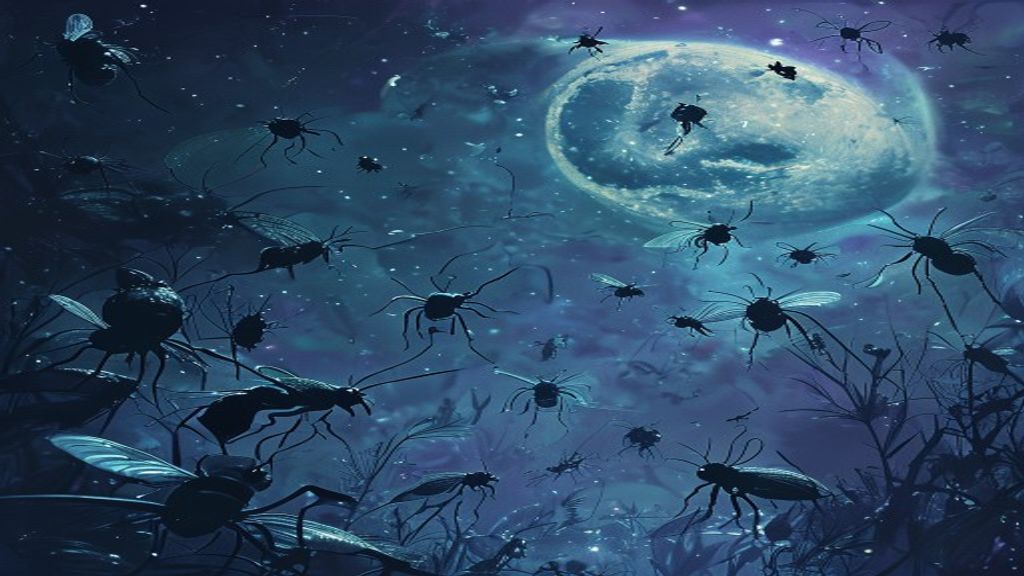
Bees in a dream typically represent collective effort, community belonging, or productive work. A sting focuses the meaning on a specific point of tension or threat. The hive’s behavior often mirrors the dreamer’s relationship to the group or project they’re most invested in.
What the dream is actually about before it’s about bees
Bee dreams almost always have a social undercurrent. Not just in the sense that bees are social insects, though that matters, but in the sense that what your sleeping mind is reaching for when it chooses a bee over any other creature is usually something about your place in a collective. Work, family, a community, a creative project with other people. The hive is the shape of the thing, and you in the dream are always somewhere in relation to it: inside it, near it, being chased from it, watching it from a safe distance.
That position is the information. The dreamer who’s inside the hive, moving with the swarm, at ease: they’re probably in a period of belonging, of productive absorption in something larger than themselves. The dreamer watching the hive from outside, unwilling to approach: that one’s about exclusion or hesitation, about a group they want to join or a project they’re circling without committing. Both dreams have bees. They have almost nothing else in common.
The sting dream is its own case. A single sting, in the hand or face especially, tends to focus meaning rather than diffuse it. It’s less about the collective and more about a specific puncture point: something that got through the defenses, a word someone said, a rejection that landed harder than expected. The sting in a dream has the physiological specificity of a real one. It draws the eye. Your mind chose that location for a reason.
| Tradition | How it reads the symbol |
|---|---|
| Ancient Egypt | Bees were associated with royalty and divine order. The honeybee hieroglyph represented Lower Egypt and appeared in pharaonic titles. A bee dream near the Nile would likely have been read as propitious. |
| Ancient Greece (Artemidorus) | The 2nd-century dream interpreter Artemidorus read bees as generally favorable for farmers and craftspeople, but potentially adversarial for politicians and public speakers. The crowd nature of the swarm cut both ways. |
| Christian symbolism | Bees represented industry, resurrection, and the community of the faithful. The hive became a standard metaphor for the well-ordered church or monastery. Dreaming of honey was almost always favorable. |
| Hindu tradition | Bees appear in connection with the god Vishnu and with Kamadeva, the deity of love, whose bow is strung with bees. The dream association tends toward devotion, sweetness, and desire. |
| Celtic tradition | Bees were intermediaries between worlds, messengers carrying news between the living and the dead. The practice of ‘telling the bees’ about family deaths survived in rural parts of Britain into the 20th century. |
| Islamic tradition (Ibn Sirin) | Bees generally signal blessing, effort rewarded, or a community in good order. A swarm attacking suggests conflict within a group. Honey found in a dream is almost universally positive. |
Jung, the hive mind, and what I’m not sure about
Carl Jung would be very comfortable with bees. The hive maps cleanly onto his concept of the collective: all those individual drives organized into something larger, something that sustains itself, something that can become threatening if the individual separates from it. Jung’s frame would say that dreaming of bees is the psyche working through its relationship to whatever hive the dreamer belongs to, not just symbolically but as a felt question. Am I part of this? Does the collective protect me or demand too much of me?
The honey is interesting to Jung in a different way. It’s what the hive produces, the result of all that collective labor, and in dreams it often shows up as something the dreamer is seeking or has found or has been given. I think Jung would read the honey as a symbol of what community produces when it functions well: something sweet, dense with effort, irreducible to any single bee. Whether your dream ends with honey or ends with a sting is a meaningful difference, and it’s worth staying with that.
What I’m genuinely uncertain about is whether Jung’s framework handles the threat dimension as well as it handles the communal one. Antti Revonsuo’s threat simulation theory would say the bee swarm dream is doing something more practical: training the mind to respond to a swarm, stress-testing the panic response, rehearsing. That’s not mutually exclusive with the symbolic reading, but it does suggest that a swarm dream that’s purely terrifying might not need a Jungian unpacking. Sometimes the swarm is just the swarm.
Artemidorus, writing in the 2nd century, took a more pragmatic approach than either. For him the same dream means different things depending on the dreamer’s age, status and occupation, so a swarm cannot carry one fixed meaning. The reading depends entirely on who’s dreaming. I find that more honest than most symbolic dictionaries, which treat the symbol as stable regardless of who encounters it. The bee doesn’t mean the same thing to someone who keeps hives as it does to someone who’s allergic.
The sound returns
Back to the hum from the opening. When a bee dream leaves that low thrumming behind, even with the picture gone, I think it’s because the sound is the collective made physical. You can’t locate it in any single bee. It’s distributed, ambient, and you’re either inside it or you’re not. Dreams that leave you with that residue, the hum still present when you wake, are usually about some group you’re part of that you haven’t fully thought about consciously.
If the part that stayed with you was the crowd of insects, dreaming of a swarm of bees goes further into what the swarm stands for. If it was the sting, dreaming of a wasp asks why the sting can matter more than the insect that delivered it. And if you found the sweetness, dreaming of honey is about what you were waiting for.
What stands out is the efficiency of the bee as a dream symbol. It delivers the collective, the productive, the potentially threatening, the sweet, and the vulnerable all in one small body. Dreams are economical that way. They don’t need a paragraph when one creature will do.
- Were you inside the hive, near it, or watching from a distance? That position is your relationship to your current community.
- Was the swarm protecting something, going somewhere, or coming for you? The behavior tells you whether the collective feels supportive or threatening right now.
- If there was a sting, where? A sting in the hand often connects to work; in the face, to how you’re seen or spoken to.
- Did you find honey, or were you searching for it? What would the honey stand for in your waking life?
One symbol, two traditions
The disagreement is honest: one school sees bee as self-communication, the other as an image to be discerned against Scripture. They can inform each other, but they do not merge.
Bees in a dream typically represent collective effort, community belonging, or productive work. A sting focuses the meaning on a specific point of tension or threat. The hive’s behavior often mirrors the dreamer’s relationship to…
You are reading this oneScripture uses bees as a figure for overwhelming opposition in Psalm 118:12 and Deuteronomy 1:44, as the source of honey in the land of promise, as a provider of unexpected sweetness in Judges 14, and as a called-up force of…
Read the biblical meaning →Quick answers
What does it mean to dream about a swarm of bees?
A swarm in a dream almost always involves a collective force, usually social or professional. If the swarm is overwhelming you, something about your community or work group feels out of control or threatening. If the swarm is organized and purposeful and you’re part of it, that often reflects a period of absorption in something larger than yourself.
What does it mean to be stung by a bee in a dream?
A sting focuses the meaning to a specific point: something got through, something hurt, something landed in the wrong place. The location of the sting in the dream is worth paying attention to. This is rarely about actual bees and usually about a specific moment or word in waking life that you haven’t fully processed.
Is dreaming of bees a good or bad sign?
Mostly neither. Bees are one of the more neutral dream symbols: they can represent effort rewarded, community, productivity, and sweetness, but also overwhelm, group pressure, and targeted pain. The scenario and the feeling underneath are far more diagnostic than the bees themselves.
What does it mean to dream about a beehive with honey?
It usually represents something earned through collective or sustained effort. If you’re searching for the honey but can’t reach it, that’s the anxiety version: reward that’s visible but not yet accessible.
Sources for this reading
- Revonsuo, A. (2000). The reinterpretation of dreams: An evolutionary hypothesis of the function of dreaming. Behavioral and Brain Sciences, 23(6), 877-901.DOI
- Jung, C. G. (Ed.). (1964). Man and His Symbols. Doubleday.
- Artemidorus of Daldis (2nd century CE). Oneirocritica. English edition: Harris-McCoy, D. E. (2012). Artemidorus’ Oneirocritica: Text, Translation, and Commentary. Oxford University Press.
Full bibliography on Sources and method. Found a mistake? Tell us and see the corrections log.