- Tradition
- Psychological readingAnimal dreams
- Also read in
- The BibleSame symbol, other tradition
- Draws on
- Revonsuo, Artemidorus
- Reviewed
- 5 min read
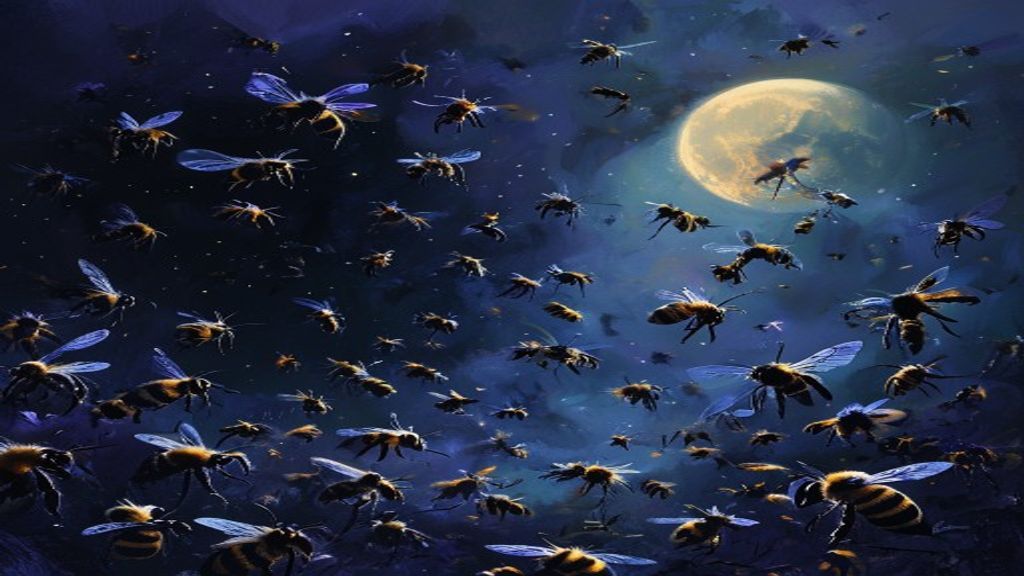
A swarm dream usually gets read as an attack dream: stings, panic, a simple danger to escape. That reading misses the part that matters, which is rarely the sting or the cloud of bees in the air. It’s the hum you feel before you see anything, like putting an ear to a wall in summer and realizing something is alive inside it. The sense of organized purpose operating just past the edge of your awareness, and you standing near it, unable to tell if you’re included.
A swarm of bees in a dream usually points to collective pressure: a group, a system, or a set of obligations whose weight has become impossible to ignore. It’s rarely about literal danger. It’s about being surrounded by something that has its own intelligence and its own agenda.
The hive in the wall you can’t see
The detail that makes swarm dreams distinct from other animal dreams is that the threat doesn’t have a face. A wolf has a face. A snake has a face. A swarm is a system. It moves with purpose but no single decision-maker you can negotiate with. That’s part of what makes it so disorienting: you can’t appeal to it, can’t reason with it, can’t make eye contact.
Revonsuo’s threat simulation theory proposes that dreaming rehearses our responses to threat, and a swarm is an awkward case for it: there’s no single target to neutralize or flee from. The dream may be rehearsing how you handle a problem that’s distributed, systemic, without one clear source. Whether you ran, stood still, covered yourself, or found yourself able to talk to the swarm is a real data point about your current waking strategy.
The swarm as a collective you belong to
Not all swarm dreams are threatening. Some are ambivalent, or even weirdly peaceful. This is the version that doesn’t get talked about, where the bees are around you but not stinging, and you’re somehow both witness and part of it.
The Jungian idea of a collective unconscious life makes the hive a useful image here, maybe the most useful frame for this particular dream. The hive thinks collectively. It regulates, sacrifices, organizes, expels. If you feel part of it in the dream, something in you is reckoning with belonging to a group whose logic isn’t yours individually. A family. A workplace. A community with its own weight and its own decisions that carry you along.
The hive mind is a useful shorthand here: not a metaphor for stupidity, which is how it’s often used, but for the genuine intelligence of collective systems that don’t require individual consent to function. Being in a swarm dream can mean you’ve been running on the hive’s schedule for so long you forgot you had your own.
- Notice the swarm’s directionIs it coming toward you, moving past you, or surrounding you? The direction tells you whether this collective pressure is arriving, passing through, or already here. A swarm that’s moving past you has a different emotional weight from one that’s centered on you.
- Ask what you did in the dreamFroze. Ran. Covered your face. Tried to speak to it. Walked through it without being stung. Your dream-self’s response is almost always faithful to your waking approach to this kind of distributed, hard-to-confront pressure.
- Find the waking equivalentWhat in your life right now moves like a swarm? Not one threatening person but a system of expectations, obligations, or social pressures with their own momentum. That’s the hive. The dream’s bees are just the clearest image your mind could find for it.
- Separate the sting from the humBeing stung is a distinct dream from being surrounded. The sting is specific and pointed: one wound, one source. The hum is ambient, everywhere. If the dream featured both, ask which one woke you. That’s the part your psyche is most urgently working on.
What Artemidorus would say
Artemidorus, writing in the second century, held that the same dream means different things for different dreamers, depending on age, status and occupation. A swarm would not have had a single meaning for him: a farmer and a public speaker dreaming of bees would not be given the same reading, because he asked about the dreamer’s situation first.
What I find striking is how context-dependent his method was. That instinct, that the same symbol means different things depending on who’s dreaming it and when, is still the most honest approach I know.
Being stung
Sharp. Specific. Unmistakable. The sting in a dream tends to point to a particular wound, a specific word said, a particular betrayal, rather than ambient pressure. Worth noting which part of you was stung, if you remember.
If the sting is all you remember, start there and skip the collective reading entirely. A single bee has its own dream: dreaming of a bee is about the sting and the sweetness.
If the swarm is tied to anxiety about work, dreaming of a roaring lion makes a useful contrast: the lion is singular authority, the hive is distributed pressure. They’re different problems wearing similar clothing. And if the pressure feels more like a crowd than a swarm, dreaming of a market is the human version: many people moving with their own purposes around you.
The hum you feel before you see anything
What I keep returning to with swarm dreams is that your dreaming mind generated an entire coordinated system just to represent something in your life. It didn’t reach for a single predator. It built a hive. Thousands of individual units acting as one organism, purposeful, relentless, and entirely indifferent to you as an individual even as it swarms around you.
That’s a very specific choice. And my tentative read, for what it’s worth, is that the thing it represents isn’t a person. It’s a system. The hive dream is a collective noun wearing a terrifying body, and what it wants from you isn’t escape. It wants to know if you’re going to stand there listening to it vibrate through the wall, or if you’re finally going to open the door.
I’m not sure which answer is correct. I’m not sure the dream knows either. But the hum keeps going until you’ve at least put your ear against the plaster and acknowledged it’s there.
- Was the swarm moving toward me, surrounding me, or moving past?
- Did I feel inside the hive or outside it, and which of those maps to something real right now?
- What in my life right now functions like a swarm: distributed, purposeful, hard to confront directly?
- Was I stung? And if so, do I know where?
One symbol, two traditions
A psychologist asks what swarm of bee felt like and what it echoes in your week. The biblical reader asks a different question entirely: what does Scripture say when this image appears, and what does it stay silent about?
A swarm of bees in a dream usually points to collective pressure: a group, a system, or a set of obligations whose weight has become impossible to ignore. It’s rarely about literal danger. It’s about being surrounded by something…
You are reading this oneIt can carry that echo, given the Psalm 118 and Deuteronomy 1 imagery. But it doesn’t have to. The meaning that fits will connect to your actual waking situation rather than a fixed symbol. Ask what in your life feels like an…
Read the biblical meaning →Quick answers
What does it mean to dream of a swarm of bees?
Usually it points to collective pressure: a group, institution, or system of obligations whose weight has become hard to ignore. It’s rarely about literal danger. The swarm has its own intelligence and agenda, and you’re somewhere near it, trying to work out your relationship to it.
Is dreaming of bees a good or bad omen?
For most people in a contemporary reading, a swarm signals that something collective in your life needs your attention. It’s uncomfortable rather than ominous. The bees aren’t judging you. They’re just very busy.
What does it mean to be stung by bees in a dream?
A sting is specific and pointed, unlike the ambient pressure of a swarm. It tends to map to a particular wound: a specific thing said, a precise moment of betrayal or criticism, rather than general overwhelm. Which part of you was stung, if you remember, usually tells you what part of your life is touched.
What does it mean to dream of bees surrounding you without stinging?
This version is often more ambivalent than threatening. The bees are present, organized, purposeful, and you’re in the middle of it, unhurt. It can mean you’re part of a collective system, whether a family, a workplace, or a community, whose rhythm has become indistinguishable from your own. The question the dream is asking is whether that feels like belonging or like losing yourself.
Sources for this reading
- Revonsuo, A. (2000). The reinterpretation of dreams: An evolutionary hypothesis of the function of dreaming. Behavioral and Brain Sciences, 23(6), 877-901.DOI
- Artemidorus of Daldis (2nd century CE). Oneirocritica. English edition: Harris-McCoy, D. E. (2012). Artemidorus’ Oneirocritica: Text, Translation, and Commentary. Oxford University Press.
Full bibliography on Sources and method. Found a mistake? Tell us and see the corrections log.