- Tradition
- Psychological readingAnimal dreams
- Also read in
- The BibleSame symbol, other tradition
- Draws on
- Revonsuo, Nielsen, Artemidorus
- Reviewed
- 5 min read
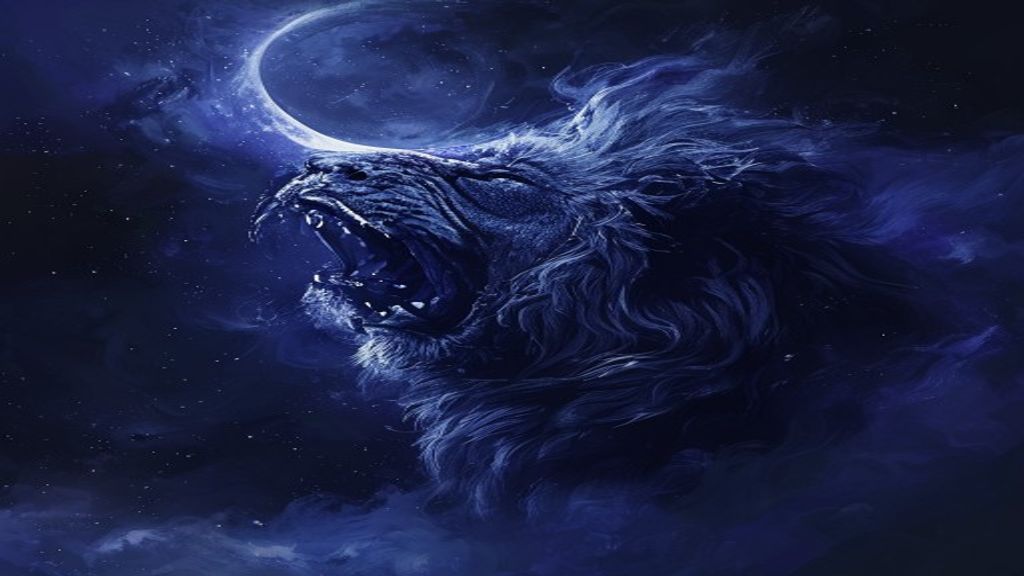
In the Nielsen et al. study of 1,181 Canadian university students, 81.5% had dreamed of being chased, and a lion is the classic animal to do the chasing. That makes the typical roaring-lion dream odd. Nothing charges. Nothing attacks. The lion just stands there and roars, and the dreamer freezes, not from danger exactly, but from something else entirely.
That thing that happens when a sound is so big it stops thought. The way a thunderclap gets inside your ribs. It’s a different experience from being hunted, and it changes how the dream should be read.
A roaring lion in a dream is usually an encounter with concentrated force, whether your own unused power, someone else’s authority over you, or a situation demanding a response you’ve been putting off. The freeze you feel in the dream is the clue: what in your waking life has you standing very still?
The sound that gets inside you
The specific anchor here is sound, not sight. You could dream of a lion sleeping and wake up calm. You could dream of a lion pacing and wake up restless. But a roaring lion plants something in your chest that’s still there over breakfast. That’s the dream doing exactly what it should: using the most visceral shorthand available to get your attention.
The dreamer is almost never in physical danger in this dream. The lion isn’t lunging. It’s announcing something. And you wake with this odd combination: frightened and somehow moved. Like standing too close to a speaker at a concert. Overwhelmed and unable to look away.
That split reaction, fear plus something almost like admiration, is worth sitting with. It means the dream isn’t only warning you. It’s also showing you something you recognize.
Two ways to read the roar
The lion is you
You’re watching your own power roar from a safe distance. This version tends to arrive when you’ve been making yourself smaller than you are: staying quiet in a meeting you should be leading, shrinking around someone who doesn’t deserve deference, or carrying a skill you’ve never shown anyone. The freeze is recognition, not fear. You know that sound.
The lion is someone else
The roar belongs to an authority figure, a situation, an obligation that’s gotten very loud in your life. A demanding parent, a job that consumes everything, a decision bearing down on you. Here the freeze is genuine overwhelm. The dream isn’t telling you to become the lion. It’s asking whether you’re ready to hold your ground.
Plenty of roaring-lion dreams turn out to belong in the first category, which can be a surprise. The natural assumption is that the lion is a threat. A few more questions often show that the dreamer recognizes the energy, that the roar felt familiar because it had been suppressed somewhere. The mirror image is a tamed wild animal: the same wildness, but held down rather than let out, which is exactly the suppression a roar tends to expose.
What the old interpreters said (briefly)
Dream traditions have never been subtle about lions: kings, rulers, the immovable forces in your life, which is also where dreaming of a king lives. Artemidorus, writing in the second century, held that the same dream means different things for different dreamers, so who the ruler is depends on who you are: for one dreamer a boss, for another a parent. The lion’s dominance isn’t the point so much as its unconditionality. It doesn’t negotiate. It doesn’t apologize for its volume. For someone raised to manage their impact on other people, dreaming of a creature that just roars because it has to is genuinely shocking.
Jungian readings land somewhere nearby, treating a lion as the shadow side of the self: instincts, drives, appetites that don’t fit the polished version of who you think you are. Which is not a comfortable reading but an honest one. The roar might be the thing you’ve decided isn’t allowed out.
I’m usually careful with old frameworks, but both of these converge on the same basic observation: the lion dream is rarely about literal danger. It’s about raw force that hasn’t been integrated yet. Yours or somebody else’s.
When the lion is a warning
Not everything is about personal growth. Sometimes a roaring lion in a dream is straightforwardly alerting you to something that scares you. Antti Revonsuo’s threat simulation theory, from 2000, argues that dreaming evolved partly to rehearse danger responses, and a lion is about as pure a threat stimulus as the sleeping brain can generate. If you’ve been around a genuinely frightening person, a job with real consequences, a situation that’s spiraling, the lion might not be your shadow at all. It might just be your nervous system running drills.
The distinction is usually in whether the lion is hunting you. If it’s roaring but not pursuing, that’s closer to the power-symbol reading. If it’s tracking you, the dream is processing a real threat, and the more useful question becomes: what are you actually afraid of and is that fear proportionate?
The version that lingers is the lion dreamed once, clearly, and followed by years of playing it small. The roar is still in the dream archive. Nobody came for you. You never went toward it either. A heron offers the contrast, all patient stillness before movement: the heron waits, the lion announces. You might need both.
The roar that comes back
Recurring lion dreams almost always mean the same thing: you still haven’t responded to whatever the roar was announcing. The dream has no other way to escalate except to repeat itself. It’ll keep coming back, I think, until you either confront the external force that sounds like a lion, or claim the internal one. Sometimes both. Sometimes neither and the dream just fades when the situation resolves on its own.
It’s an open question whether naming it is enough, or whether something has to change in the waking life for the dream to stop. Plausibly it goes both ways. A dreamer who finally speaks up in a situation they’d been silent in may see the lion retire, while another who simply sits with the recognition that the roar was theirs, without changing anything externally, may find it fades too. So maybe the dream’s bar is lower than we think. Maybe it only wants to be heard. A black snake is the quiet counterpart: an old instinct that arrives without any announcement at all, where the lion arrives with a roar.
- Was the lion hunting me, or just roaring? That difference decides almost everything.
- When I froze in the dream, what did the freeze feel like: terror, awe, or recognition?
- Is there something in my waking life I’ve been making myself small around?
- Whose voice does the roar remind me of, including my own?
One symbol, two traditions
The disagreement is honest: one school sees roaring lion as self-communication, the other as an image to be discerned against Scripture. They can inform each other, but they do not merge.
A roaring lion in a dream is usually an encounter with concentrated force, whether your own unused power, someone else’s authority over you, or a situation demanding a response you’ve been putting off. The freeze you feel in the…
You are reading this oneScripture uses the roaring lion for both the adversary (1 Peter 5:8, where the devil ‘as a roaring lion’ seeks to devour) and for divine authority (Revelation 5:5, Amos 3:8, Genesis 49:9). Proverbs 28:1 also uses it as an image…
Read the biblical meaning →Quick answers
What does it mean to dream of a roaring lion?
A roaring lion in a dream typically points to a concentrated force that’s demanding your attention: either your own power sitting unused, or an authority or situation that’s become impossible to ignore. The freeze you feel is the key. It tells you whether the encounter feels like recognition or overwhelm.
Is dreaming of a lion a good or bad omen?
It depends almost entirely on what the lion is doing. Roaring but not charging leans toward power and announcement. Pursuing you leans toward threat processing. A sleeping or still lion is its own thing entirely. Most lion dreams are less ominous than they feel; the fear in them tends to be proportional to whatever you’ve been avoiding.
Why do I keep dreaming about a roaring lion?
Recurring lion dreams usually mean something the dream flagged hasn’t been acknowledged yet. You haven’t responded to whatever the roar was announcing, whether that’s a situation that frightens you, an instinct you’ve been suppressing, or someone whose authority over you hasn’t been examined. The dream tends to stop when you engage with it.
What does it mean when you’re not afraid of the lion in the dream?
That’s actually the more interesting version. If you stand your ground, or feel calm, or even feel some kind of kinship with it, the lion may be acting as an aspect of yourself you’re finally ready to own. People who wake from those dreams often describe feeling unusually clear about something they’d been muddled about. Trust that.
Sources for this reading
- Revonsuo, A. (2000). The reinterpretation of dreams: An evolutionary hypothesis of the function of dreaming. Behavioral and Brain Sciences, 23(6), 877-901.DOI
- Nielsen, T. A., Zadra, A. L., Simard, V., Saucier, S., Stenstrom, P., Smith, C., & Kuiken, D. (2003). The typical dreams of Canadian university students. Dreaming, 13(4), 211-235.DOI
- Artemidorus of Daldis (2nd century CE). Oneirocritica. English edition: Harris-McCoy, D. E. (2012). Artemidorus’ Oneirocritica: Text, Translation, and Commentary. Oxford University Press.
Full bibliography on Sources and method. Found a mistake? Tell us and see the corrections log.