- Tradition
- Psychological readingAnimal dreams
- Draws on
- Revonsuo, Jung
- Reviewed
- 5 min read
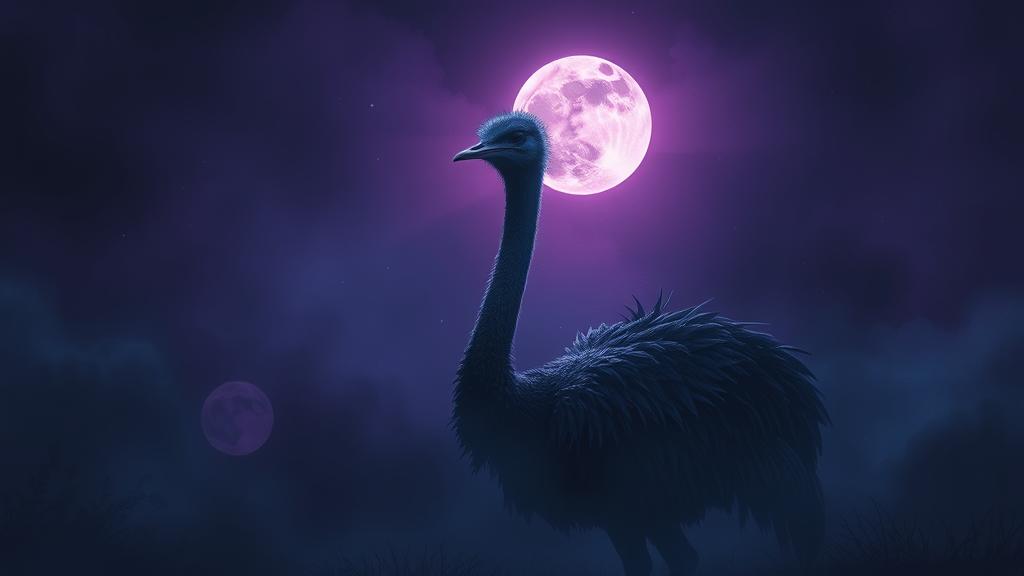
Burying your head in the sand is the idiom that hangs over every ostrich dream: you must be hiding from something. That fails on the facts of the bird. An ostrich is enormous. It can outrun a horse. It does not hide, it just refuses, flatly refuses, to fly. When an ostrich turns up in a dream, that specific quality, the refusal of the obvious capacity, is usually what the image is using.
What the ostrich is actually doing in your dream
The head-in-sand image is a myth, incidentally. Ostriches don’t bury their heads. They lower them to turn their eggs in ground nests. But the myth has been so persistent and so culturally useful that the dream image works with the myth, not the zoology. Dreams rarely care about accuracy. They care about resonance. So an ostrich in your dream is likely using that resonant cultural shorthand: something is being avoided. Something visible is being treated as if it doesn’t exist. That something might be a conversation, a decision, a change in a relationship, or a truth about yourself that’s been sitting in plain view. Unlike dreams involving more overtly threatening animals, like those in dreaming of many snakes, the ostrich dream rarely feels frightening. It just feels slightly absurd. Which is, maybe, the point.
Working out what you’re avoiding
- Notice who is the ostrichAre you observing the bird, or are you somehow the bird? Dreams of watching an ostrich often point outward: someone in your life is in avoidance mode. Dreams where you feel the ostrich’s weight or posture in your own body are almost always pointing inward.
- Find the ground-level detailWhat is the ostrich near? A particular building, a person, an object? The dream places the bird in a scene for a reason. The environment isn’t decoration. It’s a direction indicator pointing at the relevant area of your life.
- Check the feeling underneathOstrich dreams usually carry one of two emotional registers: faint shame (you already know what you’re not looking at) or a kind of grim comic recognition. The shame version is asking you to act. The comic version may just be your mind filing an observation.
- Separate refusal from incapacityAn ostrich can’t fly. It won’t fly. Those are different things, and they map onto different problems. If the dream has a quality of genuine inability, it may be about something you’re not yet capable of facing. If it has a quality of choice, the question is why you’re choosing the ground.
The speed nobody mentions
Here’s what gets missed in every ostrich symbol discussion: the bird is extraordinarily fast. Not flying-fast, but ground-level fast, faster than almost anything it might meet. The avoidance reading is real, but the speed is also real, and in some dreams the ostrich is running, not hiding. An ostrich in full sprint can carry a different meaning: something enormous is moving through your life at a pace you can’t quite track. Or you are moving through something at great speed while keeping your head decidedly at ground level, not looking up at the larger picture. Dreams about a white horse carry a related energy of driven speed, but the horse moves with grace and intention while the ostrich has something almost comedic in its movement, ungainly and relentless at the same time.
What Jung and the old dream books would notice
Carl Jung’s framework of the shadow, the parts of yourself you haven’t integrated, doesn’t usually come up in animal dream discussions because people want a specific bird reading. But the ostrich fits unusually well. The shadow is precisely the thing that’s obvious to everyone else and invisible to yourself. The thing your colleagues can name, the thing your partner tries not to mention, the enormous bird sitting in your waking life while you carefully look at something else. The ancient dream books are not the place to look for ostriches specifically. But the general logic of omen reading applies: a bird that cannot fulfil its primary function suggests an obstacle to one’s natural direction. An ability present but unused. Revonsuo’s threat simulation theory is worth invoking here too, though perhaps with a note of irony. The argument is that the dreaming mind rehearses responses to threat. The ostrich dream may be the mind rehearsing a threat by depicting the refusal to rehearse it. Which is, honestly, quite an elegant loop.
When it’s about someone else
Some ostrich dreams aren’t about avoidance at all. They’re just about an encounter with something strange and large and out of place. An ostrich in a domestic setting, in a corridor or a car park, is an incongruity dream: something belongs somewhere else and you’re being asked to notice the mismatch. For that version, the question isn’t what you’re avoiding but what’s out of place in your life. What element is in the wrong environment? Dreams like dreaming of a peacock sometimes carry the same dislocation quality, a wildly unsuitable bird wandering somewhere it has no business being. Whoever names the ostrich thing is usually right, and the matter that has been avoided does eventually get dealt with, usually later than it should. Meanwhile the ostrich watches from the edge of awareness, patient and enormous and slightly ridiculous.
- Was I the observer or was I the ostrich? The answer changes the interpretation entirely.
- What was the ostrich near or avoiding? That environment is the clue.
- Is there something obvious in my waking life that I’ve been treating as if it isn’t there?
- Was the bird hiding, running, or just standing? What was the quality of its refusal?
Quick answers
What does it mean to dream of an ostrich?
An ostrich in a dream most often points to avoidance: something you or someone close to you is refusing to acknowledge. It can also appear when something enormous is moving through your life at ground level, fast but earthbound, and you haven’t looked up to take stock of it yet.
Does dreaming of an ostrich mean I’m avoiding something?
Often, yes. The cultural myth of the ostrich burying its head is so persistent that your dreaming mind almost certainly uses it that way. But check whether you’re the ostrich or watching one: if you’re watching it, the avoidance may be someone else’s. If you feel its weight in yourself, it’s probably yours.
What does it mean if the ostrich is running in my dream?
A running ostrich usually shifts the emphasis from avoidance to speed. Something large is moving fast, and you may be keeping your attention at ground level while missing the larger picture. It can also indicate rushing through a situation you haven’t really examined.
Is an ostrich in a dream a bad sign?
Not inherently. The avoidance reading is a nudge, not a condemnation. The dream is usually pointing at something you already know but haven’t acted on yet. That information is useful rather than threatening. Most people find these dreams slightly embarrassing rather than frightening.
Sources for this reading
- Revonsuo, A. (2000). The reinterpretation of dreams: An evolutionary hypothesis of the function of dreaming. Behavioral and Brain Sciences, 23(6), 877-901.DOI
- Jung, C. G. (Ed.). (1964). Man and His Symbols. Doubleday.
Full bibliography on Sources and method. Found a mistake? Tell us and see the corrections log.