- Tradition
- Psychological readingAnimal dreams
- Also read in
- The BibleSame symbol, other tradition
- Draws on
- Revonsuo, Artemidorus
- Reviewed
- 6 min read
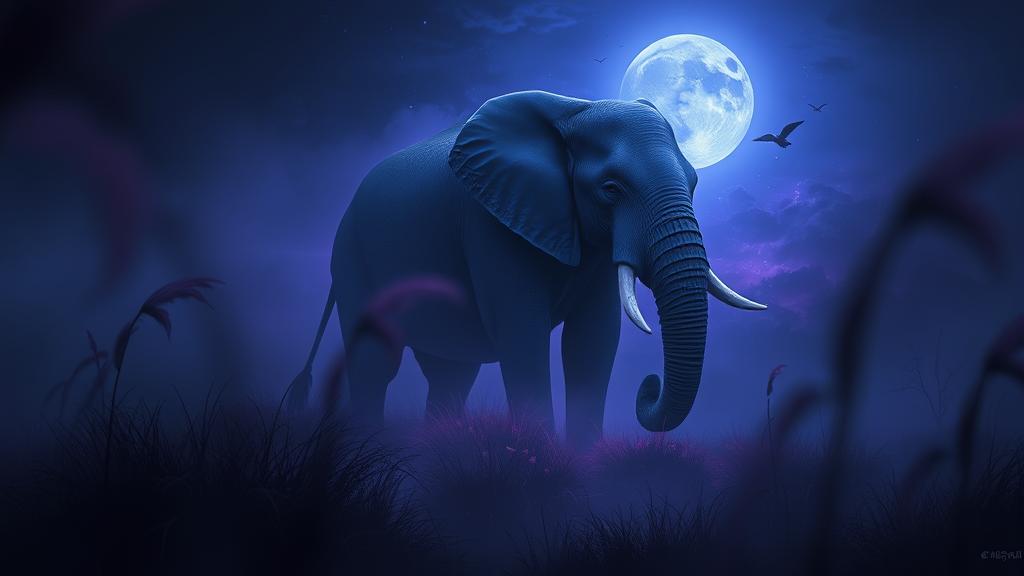
You’re walking and it’s just there, filling the space ahead of you. Not aggressive. Not moving toward you, exactly. Just present in the way that very large things are present: you have to route around them, you can’t pretend they aren’t there, and the decision about what to do next is entirely yours.
That is the shape of most elephant dreams. The elephant is rarely the attacker. It’s the weight. It’s the thing in the room, the thing in the corridor, the thing your eye keeps returning to while you pretend to concentrate on something else.
An elephant in a dream almost always represents something durable: an old grief, a long-standing responsibility, a memory that hasn’t fully processed. The animal’s real-world qualities, memory, herd loyalty, slow enormous weight, are exactly what the dreaming mind borrows. The question isn’t what the elephant is. It’s what you did when you saw it.
What you did when you saw it
The dream rarely gives you an elephant without giving you a reaction. And that reaction is where most of the meaning lives. Not in the elephant itself, which is just the form the old thing took tonight, but in whether you froze, or tried to back away quietly, or walked toward it, or stood completely still and let it pass. Your dreaming self knows what to do with a large old thing. Watch what it chose.
Depth psychology talks about the ways the unconscious encodes what’s too large for ordinary language, giving the unsayable a form your dreaming self can encounter on a path rather than in abstract thought. An elephant is, among other things, a form that can’t be ignored or minimized. It doesn’t fit in a corner. That may be precisely why the mind reached for it.
The weight is the point
An elephant is enormously heavy, and that physical fact is inseparable from what it means to stand near one. It’s not dangerous the way a snake is dangerous, quick and hidden. It’s heavy in a way that changes the ground. You feel an elephant before you see it sometimes. A vibration in the floor.
I think this is why the dream reaches for elephants when the waking-life weight is old rather than new. A fresh wound sends you different animals. An old grief, a long responsibility, a thing you’ve carried so long it’s become invisible to everyone around you but still registering in your body as a low, floor-level hum: that’s elephant weight. That’s the dream saying, here it is, in a shape you can look at.
The memory angle isn’t incidental. In waking life, elephants are the animals we associate with not forgetting. Whatever the dream elephant is standing in for, it’s almost certainly something your mind has held for a long time. Not necessarily with suffering. Sometimes with loyalty. Sometimes with love.
What Artemidorus noticed
Artemidorus, working in the second century, held that the same dream means different things for different dreamers, depending on age, status and occupation. That instinct is useful here, because elephants were part of the ancient Mediterranean’s visual landscape, used in war, in spectacle, in processions, and an elephant was never only a matter of size. It was a matter of power and status too. I find that instinct right, even if the framing has aged. Elephant dreams are about power relations, about where the power sits and who’s managing it.
The contemporary version of that reading is less about political power and more about psychological weight. The question is still: who’s in charge of this large old thing, and how did that situation develop?
The herd
Multiple elephants deserve a note on their own. The herd in elephant behavior is a well-studied social structure, matriarchal, multigenerational, organized around memory and care. A herd in a dream almost never points to threat. It points to belonging and to lineage. To a weight shared across time rather than yours alone to carry. If the herd appeared and you felt part of it rather than in its way, that’s a different dream than any of the single-elephant scenarios.
For family weight specifically, dreaming of a dead dog is about an animal that was yours, or was entrusted to you. Dogs and elephants carry different kinds of loyalty and different registers of loss, but both leave the sense of a presence that outlasts its time.
What tends to remain
Elephant dreams are rarely frightening in the way a dream predator is frightening. It’s more complicated than that. There’s often something like awe in them, and something like exhaustion, and something that might be relief. Because the dream put the weight into a shape you could see clearly, even if briefly.
Take someone who has been a caretaker for years, first for an unwell parent and then for a sibling, and who dreams of a single elephant standing very still in their childhood kitchen. Not blocking the door. Just standing there. The kitchen in the dream is exact: the specific drawer pull, the particular way the afternoon light comes through the window. The elephant is quiet. They wake up crying, and don’t think it was a sad dream.
If your elephant dream had an energy of busyness or collective motion rather than weight and duration, dreaming of bees is the communal animal dream where the collective activity is urgent rather than still.
- What was my first move when the elephant appeared? Walk toward it, away from it, stand still?
- How long have I been carrying the thing this elephant might represent?
- Did the elephant feel like mine, or like something that arrived from someone else’s life?
- Was the elephant in a place that should have been too small for it?
One symbol, two traditions
The disagreement is honest: one school sees elephant as self-communication, the other as an image to be discerned against Scripture. They can inform each other, but they do not merge.
An elephant in a dream almost always represents something durable: an old grief, a long-standing responsibility, a memory that hasn’t fully processed. The animal’s real-world qualities, memory, herd loyalty, slow enormous weight…
You are reading this oneNot directly. The word elephant doesn’t appear in most English translations. Ivory appears in 1 Kings and Amos, usually as a mark of wealth and excess. Qualities associated with elephants, such as strength and endurance, do…
Read the biblical meaning →Quick answers
What does dreaming of an elephant mean?
Elephants in dreams almost always represent something durable and long-held: a grief, a responsibility, a memory that hasn’t fully resolved. The animal’s real qualities, its weight, its famous memory, its slow permanence, are what the dreaming mind is borrowing.
Is an elephant dream a good or bad sign?
Neither, usually. It depends almost entirely on what the elephant was doing and how you responded. A calm elephant that you moved around or toward is very different from one that charged. The most important thing to notice is your own reaction in the dream.
What does it mean when the elephant is in your house?
A very specific kind of dream. The house tends to represent the self, and an elephant inside it means the heavy, durable thing is inside your inner life rather than outside in the world. You can’t route around something inside your own house.
Why do I keep dreaming about elephants?
Recurring elephant dreams usually mean the thing the animal represents, some long-standing weight or old grief, hasn’t been fully acknowledged or set down. The dream keeps offering the image until you do something with it, name it, grieve it, or consciously decide how to carry it going forward.
Sources for this reading
- Revonsuo, A. (2000). The reinterpretation of dreams: An evolutionary hypothesis of the function of dreaming. Behavioral and Brain Sciences, 23(6), 877-901.DOI
- Artemidorus of Daldis (2nd century CE). Oneirocritica. English edition: Harris-McCoy, D. E. (2012). Artemidorus’ Oneirocritica: Text, Translation, and Commentary. Oxford University Press.
Full bibliography on Sources and method. Found a mistake? Tell us and see the corrections log.