- Tradition
- Psychological readingAnimal dreams
- Also read in
- The BibleSame symbol, other tradition
- Draws on
- Domhoff, Revonsuo, Jung
- Reviewed
- 6 min read
G. William Domhoff’s continuity hypothesis holds that dreams extend what we are already thinking and feeling by day, and few dreams show it more plainly than this one. The dog in the dream is often a real dog, often recently gone, and what the dream asks for is not interpretation so much as permission to grieve something the dreamer may have been told is just a pet.
So before the framework: it was not just a pet. The grief is real. The dream is honoring it.
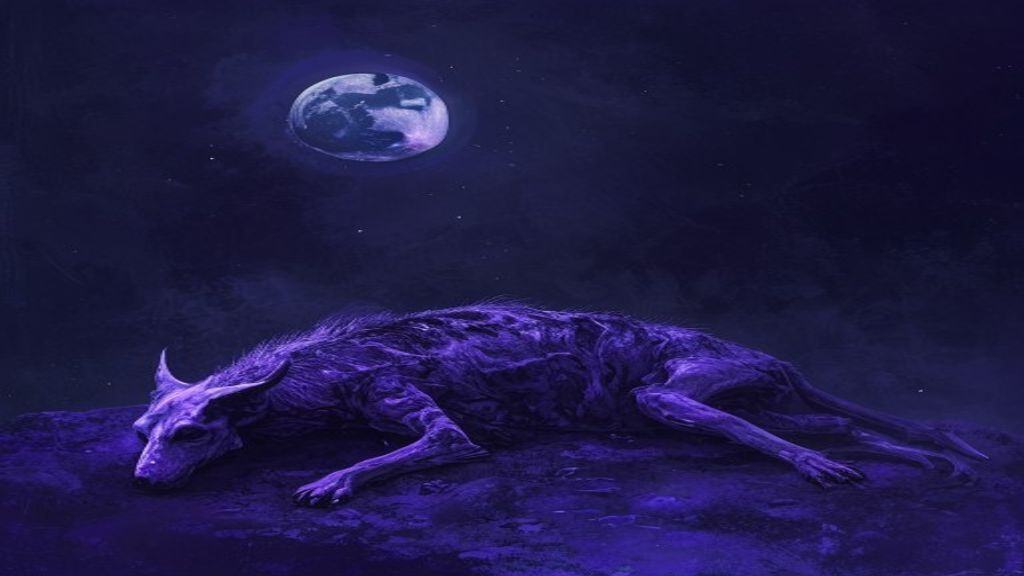
Dreaming of a dead dog almost always touches loyalty and loss, whether the dog was real and recently gone, or a symbol of something else you’ve loved and lost. When the dead dog is a stranger, it tends to point to a relationship, a commitment, or a version of yourself defined by devotion that has ended. Either way, the dream isn’t morbid. It’s paying attention.
The weight of it in the morning
What distinguishes this dream from other animal dreams is that specific heaviness on waking. The usual verdict isn’t a disturbing dream. It’s a dream that sat there all morning and wouldn’t shake loose through breakfast. The feeling is closer to the residue of real grief than the residue of fear, which is the first useful clue about what the dream is actually doing.
If the dog in your dream was a dog you knew, one who’s died, or one still alive, the dream is doing something relatively direct. It’s processing the loss, or the anticipated loss, or the guilt that often trails pet loss (the decisions made, the timing, the days you were too tired to walk them). Dreams can be startlingly specific about grief that hasn’t been fully felt yet. Sometimes the dog dies in the dream before it has in waking life, and the dreamer wakes shaken by the preview. That version is worth sitting with rather than dismissing.
When you didn’t know the dog
This is the reading people find more surprising: the dead dog you’ve never met. An unknown dog that’s dead in a dream usually points to something that was loyal to you and is now gone, but that something isn’t a dog. A friendship defined by devotion and reliability. A job you believed in. A version of a relationship that ran on a particular kind of trust. Dogs in dreams carry the specific vocabulary of loyalty, faithfulness, the willingness to stay.
A Jungian reading takes the dog as a figure from the unconscious representing exactly those qualities: the instinctual capacity for unconditional attachment. When that figure dies in the dream, something unconditional has ended in waking life, or is ending. It would also note that the death in the dream doesn’t have to be tragedy, things that end have lived. The dream is marking the boundary, not pronouncing a verdict.
- 2nd century CE
Artemidorus in the Oneirocritica holds that the same dream means different things for different dreamers, depending on age, status and occupation. A dead dog would carry one meaning for a shepherd and another for a city dweller. His insistence on the dreamer’s own relationship to the image has proven durably useful.
- 1900s, Freud
The Interpretation of Dreams (published 1899, dated 1900) reads dreams as wish fulfilment, with manifest content disguising latent content. A dead dog in that framework is a disguise for something else, perhaps a bond that feels punished or a wish that has gone unspoken. Less useful here than other approaches, but historically the baseline.
- 1964, Jung
Man and His Symbols presents Jung’s archetypes to a general reader. In a Jungian reading, animals carry instinctual knowledge, and the dog stands for loyalty and the capacity for unconditional attachment. A dead dog marks the ending of something that operated on those terms.
- 2000s, Revonsuo
Threat simulation theory proposes that threatening dreams rehearse danger. Applied to a dead dog, it would say the dream runs the scenario of loss and discontinuity so we can metabolize it, not to predict, but to prepare. It is a stretch for grief, but not an empty one.
- Today
The most common reading synthesizes the above: the dead dog is grief made visible. Whether the loss is literal (a pet) or symbolic (a loyalty, a bond), the dream is honoring something that mattered enough to bury.
The guilt that comes with it
Guilt is rarely absent from this dream. Not always expressed directly, often it’s framed as wondering whether you did enough, or said goodbye properly, or whether the dog suffered. The guilt is part of what the dream carries. Dogs are creatures we’re responsible for, entirely, and that responsibility can become a weight that outlasts them.
The dreamed guilt tends to be the mind’s way of staying close to something it loved. It’s not accurate, it’s not a verdict on what you did, but it’s a kind of custody. The guilt version is arguably healthier than the numb version. The numb version is the one to watch. The guilt version is still engaged.
If the dog comes back
A distinct variation: the dog is dead in the dream, and then it moves, breathes, returns. This version is the most disorienting, and often the most comforting in retrospect. Psychologically, the returning dog tends to represent a quality or a relationship that was thought to be over, but hasn’t finished, or isn’t as finished as it seemed. Not a prediction. Not supernatural. Just the dreaming mind holding open a question it’s not ready to close.
I wouldn’t dismiss that reading as wishful thinking. The parts of us that grieve aren’t irrational. They’re doing accurate work about what mattered. If the dog you lost was your own, dreaming of your dead pet follows what comes back and why. And dreaming of a dog attacking shows the other face of the same animal, which matters if the dog in your dream turned from loyal to threatening.
There is an old and useful way to read a dead dog: as the end of something protective. That framing holds up. Whatever the dog represented, faithfulness, a relationship’s best quality, a version of yourself that trusted easily, it was guarding something. And now it isn’t. The dream is asking you to notice what’s less protected now, and maybe to decide whether it needs new protection. Or whether it’s finally safe to put down.
If the dog was a stray or a stranger, dreaming of a dead animal asks what the creature meant to you alive, which is the question that opens most of these dreams.
- Was this a dog I had known? If so, is there grief around that loss I haven’t fully sat with?
- If I didn’t know the dog, what in my life was defined by loyalty or devotion and has recently ended?
- Was there guilt in the dream? What would I need to forgive, myself, or the situation?
- Did the dog come back? If so, what do I wish weren’t over?
One symbol, two traditions
The disagreement is honest: one school sees dead dog as self-communication, the other as an image to be discerned against Scripture. They can inform each other, but they do not merge.
Dreaming of a dead dog almost always touches loyalty and loss, whether the dog was real and recently gone, or a symbol of something else you’ve loved and lost. When the dead dog is a stranger, it tends to point to a relationship…
You are reading this oneThe dog in Scripture most often signals radical unworthiness (2 Samuel 9:8), the outsider or unclean (Matthew 15:26; Revelation 22:15), or the person trapped in compulsive self-harm (Proverbs 26:11). A dead dog specifically is…
Read the biblical meaning →Quick answers
What does it mean to dream of a dead dog?
It most often processes loyalty and loss. If the dog was one you knew, the dream is working through grief or guilt connected to that specific bond. If the dog was a stranger, it usually represents a quality, faithfulness, devotion, unconditional attachment, that has ended or is ending in your waking life.
Is dreaming of a dead dog a bad omen?
But it’s not a prophecy of disaster. It’s the dream honoring an ending that the waking self may still be processing. Difficult, but not a bad sign.
Why does this dream feel so heavy when I wake up?
Because it’s doing real grief work, or rehearsing it. Dreams that carry that persistent morning weight tend to be processing something that hasn’t been fully felt in waking life. The heaviness is the dream being effective, not excessive.
What does it mean when the dead dog comes back to life in the dream?
That version tends to point to something you thought was over that may not be, a bond, a version of a relationship, a quality in yourself. It’s worth asking what you’re not quite ready to release, and whether that’s wisdom or avoidance. Both are possible.
Sources for this reading
- Domhoff, G. W. (2003). The Scientific Study of Dreams: Neural Networks, Cognitive Development, and Content Analysis. American Psychological Association.
- Domhoff, G. W. (1996). Finding Meaning in Dreams: A Quantitative Approach. Plenum Press.
- Revonsuo, A. (2000). The reinterpretation of dreams: An evolutionary hypothesis of the function of dreaming. Behavioral and Brain Sciences, 23(6), 877-901.DOI
- Jung, C. G. (Ed.). (1964). Man and His Symbols. Doubleday.
- Freud, S. (1900). The Interpretation of Dreams (Die Traumdeutung; first published November 1899). English translation by James Strachey, Basic Books.
- Artemidorus of Daldis (2nd century CE). Oneirocritica. English edition: Harris-McCoy, D. E. (2012). Artemidorus’ Oneirocritica: Text, Translation, and Commentary. Oxford University Press.
Full bibliography on Sources and method. Found a mistake? Tell us and see the corrections log.