- Tradition
- Psychological readingAnimal dreams
- How common
- 22.1%of people have had itNielsen et al., 2003
- Also read in
- The BibleSame symbol, other tradition
- Draws on
- Revonsuo, Artemidorus
- Reviewed
- 5 min read
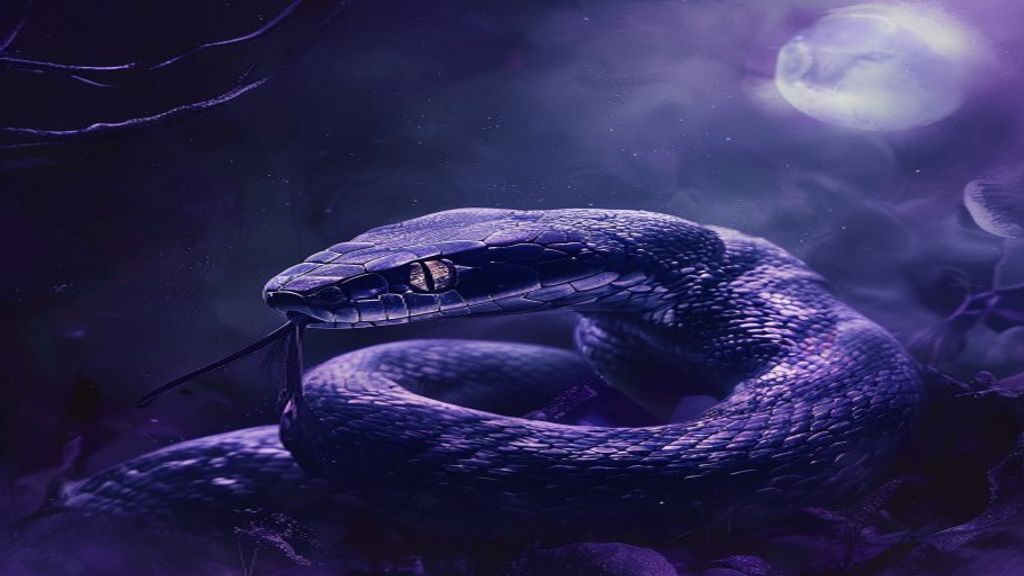
Snake dreams get dismissed as too obvious: every tradition’s favorite symbol, read the same way for centuries. The bite complicates that. It leaves a wound on a specific body part, the ankle, the wrist, the hand, and the sensation can still be there on waking. Threat simulation theory, proposed by Antti Revonsuo in 2000, holds that dreaming rehearses danger so the waking mind stays sharper. That phantom sting is what makes this dream hard to dismiss.
A snake biting in a dream usually marks an intrusion: something has broken through a boundary. The bite location tells you where, the snake’s behavior tells you whether the venom is transformative or simply threatening, and the sting you wake with is the mind insisting you don’t dismiss it.
The place it bit you
The body part is rarely chosen at random by the dream. A bite on the hand tends to arrive when your capacity to act, to make things, to give, is under some kind of threat or pressure. The wrist is stranger: it’s where something could stop you entirely, and those dreams often come when the dreamer is overextended in a way they haven’t admitted yet. Ankle or foot bites show up when movement feels dangerous, when whatever step you’re about to take is the one that’s at stake.
None of this is mystical anatomy. It’s the dream borrowing the logic of the body to point at a waking-life dynamic. Your mind already knows which part of your situation is most vulnerable. It just found a way to mark it.
How it bites across traditions
| Tradition | How it reads the symbol |
|---|---|
| Ancient Egypt (Chester Beatty papyrus, ~1200 BC) | A snake bite in a dream was often read as a warning of hidden enemies, but also as potential healing: the serpent was sacred to both destruction and medicine. |
| Artemidorus, 2nd century | In the Oneirocritica, snake bites signal harm from someone known to the dreamer, with the snake’s color and behavior narrowing the meaning. A bite without pursuit was a lighter warning than a prolonged attack. |
| Jungian reading | The serpent as shadow content: it bites when repressed material forces its way into consciousness. The pain is the border being crossed. |
| Ibn Sirin tradition | A snake biting in a dream may represent an enemy’s active move, or a health matter that demands attention. The dreamer’s own composure in the dream matters as much as the bite itself. |
What it usually isn’t
A prediction of physical harm. A judgment on your character. A snake dream is almost never the universe telling you something bad is definitely coming. I know that’s what the first instinct reaches for when you wake up with that phantom sting in your wrist. Threat simulation theory is useful here precisely because it’s so unromantic: the dreaming brain rehearses threats to make the waking brain sharper. The snake bite might be your mind preparing you to notice something it’s already clocked.
The bite that transforms
Not all snake bites in dreams feel like attacks. Some feel like tests. The dreamer is bitten and waits for the venom to work, sometimes it does, sometimes it doesn’t, sometimes the bite turns out to be the beginning of something rather than an ending. When that happens, the bite initiates rather than damages. Color narrows it further, and a red snake is the vivid case, where urgency comes attached to the bite.
The Jungian frame is heavy here, and I don’t always trust it, but the idea of the serpent as an initiating force rather than purely a predator is hard to set aside entirely. The mythology all points the same direction: snakes shed their skin. They persist by changing. A dream that bites you might be pushing you toward something you’re not ready to enter willingly.
When this dream recurs, the location may shift. A dreamer who tracks the bite across several nights, ankle to wrist to hand, may well be able to match each move to something changing in their waking life. The dream is moving along with the threat, updating it. It’s a strange kind of loyalty, if that’s the right word. A swarm of bees carries the same logic from the other end: not one bite but many small ones, pressure spread across many points rather than concentrated in one.
And if the dream keeps biting the same place, over the same nights, it’s worth asking what in your waking life is being repeatedly threatened at exactly that point. The body part, the location, the insistence: these aren’t decorative. The dream is a very literal cartographer of your vulnerabilities. I find that more useful than frightening. Sometimes it takes the phantom wrist-ache a few mornings in a row before you sit up and actually pay attention. Spiders carry a similar energy in dream life: patient, present, waiting for you to notice.
- Where exactly did it bite me, and what does that body part do in my waking life?
- Did the bite feel like a threat, a test, or something else entirely?
- Was the snake familiar, or a stranger? Big, or unremarkable?
- Am I carrying a phantom sensation right now, and what is it pointing at?
One symbol, two traditions
Psychology keeps snake biting inside your own story, a symbol your mind built from your days. The biblical tradition looks outward instead, and asks whether Scripture gives the image any voice at all.
A snake biting in a dream usually marks an intrusion: something has broken through a boundary. The bite location tells you where, the snake’s behavior tells you whether the venom is transformative or simply threatening, and the…
You are reading this oneScripture contains two major snake-bite episodes: the fiery serpents of Numbers 21, where bites kill and looking at the bronze serpent heals, and the apostle Paul’s bite on Malta in Acts 28, which does nothing to him. Neither is…
Read the biblical meaning →Quick answers
What does it mean when a snake bites you in a dream?
It usually marks an intrusion: a boundary has been broken, something has forced its way through a defense. The location of the bite, the behavior of the snake, and your own reaction in the dream together tell you far more than the bite alone.
Is a snake bite dream a bad omen?
Across most traditions it’s a signal rather than a verdict, and it can go either way. A painful, threatening bite leans toward a waking conflict or pressure you’ve been avoiding. A calm or painless bite often signals transformation: something is beginning rather than ending.
Why do I still feel the bite when I wake up?
That phantom sensation is your nervous system completing the threat response it started. It’s also the mind’s way of insisting you don’t dismiss the dream. The more vivid the physical sensation, the more urgent the underlying concern.
What does a snake biting my hand or wrist mean in a dream?
Hand bites tend to point at your capacity to act, make, or give, as under pressure. Wrist bites are rarer and tend to arrive when the dreamer is overextended or when something feels potentially stopping rather than merely inconvenient.
Sources for this reading
- Revonsuo, A. (2000). The reinterpretation of dreams: An evolutionary hypothesis of the function of dreaming. Behavioral and Brain Sciences, 23(6), 877-901.DOI
- Artemidorus of Daldis (2nd century CE). Oneirocritica. English edition: Harris-McCoy, D. E. (2012). Artemidorus’ Oneirocritica: Text, Translation, and Commentary. Oxford University Press.
- Nielsen, T. A., Zadra, A. L., Simard, V., Saucier, S., Stenstrom, P., Smith, C., & Kuiken, D. (2003). The typical dreams of Canadian university students. Dreaming, 13(4), 211-235.DOI
Full bibliography on Sources and method. Found a mistake? Tell us and see the corrections log.