- Tradition
- Psychological readingAnimal dreams
- How common
- 33.8%of people have had itNielsen et al., 2003
- Also read in
- The BibleSame symbol, other tradition
- Draws on
- Revonsuo, Artemidorus
- Reviewed
- 6 min read
The usual assumption is that a spider dream is a fear dream: spiders frighten people, so the dream must be frightened too. For someone with a genuine phobia that may well be right. But the symbol carries an older, less nervous meaning. A spider is a builder, and a web is a structure made patiently, in the dark, out of the animal’s own body, engineered for a purpose that has nothing to do with you. That is why so many of these dreams feel stranger than they feel scary.
Spider dreams are one of those categories where the dreamer’s waking feeling about spiders matters enormously. If you’re genuinely arachnophobic, the dream is almost certainly working on fear, and the interpretation is closer to Antti Revonsuo’s threat-simulation framework: your nervous system running a stress drill. But most spider dreams don’t feel like horror. They feel like something else, stranger and harder to categorize.
The web before the spider
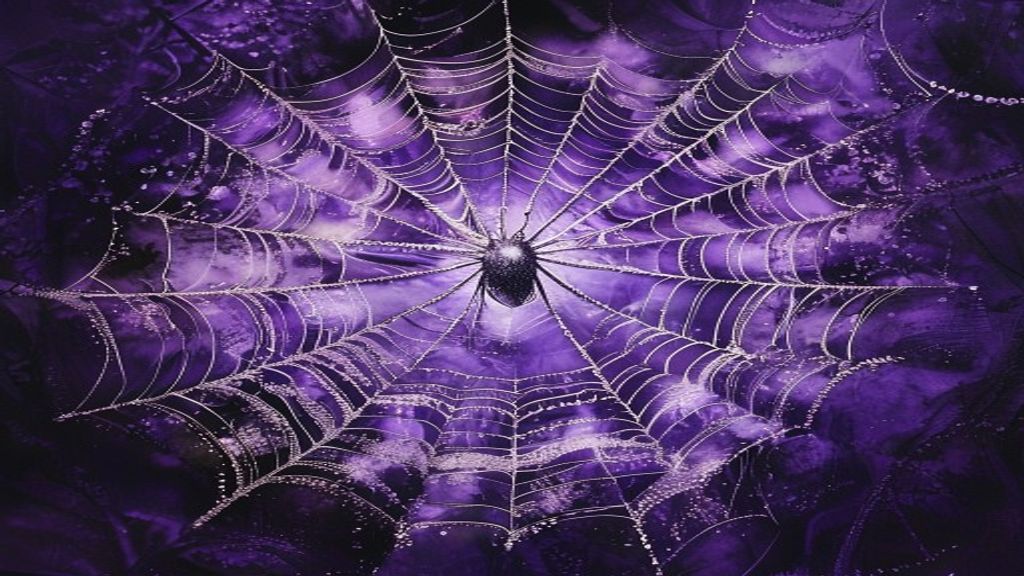
What a spider produces is more interesting than the spider itself. A web is patient construction. It requires precision, repetition, a structural logic that isn’t visible until it’s complete. And it’s invisible in the right conditions. You walk into it without knowing it was there. Or you see it from a distance, jeweled with dew, and it looks like nothing else in the world.
That double nature, trap and wonder, is almost always present in spider dreams. People rarely dream of spiders as purely one thing. The spider in the corner of a dream might be quietly ominous or quietly magnificent, and the difference usually comes from the dreamer’s own sense of whether something being built or spun in their life feels like creation or entrapment.
Depth psychology has often treated the spider as one of the older feminine symbols, linked to fate, to creative power, to the mother figure in its more complex forms. I take that reading seriously and also find it slightly abstract for practical purposes. What I find more useful is its underlying point: the spider isn’t just an animal in these dreams. It’s a figure of deliberate construction. Whatever it’s doing in your dream, it’s doing it on purpose.
What Artemidorus’s principle does for spiders
Artemidorus is the closest thing the ancient world has to a systematic dream dictionary, and his guiding principle is worth citing here: the same dream means different things depending on the dreamer’s age, status and occupation. Spiders show why that matters. For a weaver or anyone who lives by patient, invisible labor, a web is an emblem of livelihood. For someone else it is a snare. Read that way, a spider dream isn’t primarily about fear. It is about craft, the kind of work that builds something over time.
That’s a reading that holds up. Spider dreams appear frequently during periods when someone is building something slowly, a business, a creative project, a relationship that requires sustained, careful tending. The spider isn’t threatening in these dreams. It’s a kind of witness, or a mirror.
- Notice the spider’s behavior firstWas it building, still, moving toward you, or somewhere above you? Each is a different question. A building spider points at creation and deliberate effort. A still spider is a warning held in suspension. A spider descending toward you is often about something you’ve been avoiding that is now arriving on its own schedule.
- Notice your position relative to itAre you watching from a distance, or trapped in the web, or being pursued? The dreamer’s physical relationship to the spider usually tells you whether this is about admiration, entanglement, or threat. Most people don’t think to record this and wish they had.
- Notice the web’s conditionIntact and geometric suggests a plan with structural integrity. Broken or abandoned suggests something that was built has come apart. An enormous web you didn’t see coming tends to represent a situation whose scale you underestimated.
- Notice the feeling on waking, not duringSpider dreams are notorious for shifting tone between the dream and the moment you open your eyes. Fear during, calm after: the dream may have been processing something your conscious mind has already accepted. Calm during, unsettled after: worth paying more attention.
- Ask whether you’re the spider or the flyThis sounds crude but it’s genuinely clarifying. Are you the one building, trapping, spinning? Or the one caught in something someone else constructed? The dream rarely makes this ambiguous once you ask it directly.
The large spider
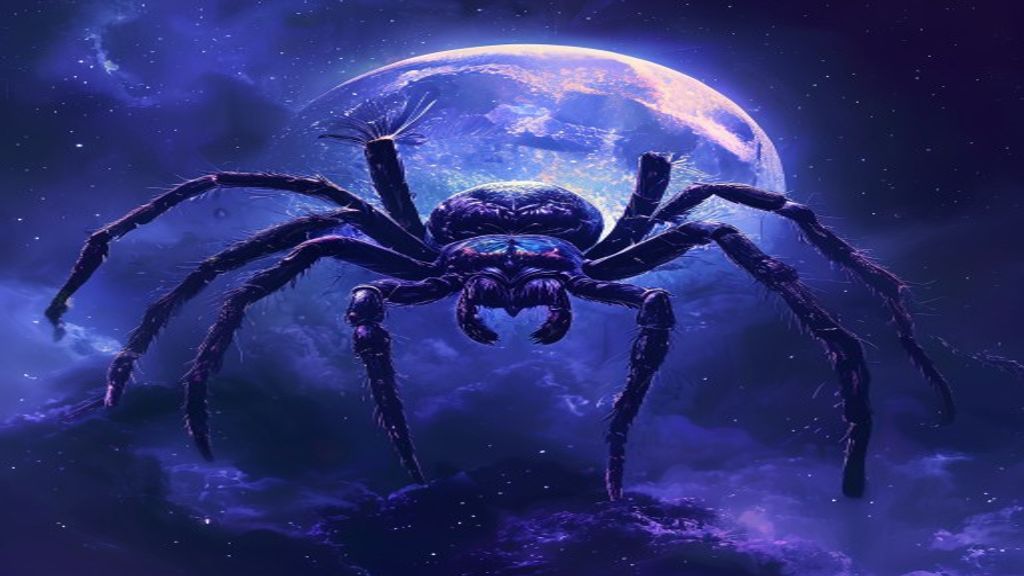
Oversized spiders, the ones that shouldn’t exist at that scale, almost always represent something whose influence in your life has grown beyond its apparent size. A worry that’s taken up more cognitive space than its actual importance warrants. A person whose opinion you’ve inflated into something architectural. An obligation that started small and is now load-bearing.
The gigantic spider is a spider dream wearing the costume of a power-and-dominance dream. The threat feels existential. But it’s still a spider. It’s still about webs and patient construction and invisible influence. The scale is your mind’s way of saying: you’ve been underestimating how much space this takes up.
If you’re afraid of spiders in waking life
Then the symbolic reading takes a back seat and the threat-simulation one steps forward. Revonsuo’s framework suggests the dream is rehearsing a fear response, calibrating it, running it at lower stakes. That doesn’t mean the dream has nothing else in it. Phobia-adjacent dreams often layer the literal fear over a more metaphorical one. But trying to find the web-and-creation symbolism in a dream that was mostly about running from something eight-legged is probably the wrong starting point.
Start with the fear. Sit with it. The symbolic layer, if it’s there, will usually become visible once the fear has been acknowledged rather than pushed aside.
Back to the builder
Take someone about eight months into a career pivot, the kind that requires you to spin your own infrastructure from scratch, without knowing if anything will land in it. A web dream could leave that person oddly less anxious on waking. Not because the dream promised it would work, but because the image of something engineered and invisible, built in the dark before anyone arrived to see it, would feel right. Like that was what they were doing.
I don’t know if that counts as interpretation or just recognition. Maybe they’re the same thing. If the spider itself changes shape mid-dream, you are in different territory, closer to dreams where an animal transforms, where the point is the change rather than the creature. But the spider dreams that stay with people are usually the quiet ones, a spider in a corner doing what spiders do, and something in the dreamer watching with a feeling they can’t quite name.
- Was I watching the spider, caught by it, or becoming it? That position shifts the reading completely.
- Was there a web? If so, was it intact, broken, or one that caught me without warning?
- Am I building something in my waking life that requires patience and invisible labor?
- Is there something whose influence I’ve been underestimating, something that’s taken up more space than I admitted?
One symbol, two traditions
Psychology keeps spider inside your own story, a symbol your mind built from your days. The biblical tradition looks outward instead, and asks whether Scripture gives the image any voice at all.
It depends on the dream’s texture. Spiders can represent patient creative work, invisible influence, entrapment, or fear, sometimes all at once. The spider’s behavior and your position relative to it matter more than the spider…
You are reading this oneIsaiah 59:6 describes webs that don’t cover and garments woven from them that don’t protect. Within a biblical frame, being caught in a web might point to a situation where what appeared to offer protection has instead become an…
Read the biblical meaning →Quick answers
What does dreaming of spiders mean?
It depends on the dream’s texture. Spiders can represent patient creative work, invisible influence, entrapment, or fear, sometimes all at once. The spider’s behavior and your position relative to it matter more than the spider itself.
Is dreaming of spiders a bad omen?
Not traditionally. Many cultures treat them as symbols of fate and creative power. The modern psychological reading is more neutral: the dream reflects what the dreamer is building or caught in.
What does a giant spider in a dream mean?
Usually that something in your life has grown larger than you’ve consciously acknowledged. A worry, a person’s influence, an obligation. The outsized scale is your mind’s way of flagging the discrepancy between how much space something takes and how much you’ve admitted it does.
What does it mean to be trapped in a spider’s web in a dream?
That you’re caught in something whose structure was built by someone else, or built by an earlier version of yourself that you can’t easily undo. The web-trap version tends to appear when someone feels their options have narrowed through gradual, incremental commitments rather than one clear choice.
Sources for this reading
- Revonsuo, A. (2000). The reinterpretation of dreams: An evolutionary hypothesis of the function of dreaming. Behavioral and Brain Sciences, 23(6), 877-901.DOI
- Artemidorus of Daldis (2nd century CE). Oneirocritica. English edition: Harris-McCoy, D. E. (2012). Artemidorus’ Oneirocritica: Text, Translation, and Commentary. Oxford University Press.
- Nielsen, T. A., Zadra, A. L., Simard, V., Saucier, S., Stenstrom, P., Smith, C., & Kuiken, D. (2003). The typical dreams of Canadian university students. Dreaming, 13(4), 211-235.DOI
Full bibliography on Sources and method. Found a mistake? Tell us and see the corrections log.