- Tradition
- Psychological readingAnimal dreams
- How common
- 33.8%of people have had itNielsen et al., 2003
- Also read in
- The BibleSame symbol, other tradition
- Draws on
- Revonsuo, Artemidorus
- Reviewed
- 4 min read
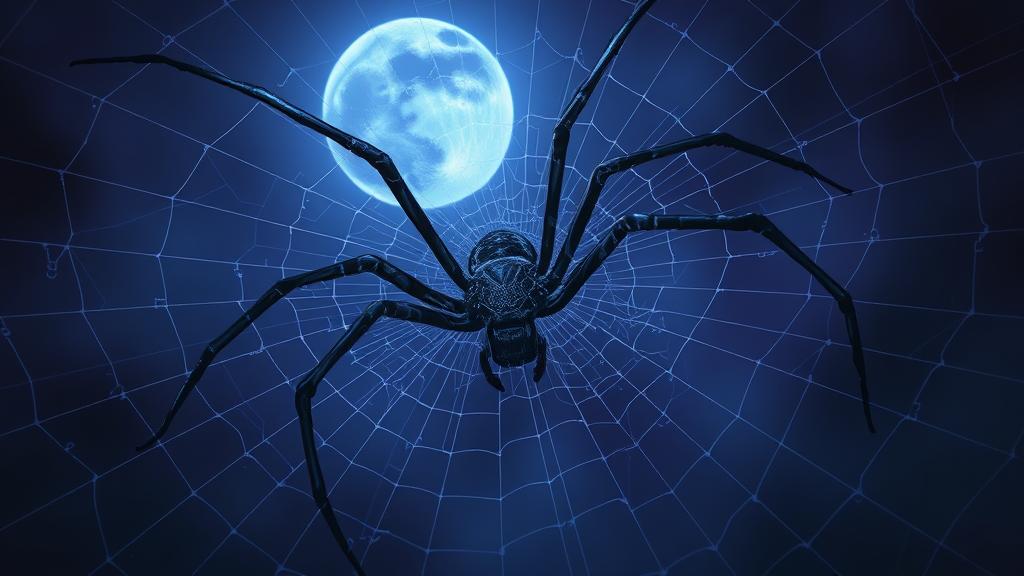
A spider in a dream doesn’t need to scare you to leave a mark. Someone who isn’t afraid of spiders at all can still wake from one rattled, and the reason is that the dream-spider rarely works through fear of the animal. It works through the web: patient, structured, built around a center, and already around you before you notice it.
A spider in a dream is rarely just a spider. It’s usually a creator, a trap, a patient force waiting at the center of something, or a signal about control. Your relationship with the web tells you more than the spider itself.
Two readings that pull in opposite directions
This is one of those symbols with a genuine split down the middle, and the split is legitimate. The spider builds something intricate, patient, structurally sound, and beautiful if you’re not in it. It’s also a trap. Both things are completely true of the web, and your dreaming mind knows which one it meant.
The Jungian tradition reads the spider, especially the large female, through the archetype of the terrible mother: the force that creates and also devours. That sounds dramatic until you think about any relationship or system in your life that has both nurtured you and made it genuinely difficult to leave. Most people have at least one of those. The spider is the dream’s shorthand for it.
But the same tradition also reads the web as a symbol of creative construction, the self spinning its own structure outward. That reading gets less press because it’s less cinematic, but it’s the one that fits when the dreamer is the spider, not the fly.
Which version did you get
What Artemidorus would ask
Artemidorus, writing the Oneirocritica in the second century, held that the same dream means different things for different dreamers, depending on age, status and occupation. For a spider, that is exactly the web tension: to a weaver or a craftsperson the web is livelihood and skill, to someone entangled in debt or obligation it is a trap. The spider is almost always, in some way, about method. How things get built. How traps get laid. Whether you’re laying them or walking into them.
The web is patient in a way you might not be
The thing that makes spider dreams linger is the patience encoded in the image. A web doesn’t chase you. It waits. And something about that quality of waiting, that structural patience, unsettles people more than a creature that runs toward them would. The spider dream often belongs to people in a situation they’re not sure is safe to exit, or not sure they want to exit, and that ambiguity is the web. You can see all the threads. You’re still in it.
A cheetah is the flip side: speed and power where the spider has stillness, an animal that refuses to wait, which is what dreaming of a cheetah reads. A giant snake encloses the way a web does, large and coiling and not quite escapable, so dreaming of a giant snake is the version where the enclosing system has a body. And the builder side of the spider, the patient work itself, is the subject of dreaming of a spider spinning its web.
Back to the opening: the dream that rattles someone who isn’t afraid of spiders. What does the rattling is recognition. Not fear of the animal. Recognition of the web. Something in your waking life has arranged itself around a center you haven’t quite looked at directly, and the dream makes you look. That’s the spider’s actual work, in the end. Not to frighten. To make visible.
- Was I the spider, the fly, or the observer?
- What in my waking life has that quality of patient, structural waiting?
- Does the web in the dream feel like something of my own making or something I stumbled into?
- If I named the person or situation the spider was standing in for, who or what would it be?
One symbol, two traditions
Read side by side, the two traditions pull in different directions: spider as a signal from your own mind, or spider as an image to test against the text. Knowing which question you are asking is half the interpretation.
A spider in a dream is rarely just a spider. It’s usually a creator, a trap, a patient force waiting at the center of something, or a signal about control. Your relationship with the web tells you more than the spider itself.
You are reading this oneIsaiah 59:6 describes webs that don’t cover and garments woven from them that don’t protect. Within a biblical frame, being caught in a web might point to a situation where what appeared to offer protection has instead become an…
Read the biblical meaning →Quick answers
What does dreaming of a spider mean?
It depends on your position in the dream. The spider as builder points to patient creative effort. The spider as waiting presence points to a relationship or system that holds its structure around you. Being caught in the web usually means some situation has more threads attached than you’d like.
Is a spider dream a bad omen?
No tradition treats it as straightforwardly bad, and most don’t treat it as straightforwardly good either. The spider holds both creation and entrapment in the same image. Your feeling in the dream is the best guide to which reading fits.
What does it mean when a spider is very large in a dream?
Size in dreams amplifies the emotional weight, not the literal animal. A huge spider usually means whatever the spider represents feels large and hard to manage right now. Jung would read it as the devouring mother archetype; you can also just read it as something in your life that feels too big to confront directly.
Why do I keep dreaming about spiders?
Recurring spider dreams often mean there’s a web you’re living inside and haven’t fully acknowledged. Some situation or relationship with threads attached that you’re navigating around rather than addressing. The dream tends to keep returning until the structure is named.
Sources for this reading
- Revonsuo, A. (2000). The reinterpretation of dreams: An evolutionary hypothesis of the function of dreaming. Behavioral and Brain Sciences, 23(6), 877-901.DOI
- Artemidorus of Daldis (2nd century CE). Oneirocritica. English edition: Harris-McCoy, D. E. (2012). Artemidorus’ Oneirocritica: Text, Translation, and Commentary. Oxford University Press.
- Nielsen, T. A., Zadra, A. L., Simard, V., Saucier, S., Stenstrom, P., Smith, C., & Kuiken, D. (2003). The typical dreams of Canadian university students. Dreaming, 13(4), 211-235.DOI
Full bibliography on Sources and method. Found a mistake? Tell us and see the corrections log.