- Tradition
- Psychological readingAnimal dreams
- Draws on
- Revonsuo, Jung, Hartmann
- Reviewed
- 4 min read
A dream takes an emotion and gives it a central image: that was Hartmann’s argument in Dreams and Nightmares (1998), and it explains why the obvious reading of a hyena dream is almost always wrong. The emotion on offer is often a borrowed one: wariness inherited from stories, from the scavenger and the thing that laughs. The image is carrying a reputation, and a reputation is not the animal. Being almost always wrong is a meaningful quality in a dream symbol.
A hyena in a dream rarely means what the cultural reflex says it does. It’s more often a symbol of something misread, underestimated, or judged before being understood. Including, sometimes, a part of you.
What we think we know about hyenas
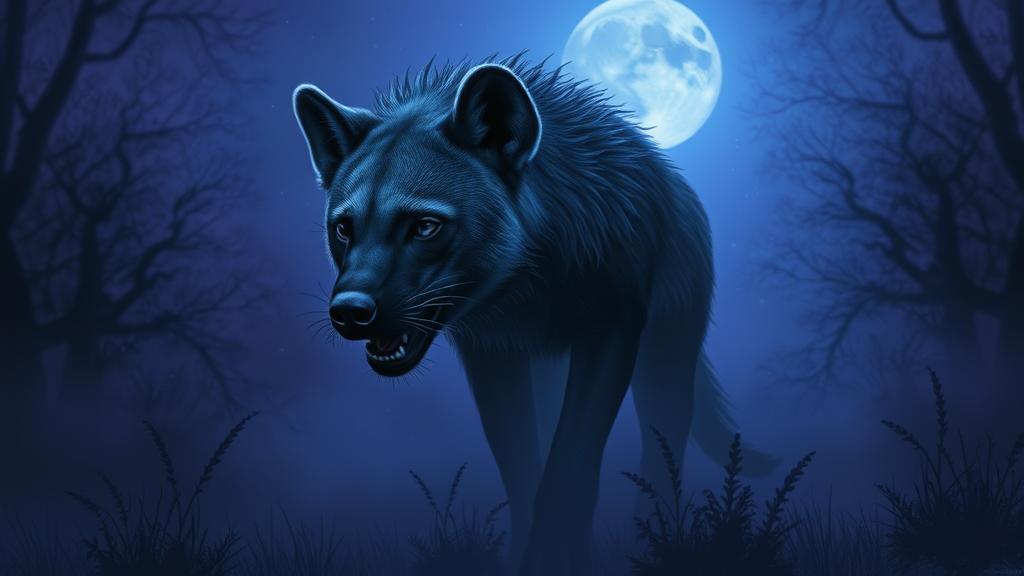
The hyena has a reputation problem. It’s the animal Western culture decided to dislike: the laugh that sounds wrong, the body that looks wrong, the habits that seem like cheating somehow. Scavengers, people say, as if feeding efficiently were a moral failure. The actual animal is a cooperative, matriarchal, highly intelligent predator that’s been miscast as a villain for centuries. Your dream probably knows this, even if you don’t.
When Jung wrote about shadow, the parts of the self we refuse to own, he was interested in exactly this mechanism: we project what we find uncomfortable onto figures that already carry the cultural weight of being unwanted. The hyena in your dream might be shadow material. But shadow isn’t the same as bad. Shadow is the part of you that’s been decided against, not the part that’s actually dangerous.
How the reading has changed across time
- Ancient Egypt
The hyena appeared in hunting scenes and carried ambivalence: predator, prey, and transformer of carrion into usable energy. Less villain than necessary figure in the cycle.
- 2nd century Rome
Artemidorus held that the same dream means different things for different dreamers, which already argues against a fixed verdict on the hyena. The meaning depends on who is dreaming and what they stand to lose or gain.
- Medieval Europe
Medieval European animal lore cast the hyena as a moral symbol of inconstancy and uncleanness, cementing its reputation as something to be wary of. This is where much of our discomfort comes from.
- 20th century psychology
Jung’s framework reopened the question. Shadow animals in dreams are rarely simple warnings. They’re invitations to look at what’s been refused recognition.
- Contemporary dream research
Revonsuo’s threat-simulation model holds that threatening dream animals evolved to rehearse responses to danger. But the hyena rarely behaves as a pure threat in dreams. It watches. It waits. It often just appears and stays.
The laugh you didn’t ask for
If the hyena in your dream made its sound, that’s worth sitting with. The hyena’s laugh is a contact call, a social signal between members of a clan. It’s not mockery and it’s not cruelty. We’ve been reading it as both for so long that the sound carries all that freight now, and a dream that gives you the laugh is using that freight deliberately. Something in your life is being read as ridicule or threat that might actually be contact. A reaching out that got mistranslated.
I’m usually careful about pushing a single interpretive frame, but the misread-signal reading holds up well for hyena dreams. The animal appears, it watches, it sometimes makes its sound, and the dreamer wakes up unsettled in a way that doesn’t quite make sense given that nothing happened. That unsettlement is information. Not danger. Just a residue from something that hasn’t been understood yet.
The one version that is a warning
A hyena that’s circling you and won’t stop: that’s closer to the threat-rehearsal dream. Not a villain from a story, but a genuine sense of being surrounded by something that wants what you have. Worth checking whether there’s an equivalent dynamic in waking life, someone or something that moves in when you’re weakened, waiting rather than confronting directly.
The animal that stays
Take a dream set in scrubland, low acacia trees, with a hyena sitting about fifteen metres away, just watching. It doesn’t move toward you. You feel no threat. You stand there and it sits there, and the dominant feeling is mutual assessment: something is looking at you and waiting to see how you’ll respond to being looked at.
There is no clean interpretation for that image. It rewards sitting with more than explaining. Jung might call it an encounter with an autonomous complex, a part of the self that’s been living outside the main story. What stands out is that you don’t run. In the dream, you stand your ground and look back. Whatever the hyena is, you don’t refuse it.
An otter makes a useful contrast: an animal the culture loves freely, set beside one it habitually misreads. And if the hyena appeared in a confrontational or chase context, a dog attacking is the cleaner threat image: where the hyena is ambiguous, an attacking dog usually isn’t.
- Was the hyena threatening, watching, or simply present? That distinction changes everything.
- Did it make its sound, and how did you receive it?
- Is there something in my life I’ve been reading as a threat that might actually be contact?
- What part of myself have I been calling the scavenger, the wrong one, the one that doesn’t fit?
Quick answers
What does it mean to dream of a hyena?
A hyena in a dream most often points to something that’s been misread or misjudged, sometimes a part of yourself, sometimes a situation or person. The cultural image of the hyena as villain is part of the dream’s material. It’s asking whether you’re seeing something clearly or seeing it through its reputation.
Is dreaming of a hyena a bad sign?
Not usually. The hyena has a frightening reputation that the dream is often specifically questioning. The exception is a circling, threatening hyena, which may point to a real dynamic of being preyed on or surrounded. Most hyena dreams are more ambivalent and more interesting than a simple warning.
What does it mean if the hyena was laughing in my dream?
The hyena’s call is a social signal, not mockery. A dream that uses that sound is often pointing at something that’s been received as ridicule or hostility and might actually be contact. Worth asking whether there’s a situation in your life where you’ve read a signal as hostile before fully understanding it.
Why do I dream of a hyena when I’m anxious?
Anxiety tends to activate dreams of ambiguous threat, things that might be dangerous and might not be. The hyena fits that register well. But the dream is often asking you to look more carefully rather than flee, to distinguish between genuine threat and the animal that just has an unfortunate laugh.
Sources for this reading
- Revonsuo, A. (2000). The reinterpretation of dreams: An evolutionary hypothesis of the function of dreaming. Behavioral and Brain Sciences, 23(6), 877-901.DOI
- Jung, C. G. (Ed.). (1964). Man and His Symbols. Doubleday.
- Hartmann, E. (1998). Dreams and Nightmares: The New Theory on the Origin and Meaning of Dreams. Plenum Trade.
- Artemidorus of Daldis (2nd century CE). Oneirocritica. English edition: Harris-McCoy, D. E. (2012). Artemidorus’ Oneirocritica: Text, Translation, and Commentary. Oxford University Press.
Full bibliography on Sources and method. Found a mistake? Tell us and see the corrections log.