- Tradition
- Psychological readingAnimal dreams
- Draws on
- Revonsuo, Jung
- Reviewed
- 4 min read
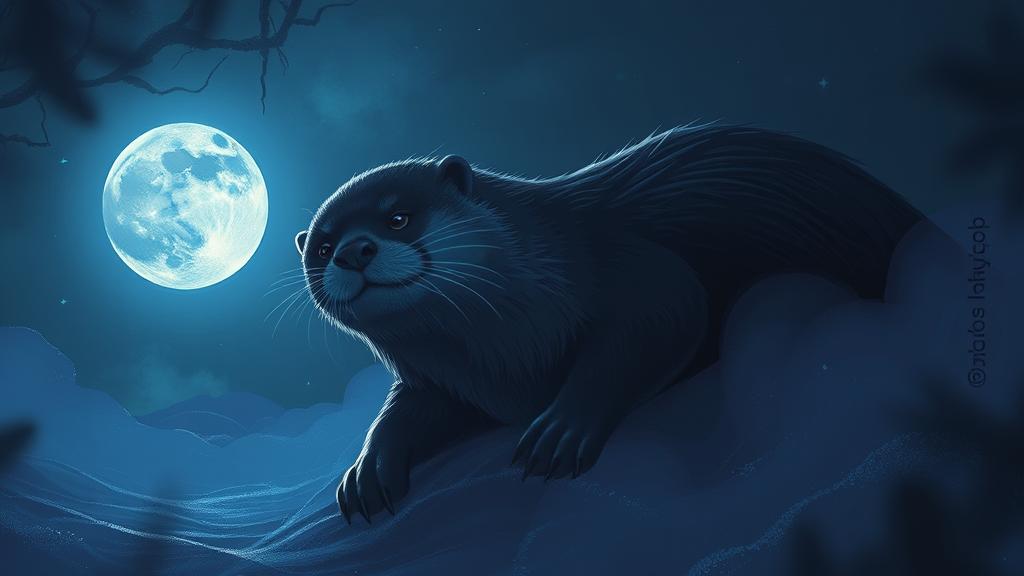
You’re standing on the bank of a river you half-recognise, and an otter cuts through the current below you, rolling once, tucking something against its chest, moving with that specific otter quality that looks like it’s having the best time and also completely means business. You wake up with the image still clear. And you’re not sure what to do with it, because nothing happened, really. No chase, no danger, no obvious message. Just the otter, the water, and the feeling that it knew exactly where it was going.
What the otter carries
The otter is one of the few animals that plays as an adult and does it with obvious intention. It uses tools. It carries its food on its chest like something precious. It moves through cold water that would slow most creatures down, and it makes the whole thing look frictionless. When it shows up in a dream, it’s rarely random. Your mind borrowed this specific animal for a reason, and that reason usually has something to do with the relationship between pleasure and purpose in your waking life.
Jung was interested in animals as expressions of instinctive knowledge, the parts of the psyche that know things the conscious mind keeps arguing about. An otter dream, in that frame, is the instinctive self demonstrating something: you can be in cold, fast water and still be at ease. You can carry what matters and still move lightly. Whether you’re actually doing that is a different question.
The thing it’s holding
If the otter in your dream was carrying something, that detail tends to be the whole message. Otters hold their food on their chests while they float on their backs, which is an impractical and oddly touching thing to do. In dreams, that image becomes a kind of portable tenderness: something you’re holding onto even while you rest, even while you drift. It might be a relationship, a project, a hope you haven’t told anyone about. The otter doesn’t let go of it. Notice whether, in waking life, you do.
Two readings it’s easy to confuse
The otter as permission
In this reading, the dream is giving you clearance. Play is not frivolous. Rest is not laziness. The otter moves through hard conditions with apparent joy, and your mind may be pointing out that you’ve been treating ease as something to be earned rather than maintained. This version of the dream tends to arrive when you’re exhausted or over-responsible.
The otter as question
In this reading, the dream is asking something. When did you last move through your life with that kind of ease? Is there a part of your day that still has that otter quality, purposeful and light at once? Or have you handed it over to obligation? This version tends to show up in the middle of long periods of grinding work that you can’t see the end of.
How to read what yours meant
Antti Revonsuo’s work on threat simulation in dreaming is a useful lens for what’s missing here: the otter dream isn’t a rehearsal for danger. It’s closer to the opposite, a rehearsal for ease, and maybe that’s the more interesting observation. Dreams don’t only process threats. They also practise the states we’ve forgotten how to enter. If your waking life has very little otter energy in it right now, the dream might simply be keeping the possibility warm.
The old readings
Older dream traditions tended to connect river animals with commerce, fortune, and the flow of things, and might well read an otter dream as a favourable omen for ventures that required both skill and luck. I’m not sure I’d go that far, but there’s something in the instinct: the otter does suggest a life where effort and current are working together rather than against each other.
If your otter shared the water with other animals, dreaming of a dolphin asks similar questions about joy and ease in water, with an added sense of something that swims beside you as a guide. And for what happens when the dream shifts from solitary play to collective purpose, dreaming of bees has the more grounded and socially complex energy.
- Was the otter carrying anything? What might that object represent to you?
- Was the water clear and moving, or dark and still?
- When did I last move through a hard day with that kind of ease?
- Is there something I’ve been holding onto even while I rest, and do I want to?
Quick answers
What does it mean to dream of an otter?
An otter in a dream usually points to the relationship between play and purpose in your life. It’s a symbol of ease in difficult conditions, of carrying what matters lightly. The dream’s emotional tone tells you whether you’re being shown something you have or something you’ve lost.
Is dreaming of an otter a good sign?
Usually yes. Otters tend to be positive dream animals, connected to adaptability, joy, and the ability to move through emotional water without struggling. The exception is an otter out of its element or visibly hurt, which shifts the meaning toward something blocked.
What does it mean if the otter was carrying something?
That’s often the core of the dream. Otters float on their backs carrying food on their chests, and in a dream that image becomes a kind of portable tenderness: something you’re holding onto while you drift. Think about what in your life that might be.
Why did I dream of an otter when I’m stressed?
That’s actually a common pairing. The dream may be offering contrast, a quality of ease and purposeful motion that your waking life currently lacks. It’s less a prediction than a reminder of a register you can still access.
Sources for this reading
- Revonsuo, A. (2000). The reinterpretation of dreams: An evolutionary hypothesis of the function of dreaming. Behavioral and Brain Sciences, 23(6), 877-901.DOI
- Jung, C. G. (Ed.). (1964). Man and His Symbols. Doubleday.
Full bibliography on Sources and method. Found a mistake? Tell us and see the corrections log.