- Tradition
- Psychological readingAnimal dreams
- Draws on
- Revonsuo, Jung, Artemidorus
- Reviewed
- 5 min read
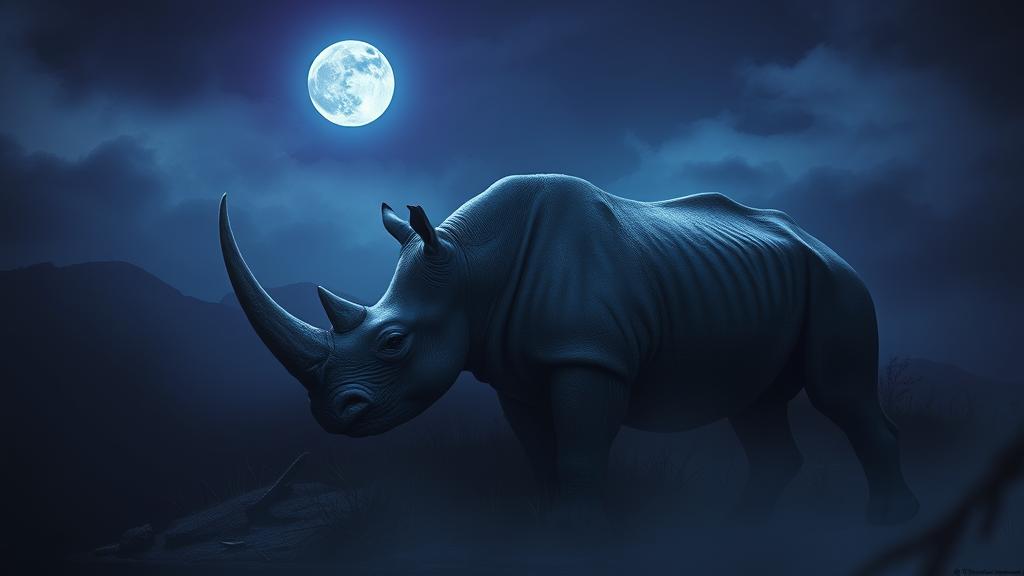
Brute strength is the default reading of a rhino dream: a bully, someone about to flatten you. That’s half right and mostly misses the point. A rhinoceros has poor vision and navigates largely by smell and sound, so all that force and all that horn is working on momentum and instinct. What the image carries isn’t power so much as commitment without a clear view, force that has already decided and is running on an old read of the terrain.
The reading across cultures
| Tradition | How it reads the symbol |
|---|---|
| West African oral traditions | The rhino signals an ancestor force: old, ungovernable, coming whether summoned or not. Dreams of it are treated as messages requiring community response, not private interpretation. |
| East African traditions | Connected to land and territorial claims. A dreamed rhino often heralded disputes over what belongs to whom, physical or otherwise. |
| Ibn Sirin tradition | Large charging animals in the Islamic dream tradition generally signal either an authority figure bearing down on you or your own suppressed ambition becoming impossible to contain. The rhino fits both. |
| Artemidorus (2nd c.) | Would likely categorize it as a beast of great force and peculiar vision, and read its presence as omen of a powerful but blunt-force outcome in a pending matter. |
| Jungian readings | The shadow made visible as something that can’t be reasoned with. Jung treated animals that charge in dreams as the eruption of instinctual energy that waking life has been trying to keep fenced. |
Something charging in near-darkness
There’s a specific quality to a rhino in motion, immediately recognizable even on film: pure committed forward motion with no apparent relationship to what’s actually in the way. That commitment, that near-sightedness, that horn pointing forward like punctuation at the end of a sentence already in progress. That’s what I think this dream is made of.
The Jungian tradition reads large, powerful animals in dreams as carrying the energy of the instinctual side of the psyche, the part of us that acts before the rational mind gets involved. I’m usually skeptical of reading everything through the shadow, but the rhinoceros is hard to argue with here. It’s an animal that doesn’t negotiate. It doesn’t reconsider. Whatever it’s doing, it’s doing fully.
Whether it’s yours or aimed at you
The most useful distinction in a rhino dream is position: are you watching it move, or are you the one moving? Dreamers who feel like they are the rhinoceros, or who feel aligned with it rather than threatened by it, usually wake with something more like exhilaration. Something that’s been stuck in them has momentum. They’ve been trying to reason their way around something that actually just needed force.
Dreamers who feel it moving toward them and can’t get out of the way are having a different experience entirely. That’s the version Revonsuo’s threat simulation frame captures best: the dream is rehearsing a confrontation with something large and unstoppable in your waking life. Not so you can outrun it, probably, but so you can at least stop pretending it isn’t there.
There’s a third position that is easy to overlook: watching the rhino charge something else, something or someone else in the dream landscape, while you stand off to the side. This one tends to arrive during periods when you’re aware of a large conflict building in your life that doesn’t directly involve you but that you know you can’t avoid entirely. The witness position in a rhino dream is its own uncomfortable reading.
The horn
Worth its own paragraph because it changes things. A rhino in the dream with the horn prominent, pointed, somehow the focal point of the image, tends to sharpen the reading toward a specific conflict or challenge, something pointed and singular rather than the general weight of force.
I’m also struck by what the horn is actually made of, which is keratin, the same material as fingernails and hair. Not bone, not iron. Compressed growth. There’s something in that which feels relevant to the dream: the most distinctive and dangerous part of this animal is made of accumulated ordinary material, hardened over time into something formidable. The thing you’ve been slowly building, quietly, without fully realizing it was becoming a weapon. Or a tool, depending on how you use it.
A puma is the other large force worth setting beside the rhino, because the two are opposites: the puma’s precision and the rhino’s momentum. The former waits; the latter doesn’t know how.
Patient construction and action that can’t be called back make a similar pair. A spider spinning its web is the slow, careful build. The rhino is what comes after the building is done. The web is patient. The rhino has already committed.
The poor vision is the most useful detail of all. All that armor, all that commitment, and the animal is essentially running on memory and instinct, not current information. The dream might be less about the force itself and more about that: the question of what you’re still charging toward based on an old read of the terrain. Whether the thing you’re barreling toward still looks the way it did when you first pointed yourself at it.
Recurring rhino dreams are worth noting specifically. When they come back more than once, they’re often tracking a situation where you’ve been aware of the confrontation ahead but haven’t adjusted your trajectory. The dream isn’t telling you to stop. It’s asking you to open your eyes properly before you hit something.
- Was I the rhinoceros, watching it, or in its path?
- What in my waking life is moving with that kind of committed, near-sighted momentum?
- Is there a confrontation I’ve been trying to reason around that actually just needs to happen?
- Am I running toward something based on how it looked a long time ago?
Quick answers
What does dreaming of a rhinoceros mean?
It usually points to unstoppable force, either yours or something aimed at you. The rhino in dreams is about committed momentum rather than strategic intelligence, and the reading depends heavily on whether you felt aligned with it or threatened by it.
Is a rhino dream a good or bad sign?
Both, depending on position. If you felt like the rhino, it often signals latent drive finally coming forward. If you felt like you were in its path, the dream is more likely pointing to an oncoming confrontation you’ve been underestimating.
What does it mean if the rhinoceros was charging at me?
A charging rhino almost always represents something in your waking life that’s past the point of being reasoned with or redirected. It might be someone else’s decision, a consequence that’s already in motion, or your own suppressed energy finally forcing its way through.
Does a rhinoceros in a dream relate to stubbornness?
Yes, often. The rhino’s poor vision and committed momentum make it a natural image for obstinacy, yours or someone else’s. The dream is usually asking whether that stubbornness is serving the direction you actually want to go.
Sources for this reading
- Revonsuo, A. (2000). The reinterpretation of dreams: An evolutionary hypothesis of the function of dreaming. Behavioral and Brain Sciences, 23(6), 877-901.DOI
- Jung, C. G. (Ed.). (1964). Man and His Symbols. Doubleday.
- Artemidorus of Daldis (2nd century CE). Oneirocritica. English edition: Harris-McCoy, D. E. (2012). Artemidorus’ Oneirocritica: Text, Translation, and Commentary. Oxford University Press.
Full bibliography on Sources and method. Found a mistake? Tell us and see the corrections log.