- Tradition
- Psychological readingNature dreams
- How common
- 27.3%of people have had itNielsen et al., 2003
- Also read in
- The BibleSame symbol, other tradition
- Draws on
- Domhoff, Artemidorus
- Reviewed
- 5 min read
Watch a forest burn in a dream and the obvious reading is disaster: loss, ruin, everything going up at once. It fails because of how the fire actually feels. Forest fires don’t creep. They make a sound like tearing paper scaled up to the size of a mountain, and the light they give is wrong. Orange and vertical and too certain of itself.
Many dreamers wake and reach for the word ‘nightmare’. Then they sit with it a moment and realize it wasn’t quite one. The fire was enormous and absolute and somehow, underneath the fear, there was something close to relief. That paradox is the whole subject.
The match you struck
The most important question is not what’s burning. It’s where you were standing when it started.
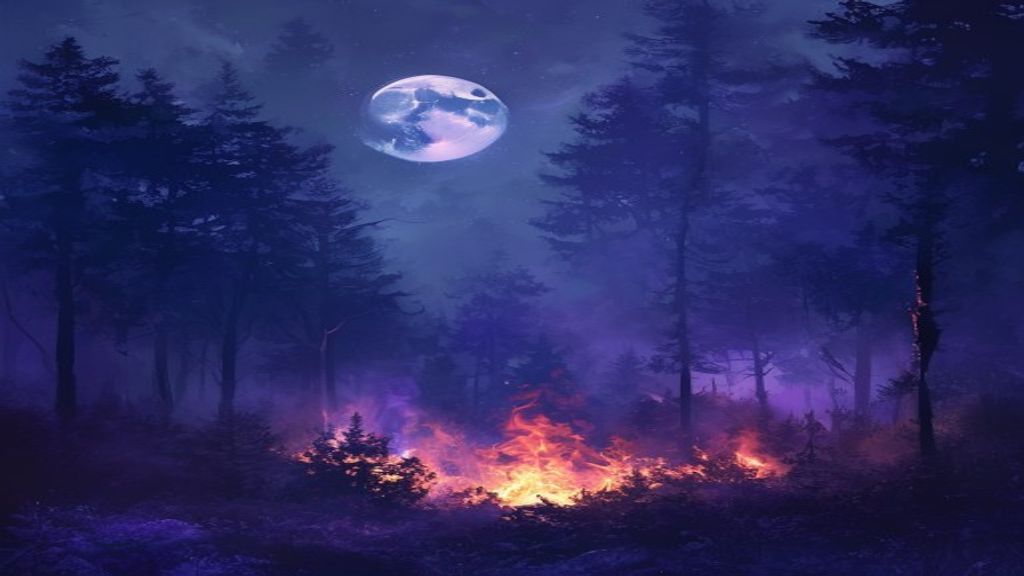
Take someone who has spent three years inside a work situation they knew for most of those years wasn’t right. Staying is a kind of staying, but it’s also a kind of burning from the inside out. When they finally leave, a dream might arrive about a week later: a hillside of dry pines, a wind, a small orange point of light at the base of the treeline. They stand at a distance and watch it climb. They don’t call for help. They don’t run. The fire isn’t theirs and it is absolutely theirs.
That feeling of watching something you’d been quietly exhausted by turn to ash. That’s not destruction, that’s clearance. The forest floor after a fire is strange and bare and rich with possibility. Seeds that only germinate in smoke. Ground that’s finally had the canopy pulled back.
A forest fire in a dream most often signals transformation, something large being cleared to make room for something new. If you felt fear but not devastation, that’s the clearest sign: your mind is burning off what it’s finished with, not what it needs.
How different cultures read this dream
| Tradition | How it reads the symbol |
|---|---|
| Ancient Greek (Artemidorus) | Artemidorus held that the same dream means different things for different dreamers, depending on age, status and occupation. By that rule a forest fire is a large change of circumstances, and whether it is welcome depends on who is dreaming it. |
| Jungian tradition | A Jungian reading treats fire as one of the oldest symbols of the transformative process: it destroys form but releases energy. A burning forest, in those terms, is psychic energy previously locked in unconscious material being released and made available. |
| Ibn Sirin tradition (Islamic) | This tradition reads dreams in light of the dreamer’s circumstances and of what happens to the dreamer in the dream. A fire that clears trees without harming the dreamer is the version most easily read as purification and the burning away of obstacles rather than punishment. |
| Indigenous North American traditions | Controlled burns are part of land stewardship. Fire as a tool of renewal, not catastrophe. A dream forest fire in this context can be read as appropriate clearing, a natural cycle being honored rather than a disaster. |
The dreamer’s position changes everything
Running from it is the version most people expect to have, and it’s the most anxious reading. Something in your life feels out of your control, too large, advancing faster than your capacity to manage it. The fire isn’t clearance in this case. It’s the pressure you’ve been under wearing vivid orange clothes.
Watching from a distance, like the dreamer on the hillside, is the contemplative version. You’re not running and you’re not in danger. You’re witnessing something that’s already decided to happen. There’s often a strange calm in these dreams, even something reverential. That’s your mind attending the end of something.
Starting the fire yourself is the version nobody likes to admit to. But it’s worth sitting with, because striking the match in your own dream is one of the more honest things your psychology can show you. It means some part of you has been wanting the clearing for longer than your waking self has been willing to acknowledge.
Domhoff’s continuity hypothesis applies here. If you’ve been in a relationship, a job, a life arrangement that’s gone hollow, your dreams know before you do. They don’t lie. A forest fire arriving in a dream about the time you’re standing at a major threshold isn’t coincidence. It’s punctuality.
When the fire was genuinely terrifying
Sometimes it’s just a nightmare. The fire has no symbolic relief in it. People are endangered, or animals, or the dreamer is trapped and the smoke is real and close. That version tends to follow genuine stress, overwhelm, or a period when things are moving faster than you can process. It’s the mind under pressure, not the mind preparing a clearance. Worth distinguishing.
What’s left after
Some forest fire dreams continue past the burning. The dreamer walks through the aftermath, the black and silver landscape, the surprising silence. Pay attention to what you felt there. Relief and sadness are both honest responses to clearance. So is a kind of tenderness toward the scorched ground.
A Jungian view holds that transformation almost always involves something being given up, that psychic energy moves forward by consuming its previous form. That sounds brutal, and sometimes it is. But a forest isn’t destroyed by fire. It’s changed into its next version. The difference matters.
A storm is fire’s cold twin, all pressure and electricity, and it is the dream to compare if other elemental disruptions are turning up in your sleep too. And if the aftermath of your fire felt strangely peaceful and open, that openness is what dreaming of a meadow is about: ground with nothing left to defend.
Go back to that hillside dream from the week of leaving. What can go unmentioned is that the dreamer might wake up crying, not knowing whether it is grief or gratitude, and not entirely sure it is either one specifically. Maybe that’s its own answer. Some clearances don’t come with a clean feeling attached. They just come.
- Where were you when it started: running, watching, or holding the match?
- Was the feeling underneath the fear closer to relief, or was it genuinely just fear?
- What in your waking life has felt overgrown, crowded out, or long past ready to change?
- Did the dream show you what was left after, and what did that ground feel like?
One symbol, two traditions
A psychologist asks what forest fire felt like and what it echoes in your week. The biblical reader asks a different question entirely: what does Scripture say when this image appears, and what does it stay silent about?
A forest fire in a dream most often signals transformation, something large being cleared to make room for something new. If you felt fear but not devastation, that’s the clearest sign: your mind is burning off what it’s finished…
You are reading this oneFire in Scripture is simultaneously divine presence, judgment, purification, and transformation. A forest fire dream doesn’t map neatly onto only one of these. The key interpretive question is whether the fire felt like…
Read the biblical meaning →Quick answers
What does dreaming of a forest fire mean?
Usually transformation: something large clearing to make room for something new. If you felt a strange calm or relief despite the scale of the fire, that’s the clearest reading: your mind is burning off what it’s done with, not what it loves.
Is a forest fire dream a bad omen?
Almost none of the serious dream traditions read it that way. Even the more cautious readings separate fire-that-harms-you from fire-you-observe, and the latter is almost always read as change rather than loss.
What does it mean to start a fire in a dream?
It’s the most revealing version. Striking the match yourself means some part of you has already decided something needs to end or change. Your waking self may still be negotiating, but your dreaming mind has apparently finished that conversation.
Why did my forest fire dream feel like a relief?
Because clearance often does. Something that’s been heavy, stuck, or overgrown finally giving way is a form of release. The relief isn’t callous. It’s honest. Your mind was ready before you were.
Sources for this reading
- Domhoff, G. W. (2003). The Scientific Study of Dreams: Neural Networks, Cognitive Development, and Content Analysis. American Psychological Association.
- Domhoff, G. W. (1996). Finding Meaning in Dreams: A Quantitative Approach. Plenum Press.
- Artemidorus of Daldis (2nd century CE). Oneirocritica. English edition: Harris-McCoy, D. E. (2012). Artemidorus’ Oneirocritica: Text, Translation, and Commentary. Oxford University Press.
- Nielsen, T. A., Zadra, A. L., Simard, V., Saucier, S., Stenstrom, P., Smith, C., & Kuiken, D. (2003). The typical dreams of Canadian university students. Dreaming, 13(4), 211-235.DOI
Full bibliography on Sources and method. Found a mistake? Tell us and see the corrections log.