Nature Dreams
Dreaming of a Waterfall: the force you're standing near
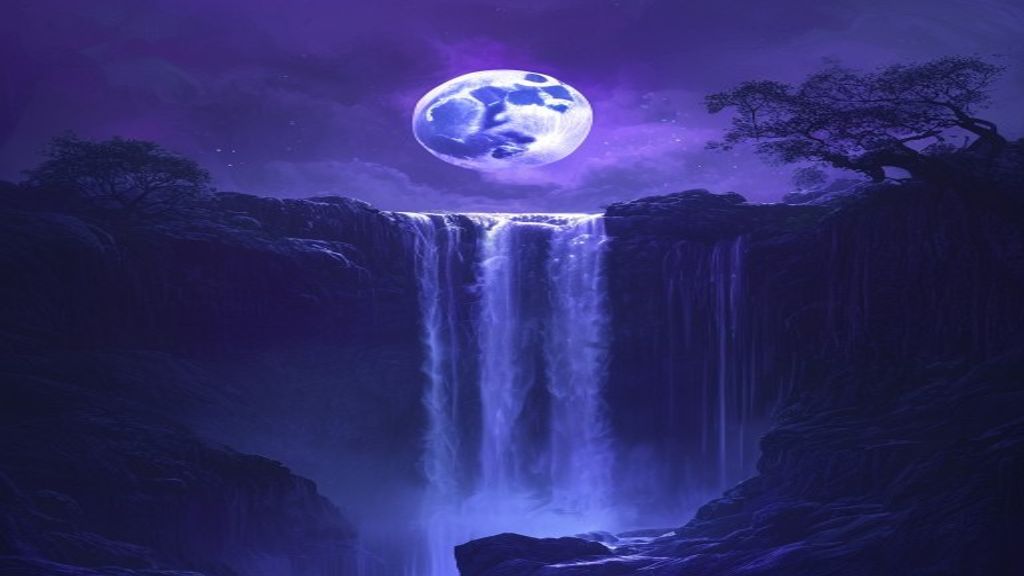
A column of white water dropping into a pool that has no visible bottom. That’s the dream. You’re standing close enough that the mist touches your face, and the sound isn’t noise exactly, it’s more like the air itself has become solid. You can’t think over it. You’re not sure you want to. Waterfall dreams have a quality that most nature dreams don’t: they’re loud. Even when people describe them in careful, quiet words the next morning, the memory has force behind it. That force is usually the whole point.
What the mist does to you
Most waterfall dreams aren’t watched from a distance. That’s the first thing that distinguishes this symbol from, say, a mountain or an ocean vista. You’re almost always close. Close enough for the mist, close enough that the sound takes over, close enough that the scale of the thing is personal rather than scenic. That proximity matters. You’re not observing power. You’re in the atmosphere of it. Your clothes are damp, or might as well be. Your thoughts get interrupted. Whatever you were holding onto before the dream arrived has been temporarily knocked loose.
This is a symbol that lives in the body more than the mind, and I think that’s why it tends to arrive during particular seasons of life: the ones when something irreversible is already in motion. A career shift that can’t be undone. A relationship that’s crossed into new territory. A decision that has its own momentum now, past the point where second-guessing it would change anything. The waterfall isn’t asking you to decide. It’s showing you what deciding already looks like when the scale gets large enough.
| Tradition | How it reads the symbol |
|---|---|
| Greco-Roman | Artemidorus linked falling water to fortune in motion: the higher the drop, the more significant the change. A waterfall seen from below was generally favorable; being caught in one required the dreamer’s wider circumstances to interpret. |
| Indigenous North American traditions | Many traditions treat waterfalls as liminal points, thresholds where the visible world meets the one underneath it. To dream of one was sometimes understood as being summoned to a boundary, not necessarily to cross it. |
| Jungian framework | Jung read the descent of water as a push from the unconscious into conscious life. The waterfall is energy that can’t be held back, an image of what happens when the psyche’s pressure finally finds an opening. |
| West African symbolic traditions | Waterfall spirits (Mami Wata traditions and related) are associated with both generosity and danger: the waterfall gives, but on its own terms. Dreams of waterfalls near these traditions often carry the flavour of unexpected gifts that arrive with conditions. |
Going over versus standing beside
The two waterfall dreams that mean very different things, and that people often confuse in retelling, are the one where you’re standing at the base looking up at the descent, and the one where you’re going over the edge. They’re practically different dreams. Standing at the base, with the water falling away from you and landing nearby, is about witnessing. About being in the presence of force you didn’t generate and don’t control. That can feel awe-inspiring, or it can feel terrifying depending on what’s currently large and uncontrollable in your waking life. Usually people know immediately which flavor it was.
Going over the edge is something else. That’s the body committing to a drop whether or not the mind agreed to it. Dreamers who experience the falling-over version almost always describe an initial moment of pure terror followed by something unexpected: the water catching them, or the sensation being less devastating than they thought it would be, or simply waking before impact in the particular way that falling dreams do. Domhoff’s continuity hypothesis would suggest you’re probably in a period of real life when something is tipping you forward faster than feels comfortable. He’d be right, in my experience. The going-over dream reliably clusters around transitions.
The pool at the bottom
Brief, but worth its own space: the pool that the waterfall falls into is often where the emotional weight of the dream collects. Clear pool, you can see the bottom: the outcome of the change feels visible, survivable. Dark pool, no bottom visible: you’re not sure what you’re falling into and the dream knows it. Some dreamers describe the pool as the only still place in an otherwise roaring dream, and that stillness is a small gift the symbol offers. Even the biggest cascade lands somewhere that holds it.
The dream as a particular kind of permission
Jung treated large, falling water as one of the more striking images of the unconscious asserting itself. Not gently. Not with the slow seepage of ordinary symbolism. A waterfall is the psyche’s version of insistence, which is why I’ve started thinking of waterfall dreams as a particular kind of permission slip written in water. Whatever has been building, whatever has been gathering force behind the plateau, the dream is confirming that it’s already in motion. You don’t have to push it. It already went.
Artemidorus noted, in his taxonomy of water dreams, that the higher and cleaner the fall, the more auspicious the omen for endeavors requiring force and resolution. Two thousand years later, sitting with people describing these dreams, that pattern still shows up. Not because dreams are prophetic, but because the mind that’s dreaming that particular image is usually already gathering its resources. The waterfall dream and the dreaming of a volcano share this quality: both involve enormous energy that’s found its release point. The difference is the waterfall tends to feel cleaner, as if the force was always meant to move.
If the waterfall in your dream was accompanied by a rainbow, that’s a distinct variation worth noting, and it overlaps with the territory covered in dreaming of a rainbow: the light bending through spray has its own meaning, one that’s almost always about the aftermath of difficulty rather than difficulty itself. The rainbow over the waterfall is the dream saying: yes, all that force, and look what the light does with it.
The question it’s asking
The mist on your face in the dream, that specific light wet sensation that doesn’t quite count as rain and doesn’t quite count as dry, that’s the waterfall’s particular grammar. It’s not soaking you. It’s touching you. Just enough to make the distinction between you and the water slightly porous. I’ve started thinking of that detail, when dreamers mention it, as the symbol offering a handshake. The enormous thing and the person standing near it, briefly in contact. Whatever force is moving in your life right now, the dream might be doing nothing more than saying: it knows you’re there.
- Was I standing beside it or going over? That single distinction changes the reading almost completely.
- What was the pool at the bottom like, and could I see into it?
- Did the scale of the waterfall feel threatening or awe-inspiring, and what in my waking life has that same quality right now?
- Is there a decision or transition that already has its own momentum, past the point of easy reversal?
One symbol, two traditions
Psychology keeps waterfall inside your own story, a symbol your mind built from your days. The biblical tradition looks outward instead, and asks whether Scripture gives the image any voice at all.
Waterfalls in dreams carry power, release, and the strange feeling of being beside something much bigger than you. Nora Vance on what this symbol wants from the dreamer.
You are reading this oneWhat Scripture actually says about rushing and abundant water, from the river of God to the voice of many waters, and how to apply it to a waterfall dream.
Read the full biblical meaning →Quick answers
What does it mean to dream of a waterfall?
A waterfall in a dream usually points to force in motion: something large and possibly irreversible already moving in your life. The key interpretive questions are whether you’re standing beside it or going over it, and how the pool at the bottom appears. Standing near a clear, falling waterfall often signals that power or change is present but not yet threatening.
Is dreaming of a waterfall a good sign?
Often yes, especially if the water is clear and the mood is awe rather than terror. Many traditions read a clear, falling waterfall as favorable for endeavors that require force and commitment. A dark or overwhelming waterfall shifts toward the version that reflects transition you’re not yet fully accepting.
What does it mean to fall over a waterfall in a dream?
Going over the edge suggests you’re being carried by something larger than your deliberate choices, a transition or change that’s moved past the decision point. Most dreamers describe the moment of going over as frightening, followed by something unexpectedly survivable, which tracks with how big life changes actually feel once you’re in them.
Why do I dream of waterfalls repeatedly?
Recurring waterfall dreams tend to appear when a large change is ongoing but unfinished. The force in the dream hasn’t resolved yet in your waking life. When the transition completes, or when you fully accept that it’s happening, the dream typically settles.