- Tradition
- Psychological readingNature dreams
- Also read in
- The BibleSame symbol, other tradition
- Draws on
- Domhoff
- Reviewed
- 6 min read
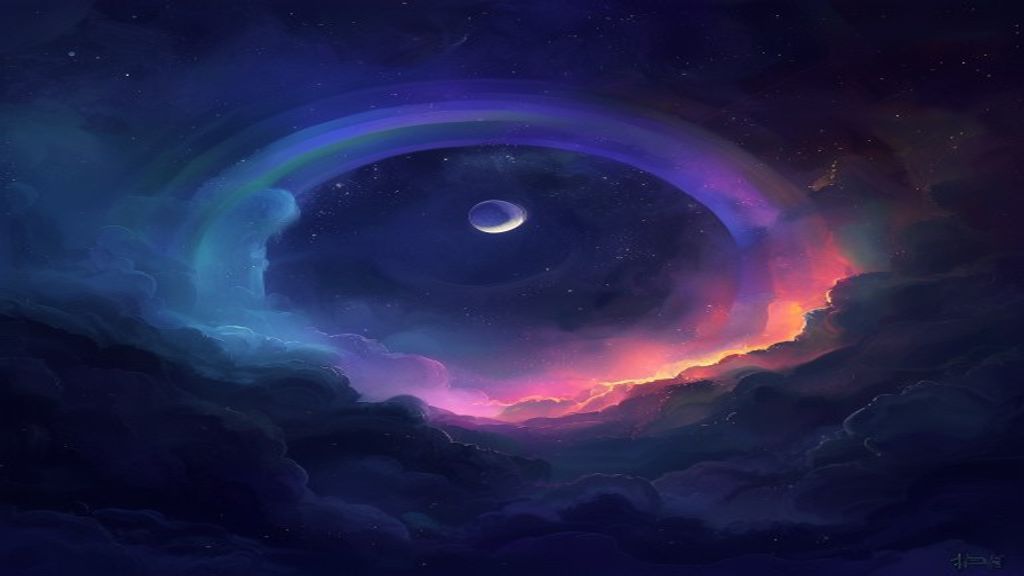
A rainbow arches over a field you can’t name, and you watch it from a doorway, jacket still damp from the rain. You don’t know why it makes you want to cry. It’s just a rainbow. And you wake with the feeling that you’ve narrowly missed something. Not grief exactly. More like the specific ache of almost.
Rainbows in dreams are strange because they seem unambiguously hopeful, and yet almost no one who dreams of one wakes feeling simply happy. They wake wistful, or moved, or with the sense that the color they saw was more vivid than color has any right to be. The dream rainbow occupies a peculiar emotional space: it’s there, it’s beautiful, it requires rain to exist, and by definition you can never reach it.
A rainbow in a dream usually points to a transition: something difficult is ending, or has ended, and something else may be starting. The emotional weight of the dream sits in whether you can reach the rainbow, walk beneath it, or only see it from a distance. Distance dreams tend to be about hope not yet touched. Being inside one is rarer and usually profound.
The smell of wet asphalt, and what rain has to do with it
Rainbows have a structural requirement that doesn’t go away just because you’re asleep: they need rain. The wet asphalt smell that lingers after a downpour, the specific gray of a clearing sky, the moment before the arc appears when the air is still heavy. In dreams, that context doesn’t always show up visually, but it can arrive as a felt sense: that something had just ended, or was still ending, when the rainbow appeared. You can’t have the arc without the storm that preceded it.
That structural dependency is, I think, part of why the image carries so much weight. The rainbow doesn’t arrive in good conditions. It arrives because conditions were recently terrible. Your sleeping mind knows this even when it doesn’t show you the rain.
What your position tells you
Where you are in relation to the rainbow matters more than almost any other detail. The most common version: you see it in the distance and can’t close the gap no matter how you move. That’s a hope dream, but it’s specifically a hope-you-can’t-hold dream. It tends to belong to a period of sustained effort toward something that keeps receding. The rainbow isn’t mocking you. It’s showing you where you’re looking.
The unreachable as a feature, not a failure
Dream traditions have long treated the rainbow as a symbol of change and transition, typically positive change after difficulty. That isn’t wrong, and the long agreement suggests it maps something real. What’s easy to overlook is that the unreachability is built in. You cannot stand at the base of a real rainbow. It moves as you do. The dream that keeps showing you a rainbow you can’t reach isn’t teasing you: it may be a dream about the nature of a particular kind of hope, the kind that organizes your direction without ever fully arriving.
A Jungian reading, predictably, reaches for the larger frame: bridges between worlds, connections between opposites. The rainbow as the path between what is and what could be. I find that reading most useful when the dream has a crossing quality, when you’re moving toward something, when the rainbow appears at a threshold rather than in the middle of an open field. Not every rainbow dream needs the mythic scale.
When it’s not hopeful
Worth saying briefly: a rainbow can feel sad in a dream, and that’s not a mistake. Domhoff’s continuity view would expect rainbow dreams to follow waking life, and that includes the period just after loss, when the worst is technically over and the light has returned but nothing has been restored. You’re in the after, and it’s still wet outside, and the rainbow is real and beautiful and you are not ready to be comforted by it. Those dreams feel like the wistful version because they are. There’s no error in the symbol. It’s doing its job with painful accuracy.
If the storm came first in your dream and the arc appeared only at the very end, dreaming of a thunderstorm reads the front half of that sequence: the sky darkening, the release, and what the upheaval was for. That sequence is your mind’s way of acknowledging the full story. Not just the hope. The difficulty that preceded it.
For the scriptural side of the same image, the biblical meaning of rainbows in dreams looks at color as a promise. And if the dream left you wistful rather than reassured, dreaming of hope is about a mind still oriented toward a future it believes in, even when the conscious self has started to doubt.
Back to the doorway
Take a dreamer who works out, a month later, that the rainbow dreams started the week after accepting that a particular chapter of life was over. No crying about it directly. Just quietly stopping expecting things to return to how they had been. The rainbow appeared instead.
It’s an open question whether that’s interpretation or coincidence. But the wet asphalt smell, the damp jacket, the almost-miss feeling make a useful shorthand for a particular kind of dream. The ones where your mind sees the arc before your heart does.
- Were you close to the rainbow or watching it from far away? That distance is the message.
- Did the dream include rain or a sense of something that had just passed?
- Was there someone who pointed it out, or were you alone when you saw it?
- What transition in your waking life is the arc appearing over right now?
One symbol, two traditions
Psychology keeps rainbow inside your own story, a symbol your mind built from your days. The biblical tradition looks outward instead, and asks whether Scripture gives the image any voice at all.
A rainbow in a dream usually points to a transition: something difficult is ending, or has ended, and something else may be starting. The emotional weight of the dream sits in whether you can reach the rainbow, walk beneath it…
You are reading this oneJoel 2:28 promises that God speaks in dreams, and throughout Scripture the rainbow carries covenant meaning. It’s reasonable to bring a rainbow dream to prayer and ask what it might be saying. But Ecclesiastes 5:7 cautions…
Read the biblical meaning →Quick answers
What does it mean to dream of a rainbow?
A rainbow in a dream usually signals a transition: something difficult ending and something else possibly beginning. The emotional texture of the dream, wistful, moved, hopeful, tells you more than the image alone. Where you are in relation to the rainbow tells you most.
Is dreaming of a rainbow a good omen?
Generally it points toward positive change, especially after a period of difficulty. But a rainbow you can’t reach, or one whose colors are wrong, carries a more complicated charge. The image itself is hopeful; your position within it is what matters.
What does it mean to stand inside a rainbow in a dream?
This is less common and usually follows a genuine turning point. Being inside the arc rather than watching it from outside suggests you’re in the transition itself, not approaching it. Dreamers who report this version often wake with an unusual sense of completeness.
Why do I keep dreaming of a rainbow I can’t reach?
Recurring unreachable rainbow dreams often appear during long stretches of effort toward something that’s visible but not yet arrived. The dream isn’t discouraging you. It may be reflecting the particular quality of sustained hope, oriented and moving, not yet landing.
Sources for this reading
- Domhoff, G. W. (2003). The Scientific Study of Dreams: Neural Networks, Cognitive Development, and Content Analysis. American Psychological Association.
- Domhoff, G. W. (1996). Finding Meaning in Dreams: A Quantitative Approach. Plenum Press.
Full bibliography on Sources and method. Found a mistake? Tell us and see the corrections log.