- Tradition
- Psychological readingAnimal dreams
- Also read in
- The BibleSame symbol, other tradition
- Draws on
- Revonsuo, Artemidorus
- Reviewed
- 5 min read
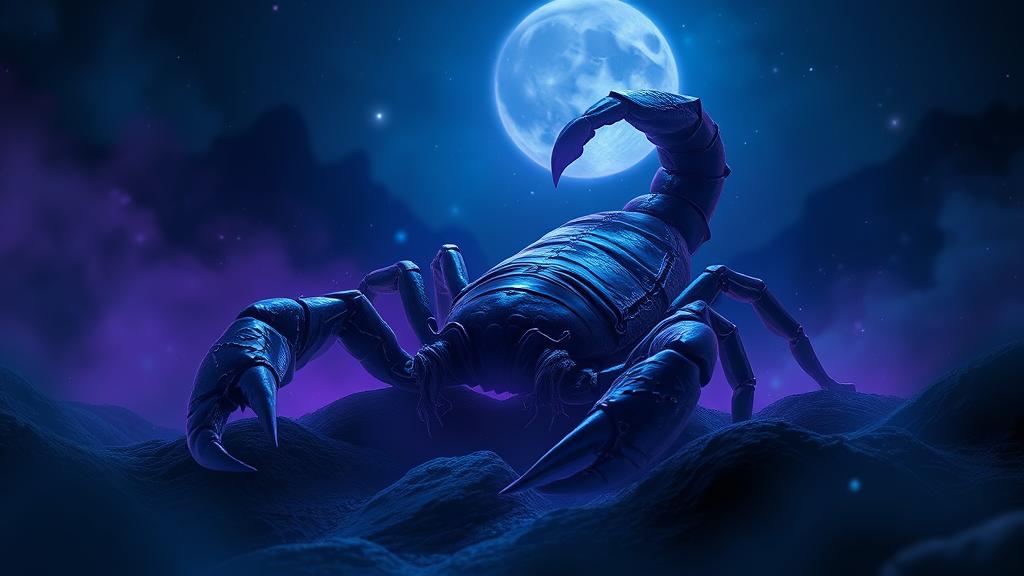
Threat simulation theory, put forward by Antti Revonsuo in 2000, holds that dreaming evolved partly to rehearse the perception of danger and the avoidance of it. A scorpion is close to a textbook rehearsal object: small, venomous, built to be missed until you are too close. What the dream produces, though, is rarely a fight or a flight. It is the half-second before your foot comes all the way down, when the shape registers but the brain hasn’t caught up yet. That freeze. That whole-body halt. That’s what a scorpion dream is made of.
A scorpion in a dream usually signals a threat that’s real but not yet visible, something in your life with a hidden sting. The setting matters enormously: your own bed versus a desert floor versus inside your shoe are three different messages. The scorpion’s behavior matters too. Motionless is not the same as curled to strike.
The freeze response wearing a new costume
Understanding that half-second starts there, not with the symbol in a dictionary. Scorpion dreams tend to be specific: the curl of the tail, the way it was still, the exact spot it was sitting. A blurry scorpion is rare. The image is usually sharp, and I think that specificity is the whole point.
The theory frames encounters like this as dangerous, contained, survivable on a good night. A scorpion fits that frame almost too neatly: venomous, small enough to hide anywhere, difficult to see before it’s too close. If your sleeping brain is running a practice drill, this is a sensible drill animal. But I find Revonsuo’s framework more useful as a floor than a ceiling. It explains why the scorpion appears. It doesn’t explain why it appears in your shoe, or in a glass of water, or sitting patiently on top of a phone that kept ringing.
That last image is the dream doing something more personal. It’s using the scorpion as a placeholder for something specific in the dreamer’s life, something already half-known to be dangerous and not yet fully picked up.
Two readings that don’t cancel each other out
External threat
The scorpion is something outside you: a person with a hidden agenda, a situation that looks safe but isn’t, a piece of news you’re bracing for. In these dreams the scorpion tends to be somewhere unexpected, a place that should be safe, like a bed or a kitchen. The feeling is surveillance. Something is watching, or waiting.
Internal wound
The scorpion is a part of you: a resentment, a self-destructive habit, an anger that’s been compressed for so long it’s developed a curl. A Jungian reading would point here: the scorpion as shadow, the part you’ve kept out of the light. These dreams often end not with a sting but with the dreamer stepping back, which is interesting. The threat doesn’t strike. It just stays visible.
A Jungian reading would take both columns above as versions of the same thing: an energy that hasn’t been integrated. I’m less interested in the integration language than in the simple question it implies: which side of your life has been operating in the dark? That’s a question worth sitting with after a scorpion dream, whether or not you believe in archetypes.
What Artemidorus got right
Artemidorus, writing his Oneirocritica in the second century AD, argued that the same dream means different things for different dreamers, depending on age, status and occupation. That principle still impresses me, and it extends from the dreamer to the animal: behavior matters. That’s sound interpretive practice. A scorpion running from you in a dream is not the same as one pinned under a glass, which is not the same as one you’re holding. The threat level in the dream rarely matches a single symbol; it’s a composite of what the animal does, what you do, and the feeling you carry back into daylight.
The location is almost everything
Inside a shoe is about something you’re about to step into, which is rarely subtle. In water, which changes what it can do, sometimes signals a threat that’s lost its power even if you haven’t noticed yet. In your own bed is harder: it points at rest, intimacy, or the place you thought was protected. At work or on a desk nudges toward a professional situation. In a child’s room, in your hands, on someone you love, each address shifts the meaning.
People dream of a black horse and feel power moving through the image. The scorpion is the opposite architecture: small, patient, capable of disproportionate damage. It’s a dream about compressed danger rather than force in motion. That compression is what gives it the staying power it has. Dreams of a jaguar tend to leave dreamers with adrenaline; scorpion dreams tend to leave them watchful. The watchfulness is the message.
If it stings you
Being stung matters. A sting dream can leave you convinced on waking that it was real, not because it was violent but because of the phantom pain. That phantom pain is the emotional truth of whatever the dream was processing. Stung in the hand points at something involving what you’re reaching for or what you’re making. Stung on the foot nudges at direction, path, what you’re moving toward. Stung in the back is the one that tends to point at betrayal, or at least the fear of it.
Back to that half-second from the opening, that freeze before the foot comes down. Because in many scorpion dreams, the dreamer never actually gets stung. They stop. They stand there. Sometimes for a long time. And then they wake up. That suspension is the dream’s real subject: not the danger itself but the awareness of it, a hovering attention that’s been missing from your waking hours. Something in your life is sitting there with its tail up, and part of you already knows it. Dreaming of lice or other small persistent creatures often has a different texture, more exhaustion than alertness, but the scorpion dream is mostly about alertness. It’s your nervous system writing you a note.
Whether you act on the note is, as always, entirely up to you.
- Where exactly was the scorpion, and is there somewhere in my waking life that should feel safe but doesn’t right now?
- Was the scorpion moving toward me, waiting, or running away? Which of those feels more honest about the situation I’m actually in?
- Did it sting me? If so, which part of my life does that body location point toward?
- Is there something I already know I should pick up and deal with, that I’ve been leaving alone because I’m not sure what it’ll do?
One symbol, two traditions
The disagreement is honest: one school sees scorpion as self-communication, the other as an image to be discerned against Scripture. They can inform each other, but they do not merge.
A scorpion in a dream usually signals a threat that’s real but not yet visible, something in your life with a hidden sting. The setting matters enormously: your own bed versus a desert floor versus inside your shoe are three…
You are reading this oneScorpions are associated with threat and with ‘the power of the enemy’ in Luke 10:19, but the verse is about authority over that threat, not vulnerability to it. Ezekiel 2:6 uses scorpions as a metaphor for resistant people…
Read the biblical meaning →Quick answers
What does dreaming of a scorpion mean?
Usually it signals a threat that’s present but not yet fully visible, something or someone in your waking life that carries a hidden sting. The scorpion’s location and behavior narrow the reading considerably. A motionless scorpion in your bed means something different from one running across an open floor.
Is dreaming of a scorpion a bad omen?
Historically some traditions read it that way, but as a symbol it’s more useful to see it as your mind flagging danger rather than predicting it. The dream is noticing something. What you do with that information is the part that actually matters.
What does it mean if a scorpion stings you in a dream?
A sting means the threat has made contact, something that’s broken through your defenses or arrived despite your awareness. The location of the sting often points toward which area of life is involved: hand for what you’re building or reaching for, foot for where you’re heading, back for trust or betrayal.
Why do I keep dreaming about scorpions?
Recurring scorpion dreams tend to mean something in your waking life hasn’t been directly confronted yet. The dream keeps running the drill because you haven’t completed the circuit. Naming what you’re avoiding, even just to yourself, often quiets a recurring animal dream faster than you’d expect.
Sources for this reading
- Revonsuo, A. (2000). The reinterpretation of dreams: An evolutionary hypothesis of the function of dreaming. Behavioral and Brain Sciences, 23(6), 877-901.DOI
- Artemidorus of Daldis (2nd century CE). Oneirocritica. English edition: Harris-McCoy, D. E. (2012). Artemidorus’ Oneirocritica: Text, Translation, and Commentary. Oxford University Press.
Full bibliography on Sources and method. Found a mistake? Tell us and see the corrections log.