Animal Dreams
Dreaming of a Parrot: Voices, Repetition, and What You Keep Saying
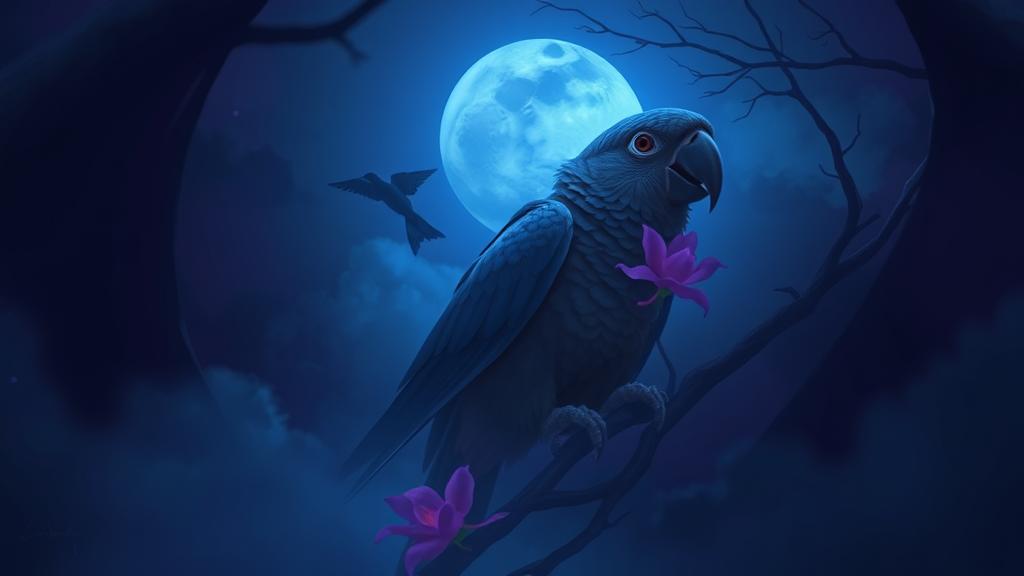
Parrots can live eighty years. They outlive most of the people who teach them to talk. That single fact has stayed with me since I read it in an ornithology textbook that had no business being as unsettling as it was: the bird keeps saying the words long after the person who planted them is gone. A parrot dream works on roughly the same principle. The bird is voice without origin. Words borrowed, repeated, detached from their source.
A parrot in a dream usually points to communication that’s borrowed rather than original: a voice that isn’t quite yours, a message being repeated without examination, or words that have traveled farther than their meaning can carry. The dream rarely criticizes the parrot. It asks you to recognize which words in your life have that quality.
The voice that isn’t your voice
The most common parrot dream I hear about has a specific texture: the bird is speaking, and the dreamer feels unsettled in a way they can’t immediately explain. Not frightened. Unsettled. Often they describe a sense that something is almost right , the words are familiar, even comforting, but they know the bird doesn’t understand what it’s saying. That gap is the whole dream.
Jung’s framework for this would focus on the persona, the layer of self that performs for social audiences, and how much of what we say has been taught rather than chosen. A parrot is a persona with feathers. It performs competently. It learned from watching us. That reading lands a little too accurately for most people who sit with it. I find myself applying it to my own patterns more than I’d like to admit.
What Artemidorus would ask first
Artemidorus, that tireless cataloguer, gave birds a lot of attention in the Oneirocritica. He associated talking birds specifically with people who make their living through words , teachers, advocates, messengers, those whose speech is their instrument. A parrot in his system was generally a favorable sign for communicators, though he noted that a bird speaking nonsense or out of turn was worth being cautious about. His instinct to ask not just “what was the bird” but “what was the bird saying and who was in the room” is still the right one. The parrot’s words in your dream, even if they’ve dissolved by morning, were specific for a reason.
How to read the parrot’s behavior
- Notice whether you taught the parrot or found it already speakingA parrot you trained is closer to your own voice than you think. A parrot that arrived already talking carries someone else’s words. Which one appeared in your dream is probably the first real clue.
- Recall the quality of the speech, not just the contentComforting words in a mocking tone. Wise advice delivered in a way that felt hollow. The delivery often matters more than the content. Your dreaming mind is often more precise about tone than you expect.
- Ask who else was in the dreamParrots often appear as proxies. If someone was in the room, the bird may have been saying what that person usually says, or what you expect them to say. Dreams about talking animals share this quality , the animal speaks so someone else doesn’t have to.
- Consider what you’ve been repeating in your own lifeNot just literally. Patterns of thought, stock explanations, a way you’ve been describing yourself in a particular situation. The parrot dream tends to surface when a script has been running so long we’ve stopped hearing it.
When the parrot is a threat
Revonsuo’s threat-simulation framework is useful here in a specific way. A parrot that’s aggressive , lunging, biting, screaming the same phrase over and over , is the threat version of the voice dream. Something is being said, or kept being said, that feels like attack. It doesn’t have to be a person saying it; it might be a thought pattern with that biting-and-repeating quality. The parrot just exteriorizes it. Makes it visible, gives it feathers and a beak so you can see the shape of what’s been needling you.
Bright colors, cages, and escape
The visual details carry weight here. A brilliantly colored parrot flying free and a dull-feathered parrot pacing in a cage are working hard in opposite directions. The caged version tends to appear when someone feels their own voice or expression is enclosed , not silenced, but constrained, allowed to make noise without being allowed to fly. The free-flying version, especially if it was vivid and unafraid, is often just the opposite: a part of yourself that speaks freely, perhaps more freely than you let yourself in ordinary life.
The parrot’s colors connect it to a broader cluster of vivid, expressive creature dreams. If you dreamed of a parrot alongside other animals, a roaring lion represents voice in a completely different register , raw authority rather than learned speech. And the parrot’s gift for mimicry places it in fascinating proximity to spider dreams, which also tend to be about patterns built patiently over time, often without realizing it.
The thing that stays with me about parrot dreams, the thing I keep coming back to: people almost never question the parrot in the dream. They accept what it says. They take the borrowed words at face value. The dream keeps returning, I think, until someone decides to ask: wait, who taught you that?
- What was the parrot saying? Even fragments , the tone might be more important than the words.
- Was the parrot in a cage or free? What would it mean if that applied to your own voice right now?
- Whose voice did the parrot remind you of , including your own?
- Is there something I keep saying, or keep hearing, that has become automatic enough that I’ve stopped really listening to it?
Quick answers
What does dreaming of a parrot mean?
A parrot in a dream usually signals something about borrowed or repeated communication: words that aren’t quite your own, a script that’s been running on autopilot, or a voice in your life that says the right things but doesn’t quite mean them. The dream invites you to examine what you’ve been repeating and whether you’d still choose those words today.
Is a parrot in a dream a good omen?
Historically, including in Artemidorus, talking birds near communicators were read as favorable. Psychologically, a free and vibrant parrot tends to point at confident self-expression. The shadow versions , a caged parrot, a parrot speaking nonsense, a biting parrot , are more cautionary, but even then the dream is usually trying to show you something correctable, not inevitable.
What does it mean if a parrot bites you in a dream?
A parrot bite tends to represent words that wound, something said (to you or by you) that left a mark. It can also signal a pattern of thought that keeps circling back and striking. The parrot’s bite is specific and targeted, which usually means the thing being pointed at is too.
Why do I dream of a parrot talking?
A talking parrot in a dream often surfaces when you’re in a period of borrowed thinking , repeating what others have told you about yourself, your situation, or your prospects, without quite deciding if you believe it. The dream is rarely critical. It’s usually just asking: is that actually yours?