Animal Dreams
Dreaming of a Koala: What That Sleepy Bear Really Means
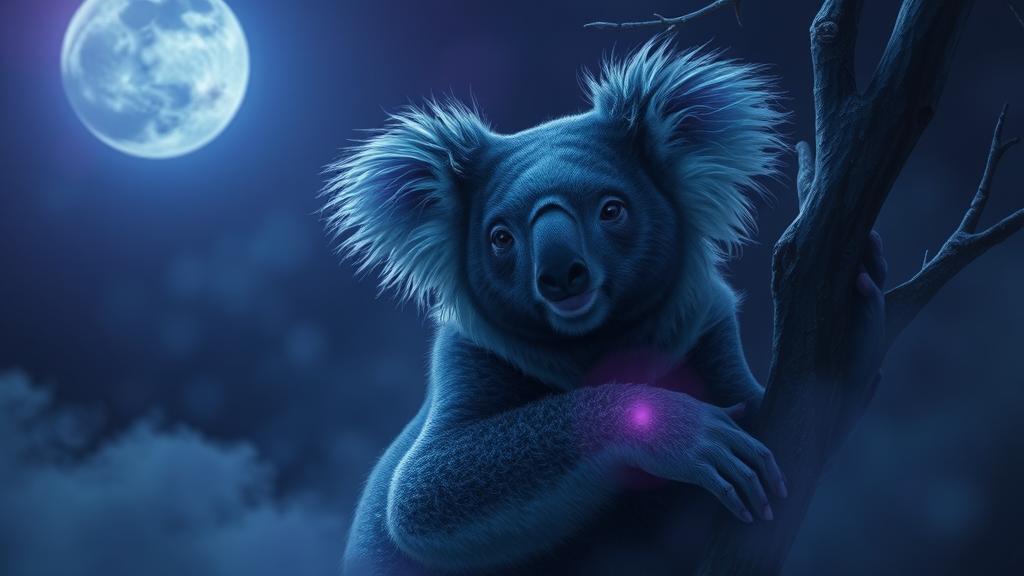
Koalas sleep roughly twenty hours a day. Most people know that fact the way they know capital cities or the boiling point of water, passively, from some childhood nature program that stuck. I know exactly which program it was for me: a Tuesday afternoon, a too-warm classroom, a narrator with a BBC accent explaining that the koala’s eucalyptus diet is so low in calories that the animal can barely afford to move. The teacher turned the lights back on and I spent the rest of the afternoon wondering what it would feel like to live at that pace. Deliberately. Unapologetically still.
A koala in a dream most often signals a need for rest that’s being ignored, or a quietness in you that’s been dismissed as laziness. The animal’s famous stillness is the whole message: something in your life may need to slow down, or you may be spending energy you simply don’t have. The feeling inside the dream matters more than what the koala does.
What the stillness is actually saying
Animals appear in dreams across every culture and era, and they almost always carry something the dreamer can’t quite name in daylight. The koala is unusual because its defining quality isn’t speed, or ferocity, or transformation. It’s rest. Specifically, it’s a creature that has biologically committed to doing less. When that image arrives in a dream, my first question is always the same: what in your life right now are you not allowing yourself to slow down?
That question makes people uncomfortable, because we’ve collectively agreed that rest is something you earn rather than something you need. So a dream offers the koala up like a small, grey rebuttal. It clings to its branch. It doesn’t apologize. Most people who tell me about this dream describe feeling strangely peaceful in it, which is itself information. The peace is the message.
Comfort you’re actively seeking, or comfort you’re afraid to ask for. The warmth of the animal in your arms is the point. What does it feel like to hold something that trusts you completely?
A fear that your chosen pace, or someone else’s, is about to become unsustainable. Not a bad omen. More like a nervous check-in from your own mind.
A still, observant energy in your life: a person, a part of yourself, a situation that isn’t moving and isn’t distressed by that. The watching is its own kind of presence.
Your need for stillness has found its way into a context where it doesn’t belong. Worth asking whether you’re trying to rest in the wrong place, or rest from the wrong thing.
Tenderness toward something fragile and slow. This version tends to appear when you’re caring for someone, or when you know you should be caring for yourself and aren’t.
The animal that doesn’t run
Here’s what’s strange about dreaming of a koala versus dreaming of almost any other animal: threat doesn’t feature. Antti Revonsuo’s threat simulation theory argues that dreaming evolved partly to rehearse danger, which would explain why so many animal dreams involve pursuit or menace. The koala doesn’t cooperate with that framework. It poses no threat. It runs from nothing. If the evolutionary function of an animal dream is to prepare you for something, the koala prepares you for sitting still, which is its own kind of preparation most people have entirely forgotten how to do.
Carl Jung would’ve found the koala interesting, I think, even though the animal is entirely absent from the European symbolic tradition he worked in. His framework of the psyche as a house has every room occupied by different aspects of the self, and the koala feels like it would live in the room you only find when you stop rushing through the corridor. The part of yourself that doesn’t need to achieve. Jung called the neglected parts of the self worth paying attention to. A dreamed koala might be exactly that: the undefended, unhurried part that keeps getting skipped.
A brief note on ancient dream records
Artemidorus wouldn’t have known what a koala was. His second-century Oneirocritica is extraordinarily detailed about Mediterranean animals, but the southern hemisphere was beyond his geography. What he does say, and it holds up, is that unfamiliar animals in dreams tend to take their meaning from their most visible quality. By that logic, the koala’s meaning writes itself.
When the dream is asking something harder
Not every koala dream is a gentle reminder to take a nap. Sometimes the stillness in the dream feels less peaceful than stuck. A koala that won’t move when you need it to, or one that’s clinging too hard to its branch even as the tree sways, can mirror a place in your life where you’re holding on past the point that makes sense. The same quality that reads as wisdom in one dream reads as rigidity in another. What shifts is the emotional weather around it.
And sometimes the koala appears when you’ve been admiring slowness in someone else while secretly resenting the pace. A partner who seems to move through life without urgency. A colleague who never seems stressed. A friend who appears to sleep eight hours without guilt. The dream brings you the animal and asks you to notice how you actually feel looking at it. Envious? Peaceful? Irritated? That reaction is the real material. For more on how animals shift meaning with emotional context, the piece on dreaming of an animal transforming is worth sitting with.
I’ve thought about that classroom a lot over the years. The nature program, the BBC accent, the word ‘unapologetically’ that the narrator didn’t actually use but that I supplied myself, in retrospect. The koala wasn’t on screen for more than a minute. But it stayed. And when I dream of one now, which has happened twice that I remember, I wake up with the same question I had at twelve: what would it feel like to live at that pace? I still don’t fully know. I’m not sure it matters that I don’t. The question is the point.
If the koala in your dream was in company with other animals, the reading shifts: the piece on dreaming of many snakes covers what it means when the dream populates with a whole ecosystem rather than a single still figure. And if what you’re really sitting with is an animal that felt wrong rather than peaceful, the dreaming of a panther entry handles that darker charge directly.
- How did I feel watching the koala? Peaceful, envious, or quietly sad about its stillness?
- Is there somewhere in my life I’m refusing to slow down, or somewhere I’m afraid I’ve already slowed too much?
- What was the koala holding on to? What am I holding on to?
- Did the stillness in the dream feel like rest or like being stuck?
Quick answers
What does it mean to dream of a koala?
It most often points to a need for rest or stillness that you’re not allowing yourself. The koala’s defining quality is its committed, guilt-free slowness, and when it appears in a dream it’s often asking you to look at the pace you’re keeping and whether it’s sustainable.
Is a koala dream a good or bad sign?
Generally positive, or at least gentle. Most koala dreams carry a feeling of peace. The exception is when the koala seems stuck or frightened, which can reflect a place in your life where stillness has become rigidity rather than rest.
What does it mean to hold a koala in a dream?
Holding the animal usually points to comfort you’re seeking or offering. The koala’s trust is part of the image. It’s worth asking who in your life needs that kind of patient, unhurried care, including yourself.
Why did a koala appear in my dream if I’ve never seen one in person?
Dream symbols pull from images the mind has stored, including childhood nature programs, photos, or passing references. The koala’s meaning comes from its qualities, not from your relationship with real koalas. Artemidorus argued that unfamiliar animals take their meaning from their most visible characteristic, and in the koala’s case that’s an easy read.