Animal Dreams
Dreaming of a Centipede: What Too Many Legs Actually Means
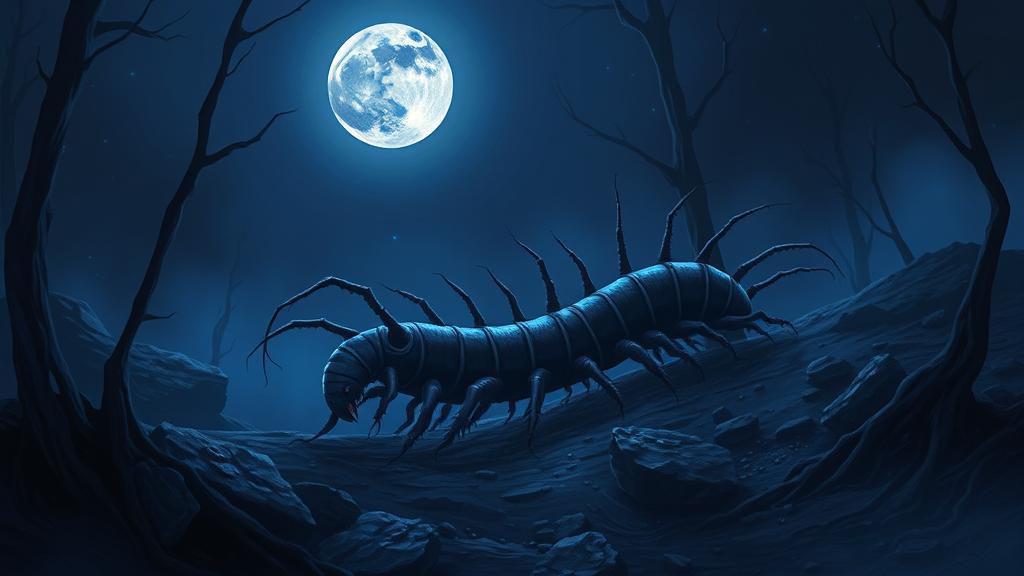
I’ll be honest with you: I find centipedes genuinely unsettling, and I’ve spent enough time with dream material to suspect that feeling isn’t irrational, it’s specific. It isn’t the size. It isn’t the bite, though that’s real. It’s the legs. The way they ripple in a wave when the animal moves. There’s something in the coordination of too many parts that trips something primal in the visual cortex.
Which is probably exactly why the dreaming mind reaches for a centipede when it’s trying to express something about complexity, coordination, or a situation that has one too many moving parts.
A centipede in a dream almost always points to something that has too many components to track comfortably: a complicated situation, an anxiety with multiple sources, or an old fear that’s been folded and refolded until it fits into a very small space. The unsettling quality of the dream is the message, not a side effect.
Why the wrongness is the point
Revonsuo’s threat simulation theory argues that dreams evolved partly as a rehearsal space for danger, and that predator and threat imagery in dreams is the mind doing something productive, however unpleasant. A centipede fits that frame. It isn’t dangerous in a simple, direct way. It’s dangerous in the way that things you can’t quite follow are dangerous: it moves in a pattern your eye can’t quite predict, it can be still and then suddenly fast, and in the dark you might not notice it until it’s already close.
But I don’t think most centipede dreams are running threat rehearsals in any straightforward sense. They’re doing something more like showing you a form for anxiety itself. Not a specific danger but the sensation of tracking something that keeps multiplying its legs.
The historical record, briefly
- 2nd century
Artemidorus included insects and multi-legged creatures in his Oneirocritica, reading them primarily through their movement: slow and deliberate creatures pointed to patience or delay, fast unsettling ones to restlessness or deception in one’s circle.
- Ancient traditions broadly
Across many pre-modern traditions, creatures that moved in unusual or uncanny ways were treated as messengers from the boundary between worlds, less about the creature’s literal qualities and more about its liminal quality.
- 20th century
Jungian analysts began reading insects and arthropods as representations of the collective unconscious breaking through, the too-many-legged thing as something that operates below individual will, part of a system larger than the self.
- Contemporary research
Modern dream researchers treat such imagery as emotionally tagged content, material the brain is processing with a heightened affective charge. The centipede tends to appear in high-stress windows rather than randomly.
What Jung might say, and where I’d argue with him
Jung treated insects and vermin in dreams as representations of things operating outside conscious control, drives, compulsions, collective forces that move through us rather than from us. For him a centipede might point to something in the shadow, the part of the self that’s coordinated and purposeful but opaque to the conscious mind. I find that reading compelling for the larger, more elaborate centipede dreams, especially the kind where the animal seems almost architectural in its size or its movement.
Where I’d push back: not every centipede dream is about repression or the deep unconscious. Sometimes it’s just a stressed brain producing stressed imagery. The same week you have eight things demanding immediate attention, your sleeping mind might show you the eight-things-at-once creature. A coordination problem wearing legs.
Size, recurrence, and the ones that keep coming back
Recurring centipede dreams are worth some attention, not alarm, but attention. The centipede keeps returning because whatever it represents, the complexity or the latent anxiety or the thing moving too fast to track, hasn’t been simplified or named or addressed. Most anxiety-animal dreams retire once the source is acknowledged. The dream isn’t being dramatic. It’s being persistent. If the dream sits inside a wider context of anxiety about something that feels unmanageable, the piece on dreaming of spiders covers overlapping ground: another many-legged animal that tends to represent anxiety about entanglement or being caught in something.
A thumbnail-sized centipede in a dream reads very differently from one that fills a wall. The small one is a version of ordinary unease, a thing that startled you and then you managed. The large or giant centipede is the dream reaching for something oversized. Something that shouldn’t be that complicated has become that complicated, or an anxiety you’ve been treating as manageable has been quietly growing.
The color matters too, though it’s easy to overthink. Dark or black centipedes in dreams carry more shadow weight in the Jungian sense, opaque purpose, something operating in a space you haven’t looked into. Vivid or bright ones can carry a different charge: something that’s showing itself, almost offering itself up to be seen, even if what it’s showing you is unsettling.
For the full picture of how arthropod and insect imagery works across dream types, the dreaming of insects everywhere article handles the overwhelming-swarm scenario, which is the centipede’s cousin: what happens when the thing with too many legs becomes things with too many legs. And if you’ve had the dream of dreaming of a dog attacking, it’s worth noticing the difference between the centipede’s uncanny wrongness and the much more direct threat language of an attacking animal. They’re both anxiety-adjacent but they’re pointing at different kinds of situations.
What I actually think
I said at the start that I find centipedes genuinely unsettling, and I still mean that. I don’t think that bias makes me a worse guide to these dreams. I think it makes me more honest about why the symbol works the way it does. The centipede doesn’t need to be a threat for the dream to register as disturbing. The coordination of too many moving parts is its own kind of message. And if you woke from a centipede dream feeling like something was slightly wrong that you couldn’t locate, your feeling was probably accurate.
I can’t tell you what the specific moving part is. You almost certainly already know, at least in the back of your chest where the dream left its residue.
- Was the centipede large or small? The size is the scale of what it represents.
- Did I watch it, flee it, or try to contain it? That response is worth noting.
- What in my waking life right now has more moving parts than I can comfortably track?
- Is there an anxiety I’ve been treating as manageable that the dream seemed to be measuring differently?
Quick answers
What does dreaming of a centipede mean?
Centipedes in dreams most often represent a situation or anxiety with too many moving parts to track comfortably. The animal’s coordination of many legs mirrors the feeling of something complex, fast-moving, and hard to predict.
Is a centipede dream a bad omen?
Not in any literal sense. It’s an emotionally tagged image your brain reached for because it fits a feeling you’re carrying. Usually it points to stress or complexity rather than something external happening to you.
What does a giant centipede in a dream mean?
The size tends to scale with the size of whatever the centipede represents. A giant or wall-filling centipede suggests an anxiety or complexity that has grown past manageable, something you may have been treating as small that the dream is showing you more accurately.
Why do I keep dreaming about centipedes?
Recurring centipede dreams usually mean the underlying complexity or anxiety hasn’t been simplified or addressed. The dream returns because the source is still active. Naming what feels unmanageably multi-threaded in your waking life often helps reduce the frequency.