- Tradition
- Psychological readingAction dreams
- How common
- 81.5%of people have had itNielsen et al., 2003
- Draws on
- Domhoff, Revonsuo, Nielsen
- Reviewed
- 6 min read
What is the snake in a chase dream, and why can’t you run fast enough? Usually it isn’t a literal threat but whatever is gaining on you: something you’re avoiding, a change that’s coming. A snake dream sits in the body before it reaches the mind. You wake up and your calves are clenched, your jaw’s tight, and there’s this low-grade alarm that doesn’t match the morning light. The dream doesn’t need to make sense to leave a residue.
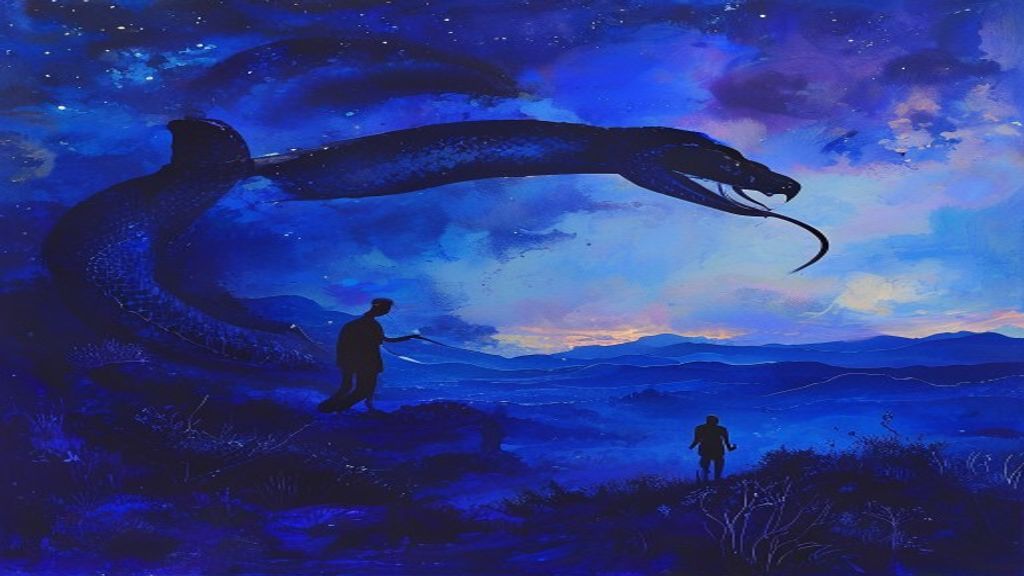
Being chased by a snake is one of the most common threat dreams across cultures. It nearly always signals something in your waking life you’re avoiding, fleeing, or haven’t turned around to face yet. The snake is rarely about literal danger. It’s about what’s gaining on you.
The thing about running
Running dreams are easy to flatten into clichés. “You’re avoiding something.” Yes, fine. But avoiding what, exactly, and how close is it? That’s where the actual interpretation lives.
The snake’s movement matters more than the snake itself. A snake that’s actively pursuing you, that seems to know where you’re going before you do, feels different from one that’s simply nearby and alarmed. The first is a pressure dream. Something is bearing down. The second is more like a proximity alert: there’s a tension in your life you’ve been circling without landing on it.
And then there’s the running itself. Often you’re running but not getting anywhere, or running in slow motion, legs churning through something thicker than air. That particular physics, the body working hard and going nowhere, is the emotional subject of the dream. You’re exerting effort in your waking life toward some escape or some solution, and the effort isn’t translating. You’re not making progress you can feel.
Nielsen et al. (2003) surveyed 1,181 Canadian university students and found that 81.5% had dreamed of being chased, the most commonly reported theme of all, ahead of falling (73.8%) and flying (48.3%). What’s interesting isn’t just the frequency but the bodily specificity: the dream is felt in the legs. You ran. Your legs remember.
Why a snake, specifically
The snake is doing double work. Part of it is just evolutionary furniture: Antti Revonsuo’s threat simulation theory argues that dreams evolved, at least partly, to rehearse danger responses, and a large reptile following you is exactly the kind of threat our oldest neural architecture was designed to flag. So some of what you feel isn’t symbolic. It’s a very old fire drill.
But snakes carry centuries of additional freight. They shed their skin, which has made them an image of transformation in many traditions. They’re associated with both poison and medicine: the snake-wound staff of Asclepius, the Greek god of healing, is still a medical emblem. They live underground and in water, threshold spaces. So when a snake is the pursuer rather than simply present in your dream, part of your mind may be casting your own incoming change as something threatening. The growth is what’s chasing you.
I say “may be” on purpose. I’m genuinely uncertain about how much symbolic weight any single image carries versus how much it’s just what your anxious mind grabbed from the available inventory. A snake might be a symbol of transformation for you, or it might simply be the animal you’re most afraid of. Only you know which.
The snake keeps pace no matter how fast you go. This is a pressure dream: something in your life is relentless, not just present. The chase itself is the message, not the snake’s arrival.
The snake anticipates your route. You feel known, cornered. This tends to map onto situations where escape feels predetermined to fail, where every option seems already accounted for.
If you ever face the snake in the dream, the dynamic shifts entirely. Dreams of turning around and confronting the pursuer often arrive right when someone is, consciously or not, considering doing exactly that in waking life.
You’re the observer rather than the runner. This can signal anxiety on someone else’s behalf, a loved one in a difficult situation you feel helpless to interrupt.
Vivid colour, an almost hypnotic quality to the threat. This is the version I find most interesting: it’s harder to run from something that draws you. Worth asking what in your life you’re simultaneously drawn to and fleeing.
What you were just before you ran
The moment right before the chase is the part that gets skipped when you recount the dream. You were somewhere. You were doing something, or standing somewhere specific, and then the snake appeared. That prior scene is context, not prologue. Where you were before the running is often where the real emotional content lives.
If you were at work and then you were running, that’s different from a dream that began at a childhood house. G.W. Domhoff’s continuity hypothesis is blunt about this: our dreams track our waking concerns with more fidelity than we usually give them credit for. The setting before the snake shows up is telling you which part of your life is generating the pressure.
The chase works as an early warning system. When the unacknowledged pressure builds long enough, the imagery can escalate, and dreaming of dying is one of the places it can go.
When the chase lasts for years
Take someone who has been running from a snake in their dreams for thirty years, and who laughs when they say so, then goes quiet. Asked what the snake is, they will often reach for a person before an idea. Thirty years is a long chase. Sometimes the dream runs that long because the waking avoidance runs that long. Dreams of being locked in share this quality: the scenario persists precisely as long as the real constraint does. The dream is patient in a way the dreamer often isn’t.
There’s something almost generous about a recurring chase dream, if you can get over the exhaustion of it. It keeps showing up. It hasn’t given up on you. That’s not a consolation I’d offer lightly, and I’m aware it probably doesn’t help at six in the morning with your heart still loud. But I think it’s true.
There is one version where the snake turns toward someone else and the dynamic shifts completely. Suddenly you’re not running. Suddenly you turn around, because now there is someone to protect. Dreaming of protecting someone is about that instinct and what it says about who you would turn around for.
- Where were you right before the snake appeared? That setting is part of the message.
- Were your legs working properly, or were you stuck? That mechanics of the running maps onto your waking sense of effort and progress.
- Has this snake appeared before, or is this new? Recurring means something’s been circling a while.
- What would actually happen if you stopped running and turned around?
Quick answers
What does it mean to dream of being chased by a snake?
It almost always signals something you’re avoiding in waking life, a pressure or a change that’s gaining on you. The snake can carry fear, transformation, or both. What matters most is how the chase feels and where you were right before it started.
Is a snake-chase dream a bad omen?
Not in any literal sense. These dreams are common, and they’re more like your nervous system filing a report than a warning about the future. They tend to show up when real pressure is building and hasn’t been acknowledged yet.
Why can’t I run fast enough in the dream?
That frustrating physics, where your legs won’t work right, is part of the emotional content. It maps onto a waking feeling of effort without progress. You’re trying hard in some area of your life, and it’s not translating into movement you can feel.
What if the snake is beautiful or I’m not fully afraid of it?
That’s the more interesting version, honestly. Feeling drawn to the thing that’s chasing you suggests something in your life you’re simultaneously attracted to and fleeing: a change, a relationship, a direction you haven’t admitted you want.
Sources for this reading
- Domhoff, G. W. (2003). The Scientific Study of Dreams: Neural Networks, Cognitive Development, and Content Analysis. American Psychological Association.
- Domhoff, G. W. (1996). Finding Meaning in Dreams: A Quantitative Approach. Plenum Press.
- Revonsuo, A. (2000). The reinterpretation of dreams: An evolutionary hypothesis of the function of dreaming. Behavioral and Brain Sciences, 23(6), 877-901.DOI
- Nielsen, T. A., Zadra, A. L., Simard, V., Saucier, S., Stenstrom, P., Smith, C., & Kuiken, D. (2003). The typical dreams of Canadian university students. Dreaming, 13(4), 211-235.DOI
Full bibliography on Sources and method. Found a mistake? Tell us and see the corrections log.