Action Dreams
Dreaming of Being Chased in a Forest: when the threat wears trees
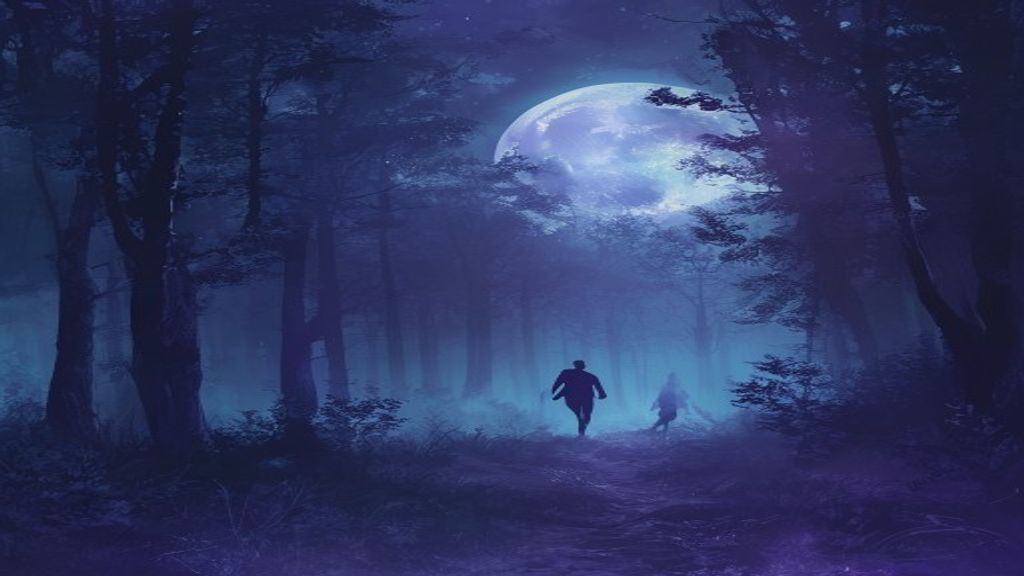
Playing hide-and-seek in the woods behind my grandmother’s house, I once hid so well I couldn’t find my way back. The other kids gave up and went inside. I stood in the trees alone for what felt like an hour, listening to the house sounds carry through the branches, knowing I was fine and feeling the particular unreason of forest solitude anyway. Safe and watched at the same time. Not being chased by anything. Just unable to shake the sense that the trees were attending to me.
That quality, the attention of the trees, is what separates a forest chase dream from any other chase dream. The pursuer matters less than you’d think. What the forest adds is enclosure, disorientation, a ground that never runs straight. You can’t see far enough to plan. Every direction looks like every other direction. The threat could be behind you or it could be in the branches above you and the dream doesn’t tell you which.
What the forest is doing that an open road wouldn’t
Chase dreams in open landscapes, a parking lot, a school corridor, a street, tend to be about the pursuer: its nature, its speed, whether it gains on you. The dreamer knows where they are. The threat is the variable. In a forest chase, the setting itself becomes part of the threat. You don’t have information. You can’t see what’s behind you because there’s always another trunk in the way. Your choices multiply into meaninglessness, left or right, deeper or back, and any of them might be wrong.
This is the dream equivalent of a situation with too many unknowns to navigate cleanly. Not a simple threat. A complex one, with obstructed vision, unreliable footing, and a landscape that offers cover equally to you and whatever is behind you.
The forest in dreams has centuries of symbolic freight behind it, most of it along these lines. Dante’s dark wood opens with precisely this disorientation: not terror, not pain, but the loss of the straight way, and the sense that the loss happened without you noticing. That’s a very specific kind of dread, and it’s the kind that forest chase dreams tend to carry.
A forest chase dream combines two distinct pressures: the chase itself (a real or perceived threat in waking life) and the forest (a situation where you can’t see clearly, can’t plan confidently, and feel monitored from directions you can’t check). The forest isn’t scenery. It’s a second threat that belongs entirely to the dreamer’s circumstances.
How this dream has been read across time
- Ancient and pre-modern
Forests as margin: the wild beyond the cultivated. To dream of flight through one was commonly read as being forced outside the boundary of social order, pursued by something one had transgressed against. Artemidorus, writing in the 2nd century, treated chase dreams as omens of persecution by enemies, with the wilderness setting amplifying the dreamer’s helplessness.
- 19th and early 20th century
Freud would have read the pursuer as a repressed drive or forbidden wish, with the forest as the unconscious itself: dense, borderless, hiding everything the waking mind has suppressed. The chase as the inevitable return of whatever was buried.
- Mid-20th century onward
Jungian readings treat the forest as the unconscious landscape and the pursuer as the Shadow: the disowned part of the self that the dreamer hasn’t integrated. The forest chase becomes, on this reading, the psyche’s dramatization of its own internal split. The thing behind you knows your name.
- Contemporary sleep research
Revonsuo’s threat-simulation theory offers the least mystical account: the forest chase is adaptive rehearsal. Dense environments with limited visibility were genuinely dangerous for most of human history, and dreaming through them kept the threat-response system sharp. The dream isn’t about your psychology. It’s about your nervous system doing maintenance.
- Present
Domhoff’s continuity hypothesis would simply ask: what in your current waking life feels like a threat you can’t fully see? The forest is accurate weather. The dream isn’t reaching into archetype or evolution. It’s transcribing your last three weeks.
I hold all of these loosely. They’re not competing: the nervous system can be doing maintenance and also accurately transcribing a real-world threat and also giving the Jungian shadow a very good set. Dreams aren’t clean.
The pursuer you never quite see
One thing that distinguishes forest chase dreams from other chase dreams is how often the pursuer stays out of view. In an open-space chase, the dreamer usually knows what’s behind them. In the forest, there’s something back there. You’ve registered its presence, maybe you heard it, maybe there’s just an animal certainty in your chest. But the trees intervene. You never get a clear look.
This is its own specific misery. A visible threat can be assessed. You can make decisions based on its speed, its nature, whether it’s gaining. A threat you can’t see stays maximally threatening because your fear fills in the gap with whatever it needs to. The dreamer’s imagination, not any detail in the dream, decides what’s behind them. Which means the forest chase is, in a way, a dream about the specific contents of your own dread.
Tore Nielsen’s work on typical dreams finds chase scenarios near the top of frequency lists in almost every culture studied. The forest variation specifically doesn’t always break out as a separate category, but dreamers consistently describe the setting as meaningful, not as incidental backdrop. The trees do work. They’re not neutral.
If your forest chase connects to a broader sense of being trapped in conditions you can’t navigate, the emotional territory isn’t far from dreaming of falling into the void: both are dreams about the collapse of reliable ground. And if the chase has a social dimension, a threat that feels human in origin, it may share something with dreaming of arriving naked at school: the sense of exposure before an audience that already knows too much.
When you turn around in the dream
It happens sometimes. The dreamer stops running and turns. This is rarer than the pure chase, and when it happens, people describe it as one of those moments where the dream tips from nightmare into something harder to classify. The pursuer, when faced, almost never lives up to the dread it generated while invisible. Often it changes. Sometimes it speaks. Sometimes it looks like someone the dreamer knows.
I don’t want to over-interpret that, because I’ve heard enough different versions to know it doesn’t always resolve into something meaningful. But the pattern of the visible-pursuer-being-less-than-the-invisible-one is consistent enough that I think it’s saying something true about dread in general. The thing you can see is always, at least somewhat, less frightening than the thing you can’t.
Still in the trees
My grandmother’s woods. I found my way out eventually, following the sound of a radio through the kitchen window. By the time I reached the back door I’d mostly convinced myself I hadn’t been scared at all. Only slightly watched. Only slightly unmoored.
I still don’t know what I thought was in there. Probably nothing. Probably exactly the sensation that becomes a forest chase dream: a place where the rules of legible space stop applying and your body decides that’s a threat whether or not anything confirms it. The trees were just trees. The attention was mine.
- Could I see what was chasing me, or did I only feel its presence? That gap is where your specific dread lives.
- What in my waking life right now has a lot of unknowns between me and any kind of resolution?
- Did the forest feel like it was hiding me as well as the threat, or was it only helping what was behind me?
- If I stopped running and turned around in the dream, what would I be turning to face in waking life?
Quick answers
What does dreaming of being chased in a forest mean?
It combines two separate pressures: the chase (a perceived threat or unresolved pressure in your waking life) and the forest (a situation with limited visibility, unclear options, and no straight path). The forest isn’t decoration. It’s telling you something about the nature of the threat: that you can’t fully see it, plan around it, or trust the ground beneath you.
Why is the forest setting significant in a chase dream?
Because it changes what the dream is actually about. An open-space chase is about the pursuer. A forest chase is also about the environment: the enclosure, the disorientation, the way every direction looks like every other direction. The setting belongs to your circumstances as much as the threat does.
What does it mean if I can’t see what’s chasing me in the forest?
The invisible pursuer is the specific shape of a threat you haven’t been able to identify or assess clearly in waking life. Because you can’t see it, your fear fills the gap with whatever it needs to. In that sense the dream is showing you the contents of your own dread more than it’s showing you the actual threat.
What does it mean if I turn and face the pursuer in a forest dream?
This is a significant shift. When dreamers turn and face the pursuer, they almost universally report it being smaller, different, or more recognizable than they expected. That’s probably accurate: the threats we avoid confronting directly tend to grow in our imagination past their actual size. Turning in the dream often follows a waking decision to stop avoiding something.